Whenever I see something that I can point out to try and prevent a major repair, I will try and provide that information to my local customers and my readers where ever you are.
We have been replacing Turbo’s pretty frequently lately, and for a while I had thought it was just isolated to the 2005 models, well that no longer seems to be the case. Below are just a couple of items that can help prolong the life of both your Turbo and your Subaru engine engine.
How to make your Subaru Turbo last and avoid costly engine repairs.
The below pertains to the 2005 and newer Subaru Legacy GT, Outback and Forester XT, while other models have some issues of their own, and some of the basics such as changing the oil still apply, the content of this article really pertains to the models listed above.
If you own a 2005 and newer Subaru with a Turbo there is a chance that you may be aware of some problems associated with the turbo becoming starved for oil and eventually failing. In the most extreme cases taking the entire engine with it.
Pictured below is the current oil filter being used by Subaru, I’d like to point out just how small it is, regardless of the any conceptions about extending the oil change interval because you use synthetic, you must understand on this model Subaru Engine, no matter what kind of oil you use the filter itself can only filter so much before it will become restricted with matter, and go into bypass mode.

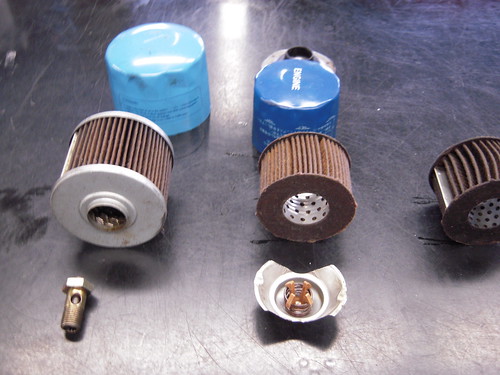
For reference I put the filter we use on all pre 2006 Subaru Non Turbo Engines next to the filter offered by Subaru to point out the size.
As the oil filter becomes restricted and goes into bypass as discussed above, there is a good chance that the filter in the bolt will become restricted.
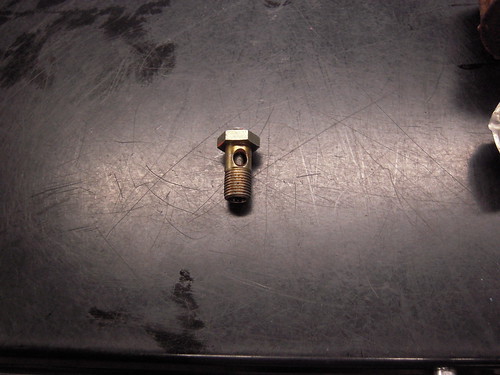
This is a picture of what Subaru calls a union screw, but basically it is a filter installed in the oil supply line to the turbo, and if this filter is restricted there will be an oil delivery issue to the turbo, causing it to become starved for oil and overheat.
We suggest checking and if needed, replacing the oil supply bolts every 60,000 miles or so, depending on how the vehicle is being used and at the time of writing this article the list price on the bolts was $15.40, plus labor to install. This is compared to a turbocharger replacement at $1600.00 to $1700.00, plus the possibility of engine damage occurring.
Subaru changed their policy on all Turbo models to state the oil needs to be changed every 3,750 miles, I still say if you want your engine to last, you need to maintain the vehicle based on how you use it, to get the most value out of it. If over 5 years you save a couple hundred in maintenance dollars only to do thousands in repairs, really what did you save?
So if you are lucky enough to own a Subaru with a Turbo, make sure you take care of it.
Thanks for reading
Justin
Hi Justin,
I own a 2007 Subaru Forester XT and live in Kathmandu, Nepal. The car has had oil changes at around 3000 miles regularly and does not throw up any warning lights or codes. Nor are there any worrying noises. The engine temp is just at middle of the normal range during drives. There is a tiny bit of smoke on startup in the morning.
However, the car does not accelerate as it used to. My independent mechanic did a boost pressure check on it and found that we’re getting only 7psi max at 5000 rpm. He’s not sure what the issue is and suggests we check with experts in other countries. What do you think might be the problem, please?
Hello George,
Low boost is most commonly some sort of a Boost leak. A smoke test is what I would do to prove that theory correct or not. There are lots of places that can possibly leak, also there are other possibilities if there are no leaks to be found such as a Turbo Failure. Someone local to you is going to have to diagnose it, again low boost is typically a boost leak.
-Justin
Hi Justin, it’s going to be difficult but try to find a turbo specialist in Nepal and if not there then look for one as close as possible in India. If the turbo is on its way out you need to know asap as it can be terminal if the bearings are shot and it let’s go during hard acceleration.
Also I’d definitely expect it to throw up a code or more in the event of it being down on boost. It may be worth getting a Subaru specific fault code scanner and seeing what it can tell you if traveling to a specialist is going to be too difficult for you for the moment.
Hi Justin,
I found a 2005 Outback XT that only has 105K on it. Car is completely stock and doesn’t appear to ever have been messed with. Overall the car appears to be in really good condition. However the current owner is the 3rd owner and has only had it for the last 2 years. There are no service records from the previous two owners. Current owner is currently away (military) and a friend is selling it for him. With the service records being a mystery would you even consider purchasing or best to just steer clear?
Thanks,
Nathan
Hey Nathan,
This is a really tough one to answer, your just not going to find to many 2005 Xt’s with 105k on them anymore. I would still just go with my advice that if you are unable to verify proper oil changes you might be the last person to drive it with that engine. Have you ran a Car Fax report to see if Car Fax shows any service history?
Hate to tell you to pass, but I would hate more for you to buy it and regret it more.
-Justin
Hello Justin, Great site!! I recently purchased a 2010 Forester XT with only 27,000 miles. I’d love to do everything possible to extend the life of the engine. In doing so…. I’d like try to locate the Union Screws w/fine mesh filters for an inspection and replacement if necessary. Your guidance would be very much appreciated. If you could explain to me the locations of the “Banjo Bolts” in my Forester, as well as the interference that needs to be removed for better access to them
I am currently changing my oil at 3,000 miles intervals using SCHAEFFER’S, 9003D, SUPREME 9000, FULL SYNTHETIC ENGINE OIL SAE 5W-30. (API SP). The Oil filter I am currently using is the MAZDA (N3R1-14-302) Oil Filter Cartridge, which fits perfectly but is longer then the oem subaru recccomended blue one. Do you see any possible issues with my choices of Oil and filter?
Hello Allen,
Filters are located @ the Turbo and at each AVCS Solenoid. You should look into buying a Service manual if you are going to attempt replacement your self, you will need the reference material and not just verbal guidance.
I would need to do the research to check the Bypass spring pressure on the oil filter you have indicated, but see no issue with the oil.
Hope that helps
-Justin
Hey I have Forester XT 2009 and I bought that’s like 8 months ago. Everything was fine for 6 months and then I got turbo failure. I changed the turbo but still the error code P0011 was there. I couldn’t figure out that and now the new turbo is also broken. I am not sure what’s happening with my car. I have checked the banjo bolts they are clear without screens. I am not sure what to do? Can you please guide me ? I am stuck with this car now 😢
Hello Moazzam,
Sorry to hear about all that. Based on what you have posted my assumption is the oil pan wasn’t removed and inspected for/cleaned debris from the first failed turbo. Or we are dealing with a very poor quality Turbo you have purchased? Its always tough when I am not looking at it my self but those are my assumptions.
Hope that helps
-Justin
s.
Hello Justin
I just purchased a 2005 baja automatic with 72, 000 miles on it. I drove it all the way home to Seattle from Salem Oregon. It was such a fun ride. I am admittedly nervous about some of the posts regarding maintaining a turbo Subaru. I have owned standard outbacks only in the past.
I noticed upon returning home that the coolant looked empty!! Any and all advice to maintain this beautiful car is appreciated. Most important info appreciated.
Hello Tracey,
Most important things to any Subaru but even more importantly on a Turbo model are lots of oil changes using good filters and oil. Stay up on the coolant levels and do not put off maintenance.
Oil changes every 3 months or 3000 miles
Coolant every 2 years.
The fact that it only has 72k is just not as important as the fact that it’s 14 years old, the cooling system is on borrowed time.
Hope that helps
-Justin
Hello Justin
First thanks for an amazing site and thoughtful replies despite fact very little of this will come back to you as business. I’m also very impressed about your measured response despite some folks communicating in an unreasonable way behind the anonymity of email. I suspect face to face they would take a different stance. Do they no realise you are offering your own time and expertise? Incredible.
I have no Subaru experience and reading all these pages on the issues of turbo’s does concern me, especially if I can’t find a 2nd hand car with an accurate service record. So therefore I’m considering the non-turbo version of the Forester in the 2008-2010 era. Are there any areas of concern to watch out for with these models. Where I live there are many japanese imports and almost always they no service records. I’m aiming to find something <50k miles to minimise risk of bad servicing. Best regards. Graham
Hey Kiwi,
I really appreciate your post.
As far as the 2008-2010 N/A Forester, that’s a solid plan. Have a look for external oil leaks from the Head gaskets, other than that they are pretty solid cars, and many go 300k and beyond.
Hope that helps
-Justin
Hi Justin. Excellent article, lots of good info. Owner of an ’05 STi purchased new, approaching 200 k. Red lined the engine a few times during the first few years, now it’s my commuter. 42 mi cruising on way commute traffic the other way. It gets an oil change at about 7k with Mobile one and OEM Blue filter. Everything still original, even the clutch. But noticed a slight oil leak at right side below cylinder head. I guess it’s time to change head gaskets.
Maintenance is key to Turbo life. Besides changing oil and filter, check the owners manual for any additional attentions or cautions. Turbos works hard under acceleration and loads and cool down before engine shut down. The TYPE of driving plays a big part of turbo life.
Besides oil and oil filter, have anybody considered oil pressure or volume?. I understand that Subaru had a problem with the oil pick tube on the earlier WRX Turbo engines. This is just something to consider looking into. And how about engine coolant concentration?
Justin, no need to respond, just food for thought.
Hi Justin,
For a 2006 Legacy GT, what’s estimated labor hours for replacing the banjo bolt in the supply line to the turbo?
Hi Jeff,
We generally charge around $150 or so.
Hope it helps
-Justin
Thanks, Justin. Very helpful.
I’ve wanted an LGT wagon for many years and finally made the leap. Unfortunately, I’m not particularly mechanically inclined and don’t have the time or space to be a home mechanic anyway, so I know this car may be a money pit for me. But I really enjoy the car, so hopefully it’s worth it.
I’m local, so may be bringing it to your shop in the future.
Thanks again.
HI there – we have a 2008 Subaru Outback 2.5XT – i was rear ended, the car had a lot of damage but I drove it 45 mins highway home. Since picking it up from the auto body shop (nearly a write off but squeaked by) the car has not run properly – rough idle, no power, CEL came on, code was camshaft sensor and oxygen sensor. Thought it was odd, just after the accident. Our mechanic said it was ok to drive – so we did, and the turbo went on the highway after about 45 mins. Big noise, the fan broken, no power. Got towed to mechanic.
Replaced turbo. Very big bill. Then the CEL came on again – camshaft sensor and oxygen sensor. Replaced those. Big bill. Driving the car and making a “whoop” and slipping sensation like right before the turbo went the last time. Took it back in – turbo was reportedly faulty, replaced it for us on warranty. Drive car and CEL back on, camshaft sensor. Mechanic is mystified as he replaced it three times. Said its a false positive, known problem with Subaru, it’s ok to keep driving. 40 minutes on the highway and poof – whoop noise, slipping, gutless, feels like the turbo again. Limped it to a safe place to tow from. Am beyond upset. Any ideas? Could this be due to the rear end accident? Was struck on the driver rear bumper, by a truck with a bull bar assembly on the front. This has all taken place in the last month.
Hello Crying Canuck,
That’s an awful story, one that I hate reading. Not having the car here in front of me makes this difficult as does not having the codes, but I can only assume that you are fighting debris from the first failed turbo causing problems still. When we replace a failed turbo here especially on an Outback XT or Legacy Gt, we remove the oil pan, inspect for and clean debris, sometimes replace the oil cooler and sometimes perform an oil flush. In some cases the engine is replaced.
What to do from here? You have to find an Us near you. There just isn’t any other way. Did the accident have anything to do with this? I just can’t answer that either without seeing the car and the repair order understanding what all was repaired.
Sorry I cant offer more, its fixable still but you are going to most likely need to take it to a different shop
-Justin
Hi there – yes, our mechanic did check the oil pan for debris, and the third time also replaced the union screw, but we are afraid to drive the car and lose another turbo. We have the car in now at a Subaru dealer – they are saying no point in an oil flush unless we remove a second filter, which involves 5 hours of work to get to – essentially replacing the timing belt and doing this second filter at the same time (the union screw is on the front for incoming oil, this is a filter at the back of the turbo?)
Is there any chance this is being triggered by a camshaft problem? The camshaft sensor (i think it is error code 034?) triggers the CEL and then the turbo goes – that is the consistent pattern. THe camshaft sensor itself was replaced – but i am not certain if the mechanic checked the camshaft. Not sure we should take on another $3,000 bill if the engine has been compromised. Might be best to just walk away from the car. Thoughts? Could this all be triggered by a timing belt needing replacement?
Hey Crying Canuck
Yes totally aware of the union screw location
At this point without seeing the car, its to difficult to really suggest much else. There is a lot that just doesn’t add up, you need an us where you are to help sort this out.
If Debris has gotten into a AVCS Cam sprocket that could also cause issues. If the Cam sprockets were removed and not put back on properly that could cause an issue as well. It just needs professional help locally.
Sorry I can’t offer more
-Justin
Hi Justin,
Big thanks for all your replies. Lots of very good technical info here.
I’ve got a 2006 forester 2.5xt with 120K miles on it. Bought it from the first mature owner with good service history.
I am looking to replace the turbo and was told that my year forester did not have the screen in oil feed banjo bolt and I can see it if bolt has a flat head there is no screen in it. Could you confirm this info?.
I love this car and want to keep it for long. I am not scared to replace the pistons, head gasket, head bolts if need to but want to start with just a turbo. Are there any obvious indication to look for of my ring lands going bad or coming head gasket failure
Hello Kamil,
The 2006 Forester should have filter in the fitting, also called a union screw.
As far as the ring lands, not really other than with a digital bore scope down in through the spark plug hole and looking at the outer edges of the pistons.
Head gasket would be an exhaust smell in the coolant on that era if it was to occur. Also pay attention to the plastic tanks on the Radiator that era Turbo Forester tend to crack from heat.
-Justin
Hello Justin,
Thank you for all your advice and guidance on Subaru’s. I read all your comments on the importance of oil change intervals and using quality oil and filters. I have a 2013 Subaru Impreza Base 2.0 with NA engine taking OEM Subaru 15208AA15A engine oil filter (blue).
I know you don’t particularly like the smaller Subaru blue 15208AA15A engine oil filter which superseded the original black 15208AA160 engine oil filter. I also noticed you were not shy in expressing dislike for Fram oil filters, who I believe also manufactures the Subaru blue filter.
I tried finding the Full, Tokyo Roki, and Nippon brand oil filters you recommended but the only one I could find is the FULL ATM 2OSB005 sold by NAPA: see: https://www.napaonline.com/en/p/ATM2OSB005. But when I contacted their technical service they said that the filter had a 15 lbs. PSID bypass rating (I believe the Subaru filter is 23 lbs. PSID) and filtration was 80% @ 20 microns. Would this still be suitable for my use even if it doesn’t meet the Subaru oil filter bypass specs?
If not, have you seen any problems or have any opinions on any of the following filters?
1. Denso 150-2003: ? lbs. PSID
2. Purolator Pure One PL14615: 20-30 lbs. PSID
3. Wix 57055: 27 lbs. PSID
Or should I just stick with the suboptimal blue Subaru OEM filter?
Thanks for any thoughts/reactions you may have on this.
Regards,
Doug
Hello Doug,
Thanks for the great question.
We are currently working on sourcing a better filter option. Your correct that the Denso does not specify the Bypass rating, which is why I just cant suggest it.
For now just like we are forced to do, I would stick with the Blue Fram Subaru filter. When we have something available, which I hope is in the next couple of months.
-Justin
Very interesting because I’m in the market for mid 2000’s turbo Subaru. Having owned 4 turbocharged cars 2 with Garrett turbos, and 2 with IHI’s, with a combined mileage of all 4 cars of approx 450,000 miles I had zero turbo problems. Clean oil is a no brained, but the screen filter bothers me. If you have a proper high quality oil filter that screen is useless, unless Subaru was using it as a restrictor. Oil pressure, either too high or too low can damage the turbo. I suspect the biggest issue is too low oil pressure from a very dirty oil filter, and old oil from poor maintainance. I don’t want to point figures at Subaru because my 2007 Impreza (non turbo) with proper maintain was sold last year with 185,000 miles and it and no head gasket problems, but I wonder if Subaru missed something here on the turbo models. I have heard no mention of the Baja models with turbos. Is there an issue with those as well, or is there something different wit that engine? II know it’s rated at 40 HP less.
Hi Russell,
I agree about the high quality oil filter thing, but even the best oil filter does you no good as it becomes restricted from doing its job.
As far as STI to Outback XT. Forester XT, etc. What we see is the owner of the STI takes better care of the car, as they are more likely to be an enthusiast and over maintain VS end up buying a Outback XT over a N/A Outback because it had a little more power.
Now as far as the Baja (which I currently drive) we replace Turbos in those cars as well, that is how I obtained the one I am driving today.
-Justin
I wanted to share the story of my ’07 Outback XT. Purchased it new, was very careful with oil changes (~3750 miles, mobil 1). One oil change did lapse till about 5000 miles, but that was the worst.
At about 85K miles, the engine lights started to come on along with an associated rough idle. I continued to drive it to about 95K. The car is now at the dealer going through an extensive repair. Subaru of N/A was not really interested in helping to pay for the repair (~$5K).
I know about the need for turbo cool down, so I always did that. The car was in great shape, the original clutch and brake pads are still good (although will be replaced during the engine repair).
What is I think a sticking point for me, is that the boxer engine design, which inherently has some great benefits (smoothness, low center of gravity), is a nightmare when it comes to major engine repair since the heads cannot be removed while in the engine bay. Most other cars this is not an issue as the heads are pulled from the top. So the boxer engine requires an engine pull, for something as simple as even a valve adjustment (I’m told the turbo engine uses bucket/shim design and requires manual adjustment).
So I will not buy Subaru again. While it was a fun car to drive, having to do a major engine repair on a well maintained car at ~90K miles is indicative of an inferior design.
Best subie info bare none I’ve found.lo mejor de todos.soy subipedro sique palante
Maybe I’ve just been lucky? I have an 05 OB Xt Ltd, which I bought new, and I’ve changed the oil every 3000K or less (sometimes more often. if oil’s on sale at Costco). Mobil 1 synthetic for the last 35k, plus Subaru OEM filters or Mazda’s Rotary filters with the same specs (Mazda’s are bigger and actually better, I think.) 59k total miles on my car now, after twelve years… and when I paid a tech to inspect the banjo bolt/filter two years ago, he did it and then laughed: “Spotless.”
I suspect that sometimes (often?) when folks have problems with the turbo, it’s because someone didn’t change the oil and filters often enough–per Subie’s recommendations—OR because they installed a crap filter that didn’t comply with the specs for a turbo. Sometimes it might just be the result of somebody shutting the car down when it was all too hot. Just an opinion, of course.
Justin, Thanks first of all for sharing your expertise in a clear and unpretentious way. I have learned a great deal from this site, the explanatory articles and your extensive exchanges with other respondents. I have an ’05 LGT wagon which I bought with 41k. I am coming up on 99K. I have always changed the oil at 3k (or close) and started running synthetic the last few years. I want to change the union screw/oil supply line bolt/banjo filter bolt, having learned of the importance of same from the above reading. I do what I can myself, aided by computer file version of the factory manual. The search function doesn’t seem to recognize any of the above terms. I need to know where it is and how to change it. At the very least, I need to know what the factory manual might call it. If this information is somewhere on the site I apologize for missing it. Thank you.
Hello Dawes,
Thanks for the kind words.
We don’t really offer a service manual on our website, or teach how to replace the union screw, if that’s what you are looking for? I am happy to provide information about what to do, but don’t really offer much in the way of how to’s on the site.
You might purchase a Factory service manual if you can still find one.
Hope that helps
-Justin
I am Putting new heads on a new short block for my 2005 outback xt but I am having real trouble getting torque values for the procedure. There are two sets of numbers out there and they are very different The numbers from Subaru are much higher than the numbers from haynes and felpro. I am at a loss for which numbers to use. What numbers do you guys use and for which gasket set?
Hello Juan,
First of all I hope you are absolutely not using Felpro Gaskets
Second of all you want to follow the OE procedure in the Subaru Service Manual.
We have a Six Star kit you can buy from us, it comes with the torque procedure and tech support. Here is a link https://awdautoparts.com/product/2006-2013-forester-2-5-turbo-2006-2014-impreza-2-5-turbo-2007-2012-legacyoutback-2-5-turbo/
-Justin
thanks for all of the helpful info, I too am reading all of these stories AFTER my 2009 Outback 2.5 xt, developed internal engine failure at 167,000 miles. I am the second owner (purchased at 165000mi with a “low mileage” replacement engine just installed) I called the 1800 subaru #, with no luck since I am the second owner. I also called a nationwide junkyard and was told that they do not have any stock on usable turbo engines nationwide! I also called my local dealer who informed me that Subaru of America has hundreds of “short blocks” in stock at the distribution center. and they have had numerous “updates” to this engine. This seems to be a very common problem, and has changed my opinion on Subaru’s reliability. My question is: have any of these “updated versions” that subaru is now selling have any different design or modifications that are worth purchasing? I can spend less $ to rebuild my current engine, or purchase the short block kit from the dealer and hope for the best? thanks for your time!
Hello Parks,
This is where I guess rumors sometimes come to die.
There have not been numerous updates to the short block. They are a stocked item for a number of reasons, as are air filters you also won’t find more that many more Turbo short blocks than N/A Short blocks. Drivers keep going for the 7000 mile oil change and engines are replaced as a result. Also the Turbo short blocks are purchased by engine builders as a starting point to a build which increases demand, overboosted engines end up breaking ringlands so those are two more reasons the Turbo blocks are in demand.
The real problem has been not enough oil changes on a Turbo Charged engine leading to turbo and sometimes engine failure. I wont say the design of the Turbo oiling system is the best invented, just it is what it is and of you take the time to understand it and maintain the car based on that and how you drive and use it I really don’t see you having multiple Turbo and engine failures, the absolute worst way to repair a turbo and engine failure is with a used engine, but that wasn’t your call..
Currently drive a 2005 Legacy gt 188k OE turbo and engine. Has had a valve job for a misfire, but no short block replacement. It’s also running a Cobb downpipe and a stage 2 mapp. They key is Oil changes, not letting the oil filter go into bypass mode, using good oil and filters, staying away from the Quicklubes and dealer lube centers.
If you are capable of rebuild yours I d say do it, using Subaru components, but better oil filters, new union screws and oil changes at the 1000 mile mark for the first oil change and every 3 months/3000 miles thereafter.
You can drive your self crazy trying to figure out ways to prevent this from happening, spend money on the best internal components, but the truth is just more oil changes will go a long way to preventing this from occurring.
Hope that helps
-Justin
Justin, thank you, and all the others here, for all this useful information. I have a 2009 Outback with the 2.5 XT Turbo. The turbo went out at 104,000 miles. I use synthetic oil and oil changes at ~ 5K-7K mile intervals.
When the turbo went out it was driving up a steep hill, it made a very loud squealing noise and then the check engine lights came on. The car lost power. The engine codes on the OBD were related to mass air sensor problems and camshaft position indicator problems. Took the car into a mechanic and unfortunately he felt nothing needed to be done, the codes were reset. I had the engine oil flushed and changed. The car drove fine, the mechanic test drove things and listened to things and did not hear any problems… I drove the car for 2 months, until last week when I could hear a faint windup noise at low rpm while starting to accelerate. Took it to a new mechanic who thinks the sound is a bad turbo, starting to go out. Also took it to my existing mechanic who was not sure… ( I am not so impressed with my existing mechanic).
After doing research online and talking with others, I am 99% sure the turbo needs replacing. I ordered a new BNR 16 EVO turbo and a new catless downpipe. (my goal is less about improved performance and more about reliability…so hopefully these mods do not send me down the wrong path). I have not yet put these new components in – waiting for their delivery next week.
I have read in many places about an oil line and filter upgrade that Infamous Performance **used** to sell (they no longer sell them). Replacing the stock oil line and union bolt (“banjo bolt” filter) seems like a smart idea to me, to put in a filter that is easier to check on a frequent basis. I have found some places that suggest removing the screen in the stock banjo bolt, others who say replace the oil line / filter, others who say leave the filter in. I get a strong sense of many people worrying about liability in their suggestions along these lines. I am also wondering why the Infamous Performance oil line kit is no longer sold — liability? The dilemma seems to be needing to filter / strain the oil going into the turbo, versus risking a clogged filter that limits oil supply to the turbo. Having a filter that did not clog so easily would be ideal (a bigger surface area for the filter). Forced Performance does sell an inline oil filter meant for turbo oil supply, however they do not have the -4AN oil lines for this filter for a Legacy / Outback (they stress this — once again seems to be liability concerns). Forced Performance does sell oil lines for WRX and STI though… (this may point out a serious design flaw with the stock Legacy / Outback oil supply for the turbo? — why can’t an aftermarket oil line filter system be used? ). Ok, enough of my “liability” theories and back to getting back on the road…
My current plan is to:
(1) remove the oil pan and inspect for debris. (if there is debris, want options do I have for “cleaning the entire oil system”).
(2) install the new 16G turbo and catless down pipe.
(3) inspect and clean banjo bolt. If it has debris, then I will clean the filter and leave the screen filter in. If it has no debris and is perfectly clean, then I will remove the screen filter –since my turbo failure was most likely due to a momentarily loss of oil supply to the turbo while driving very fast up a mountain road with curves (??). My 2009 Outback 2.5XT may not even have a banjo screen filter in it (will find out soon).
(4) change synthetic oil at 3000 miles and check the oil line filter regularly.
My specific questions are:
Q1: Does the 2009 Outback 2.5XT actually have a banjo bolt filter before the turbo like the earlier years?
Q2: Is there an alternative oil line and filter system that I can upgrade to?
Q3: If I do find metallic debris in the oil pan what are my options for cleaning the engine out — doesn’t the engine oil filter do this?
Q4: What does a failing, or failed, turbo sound like?
Thanks,
Ed
I hope this works and that I am not replacing an engine, or more turbo units in the near future.
Hi Ed,
The Turbo failing sounds like a rotational grinding/slight knocking noise. The debris gets into the pan once the filter is in by pass mode, which on your car will happen around 3-4000 miles.
As far as cleaning it out of the engine, you would need to disassemble it and you might want to think about checking the Rod bearings as well, if you see a lot of debris in the oil pan.
No alternative line as none is needed, I am a broken record here, and I have posted this 100 times but the key to having your Turbo not fail is changing the oil every 3 months, 3000 miles or sooner based on how you use it. I totally understand that you want to do something to avoid this from happening again, but there is no redesign needed and I have not seen any aftermarket line do anything different.
I know the definition of severe and normal use are hard to understand sometimes, but any Turbo vehicle really falls under severe use.
Yes the 2009 uses the Union Screw, and yes you should replace it with the New Turbo, and your planning on a Tune afterwards yes?
Hope that helps!
-Justin
Hi Justin,
I need your wisdom. I recently purchased a 2010 Subaru Forester XT Turbo with 42,000 miles. As a 46 year old mom who lives on a dirt road, I love the Forester for it’s safety rating and rugged driveability, but admittedly I also like 2010’s appearance and the get up and go it has, much sassier than my 2002 Forester with 195.000 trade-in! Although I miss the manual transmission of my 2002 which is the main reason I went with the turbo. Unfortunately after only 2000 the transmission blew and it is now at the shop waiting for factory rebuild transmission – the Subaru dealer’s mechanic indicated this is rare at such low mileage. Should the dealer take some responsibility for this failure (it is 7 days beyond the 30 day dealer warranty period!)? Given this repair should I be leery about keeping the car and work with the dealer to get me into something else? Also while I love the turbo feature (I was a teenage lead foot who grew up driving 8 cyclinder Olds and Caddies and with brothers who rebuilt and drove Chargers and Roadrunners etc.), I’m not sure I up to the challenge of maintaining it? For instance must I warm up the turbo it I’m going to drive the first 2 miles (down my dirt road) at less than 20 miles per hour – is driving at that speed a sufficient warm-up? My loaner car is a 2016 Subaru Forester non-turbo and I am impressed with it’s pick-up, do you know if the 2010 non turbo has similar pick-up? I’m going to own whatever car I stick with through my 50th birthday and I want to enter that decade of my life with some get up and go! I I’ve been teaching for 23 years and driving very sensible cars – I love how the 2010 turbo makes me feel when I drive it – it’s a treat I’ve earned I keep telling myself. Thanks for any wisdom you can share as I try to sort out my options,
Hello SubiMama,
Love the name choice!
I am also surprised it needs a transmission. The 2010 Forester cam with a 5 year 60k powertrain warranty, which has technically expired. It’s possible if you call SOA at 1800 Subaru 3, you are nice, but firm in your disappointment they may help. If you also bought it as a certified used Subaru that could also be a little leverage to use.
As far as warm up cycles, a couple of minutes is not a bad idea, this is subject to temperature outside however.
Typically speaking if you are going to be nice to it and it will be just off of idle at lower speeds, and its spring summer and fall in some places that should be okay to get in and go.
Hope that helps
-Justin
Thanks for your response. I may call the 800 number if my meeting with the dealer does not go well. I basically would like them to take some ownership, shouldn’t the 152 point inspection have caught this transmission issue before the car left the lot?
If you were me in this situation would you stick with the 2010 turbo OR look for a way out of owning this car? (given the transmission issue).
I believe in being nice and honest and I hope for the same in return. : )
SubiMama
Great thread, thanks for your dedication and calm ongoing support. My 2006 Outback XT needs new turbo. BuyAutoParts.com says they are the OEM manufacturer. You can buy new kit from them for ~$800 or OEM also from them for ~$1300. Are they legit?
Hello Michael,
Never use anything but the OE here, so I have no experience with that site or brand, we have to use parts we can rely on here at the shop and from local vendors. I have kicking and screaming installed some aftermarket stuff for customers, it hasn’t gone well, and usually we end up taking it out and putting OE in, this just occurred last week so its fresh in my mind.
Hope that helps
-Justin
Hi Justin, first off thank you for the education here. I’ve learned a lot.
I have just purchased a 2010 Forester XT Limited, 194k kms on it. I literally just got it home when I heard the engine making noise.
I’ve never owned a turbo engine before so I popped the hood and listened for where the sound was coming from. As you can guess,it was the turbo rattling.
I had only driven it for 60 kms to get it home. I did not drive it again till this morning to take it back to the dealer. By the time I got there it was smoking like crazy out the tail pipes and rattling even more.
So my questions are,
Could there be further engine damage with the visibility of the smoke? (Blueish white)
Is there a quick and easy way to check if the mechanic did actually pull off and clean the oil pan?
Once again thanks for the education I’ve just gotten from here.
Paul C
Hi Paul,
Other then pulling the pan and cleaning, and or removing the Connecting Rod Caps and inspecting there just isn’t any way to know if there was damage.
As far as seeing if the pan was removed, hopefully that wouldn’t ever be an issue but you could look for fresh sealer @ the pan to engine block, maybe they painted the oil pan, ( we do here).
Hope that helps
-Justin
I bought a 2005 Outback this year and have had endless problems with it. I do enjoy driving it much more than my Nissan Sentra that I could not kill. I had an inexperienced mechanic (little to my knowledge) replace the timing belt. Since then, there have been leaks coming from the radiator and problems with the engine running hot. The inexperienced guy left the power to the fan for the radiator unplugged after putting the car back together. I fixed it myself. Yikes! And when he reattached the hoses to the radiator, there were tiny leaks, causing me to lose radiator fluid over time and have to deal with the smell of it. What a loser. A more experienced mechanic has been working on the rest of my problems to try to get to stop leaking. I’m hoping after replacing a few more hoses, I will have no more issues with overheating and losing coolant. Pretty recently a heater hose broke and I had to pull over and pray I had a car left. We’ve ordered new hoses to replace them ASAP. The engine seems to be okay. Do you think some of the overheating issues could be caused from not changing the oil often enough? I change it every 4000 miles and I use a Valvoline synthetic. I think I had an interval of 5000 pretty recently because I go too busy.
Hey There Subaru girl,
Sounds like the real issues were with the service work performed by the inexperienced Mechanic, and yes some of the issues you are still having could be related. At this point I am hoping someone has checked it for the following.
Poor quality aftermarket thermostat
Possible internal head gasket failure
I don’t think the overheating is a result of the oil change intervals directly, but over time not changing the oil enough can lead to less then desired times before needing to replace the head gaskets.
I hope you get through the current situation and can enjoy your Subaru.
-Justin
My husband just bought me a 2005 Subaru Outback with the Turbo. i drove it for a little over two weeks and the check engine light came on. I took it to the dealer ship and they said I was using cheap gas. It came back on not long after I added some “heet” to the gas and started using premimum gas. The dealership said there was nothing they could do because the 30 day warranty was over. My husband replaced some sensors and when he removed the turbo he found oil in the air charge cooler. Is this normal? My husband has been a mechanic for over 20 years and this has him puzzled.
If you wanted to get the code number and come back here and post that info I might be able to help. Without the code number it’s just not even possible to try and help.
-Justin
Justin
Just found this site and I am an owner of a Turbo Forester 2014. I bought it new and it has now 17000 miles on it. I love the vehicle and its really the wifes car as she uses it for commute to work which isn’t a very long one. I see your recommendation for replacing the oil supply bolts and I intend on having the dealership look at these at or around 30000 miles. Im hesitant at times to let people work on my vehicles as I am one who questions work quality at a lot of dealerships. When replacing or checking these oil supply bolts is it possible to get them installed incorrectly and that causing failure or would the reinstall or replacement be difficult to mess up. Thanks Al
Hi Al,
Not really, As long as the area is clean, the bolt is sealed properly and torqued, I cant imagine much that would go wrong. Anything can be cross threaded, but you would hope that couldn’t occur at the professional level..
-Justin
Thanks Justin. After some research I now have read that subaru has left out the screen on these bolts in the newer models. 2014 and above. Are you aware of this or do you know if that is in fact true? Al
Hello Al,
Yes the New Union screw @ the Turbo is part Number 14439AA010, and has no screen.
Thanks for the Question
-Justin
Justin
Thank you so much for taking the time to answer all of the questions that people are posting to you. We really appreciate your expertise and willingness to share your knowledge of Subaru vehicles. I’m hoping that you can answer a question for me. I am thinking of importing a JDM Subaru ST/B Forester from Japan to Canada. This is legal as long as the vehicle is at least 15 years old. The Forester has a 2.0L EJ205 Turbo engine that is rated at 250 HP. The Turbo on this engine is a TD04. I can get a Forester with low mileage-50,000 KM or 30,000 miles with a 5 speed manual for $5200(Canadian dollars) shipped to port of Vancouver. My question for you is how reliable and trouble free is this engine and turbo setup? Turbo and headgasket issues are a real concern with some Subaru vehicles so was hoping you could let me know if I have anything to worry about with this particular vehicle. Thanks again for your help-it is truly appreciated!
Hi Melvin,
We don’t use the JDM engines here as they are no emissions compliant. The Turbo engines generally do not have the HG issues. As long as the oil is changed the turbo should be okay.
Having said all of that, have you researched parts if something was to happen? Thats the real issue, is so many things are different, If you know that ahead of time and are okay with it, I guess go with it.
-Justin
My 16 year old son just bought his first car. It is a 2005 Subaru Legacy GT. We got it for $3,200. We were told the engine light was on because the oil needs changed. They said they change it and it goes out. They said the turbo, water pump and timing belt has been changed. My son’s friend put an analyzer on it and it read timing. After reading on here, I am thinking it may be low oil pressure due to a clogged banjo filter. His cruise control light was flashing as well. We are also feeling a flutter with the steering wheel when making sharp turns. I am afraid we have bought a lemon. I want to make sure he is safe and not broke. Any ideas?
You need the code number, with out it no one knows why the check engine light is coming on.
Hi Justin,
Are the newer model Forester XT turbos (2014-2015) more reliable? Is it hard on the turbo if you do 60-70% of your driving in the city (3 miles to work). We only drive the freeways on the weekends.
Thanks,
Mark
We Don’t see a lot of issues with the Newer Turbo models.
Yes 3 miles to work is going to hard on any car.
-Justin
Hi Justin.
First, thanks for this helpful info. Forgive me if it is mentioned in another post/reply, but when I look through the parts diagrams, I see multiple union screws.
Two appear to be on the turbo diagram (15194 and 14438), but I’ve found at least one more elsewhere.
Can you please shed some light on this?
My vehicle is a 2005 Baja Turbo MT.
Thanks so much.
Jim
There is also a union screw on the left side for the AVCS. Requires removal of the inner timing cover to replace.
-Justin
Hi Justin,
I bought my 2006 LGT 5mt brand new and had always changed the oil about every 3000-3300 miles with whatever the Subaru dealer uses. I’ve never had any single issue with the engine and engine still feels strong. It barely uses oil. I’ve also done every 15, 30, 60, 75K service and changed the timing belt @75K. Now it’s reaching the 90,000 mile mark and I wonder if it would be a good idea to replace the catted uppipe with an STI one I got several years back, but never got around to change it? This mainly to avoid cat debris going into the turbo over time. I’m also thinking, if I’m repalcing the uppipe, might as well replace the downpipe with a Cobb Catted unit and make it into stage 2 with an AP. You think this will be a good idea considering the miles on the turbo? or I’m looking for trouble? Replacing the turbo along with the pipes would be kind of pushing it and I think I rather put the money towards a 2015 WRX. This year I replaced the clutch (2007 Single mass), radiator, axle boots and PS pump in it.
PS – I doubt the banjo bolt has been cleaned or replaced during service. I can check the records but I doubt it based on your comments about dealer labor costs. The Subaru Dealer is a good Dealer in the Houston area, even recommended on NASIOC and LGT Forums.
Best Regards,
AJ
Hey Aj,
We ran the Cobb catted down pipe, Borla Car back and Access port on Stage 2 on my 05 Legacy GT wagon with higher miles and as far as I know its still doing just fine, I sold it about 2 years ago.
You are doing everything right so I suspect you will be just fine, however performance does sometimes come at a price.
Hope that helps
-Justin
hi,i brought a subaru forester 2007 After 6mts,one morning going to work,my car started to buck,i service the trouttle body,the car started but it still bucking an i am smelling gas burning from the muffler.
Justin – Thanks so much for posting this article a few years ago and for continuing to respond to comments. I really, really appreciate it.
I have a 2006 LGT MT with 85k. I have owned the car since 6k and have kept excellent records on all maintenance/repairs. To date, I’ve had no apparent issues with the turbo and I had the banjo bolt/filter checked/cleaned at 60k. After recently reading this post, I checked my records and they show on average that I have replaced my oil every 4k to 5k miles. After reading this, I will now move that to 3k to 3.5k max.
My question is, what are the first signs of the start of turbo failure in an ’05-’09 LGT? Is it a certain sound? Is it some initial lurching in acceleration soon after a morning start? Is it an oil leak? Is it an increase in oil burnoff between changes? I just want to know what to look for so that a turbo failure doesn’t result in a complete engine replacement. I’ve noticed recently that my car lurches a little bit when driving up the hill out of our sub-division when I leave for my morning commute. It is ever so slight, but I notice it a bit. Is that a sign?
Again, thanks for this post and continued dialog. I look forward to your thoughts on this.
Hi Jim,
Thanks for the feedback. So the turbo can fail in a few different ways as such the symptoms can also be different.
The number one thing is some oil use, followed by noise. Next would be a drop off in power and if you had a way of checking boost that may also be under specs. Lastly they can crack internally, all of this is generally from heat as a result of a lack of lubrication and cooling. There are other things that can also happen but not usually as a results of maintenance habits.
Things to look for are; Oil residue around the turbo, Remove the down pipe and check for shaft play and cracks. Neither one of these are invasive orr expensive and its better to replace a turbo as it’s failing rather then after it has failed.
The lurch could be a low boost issue and a sign and you are correct to be concerned.
-Justin
I have a ’04 baja turbo with 175k miles on her she’s on her 3rd turbo an would still be working on her first if it wasn’t for the damn banjo bolts so I have a reccomend that instead of always worrying about paying for an changing the banjo bolts an keeping track of all that crap simply remove the filters within the banjo bolts like I did 50k miles ago and change oil ever 3.5k and put top of the line oil filter in her an she will run like a top I love my baja to death an am very proud of her she gets romped on aswell quite a bit an as long as she gets to cool down after hard runs for 10 min she never has issues also she’s ran synthetic oil since her first mile subies are the best cars as long as you know her needs an get her cleaned when she’s supposed to they’ll go for 300k++ no prob with no crazy maintaince issues
Hi Justin,
I have an 06 Outback XT and it has about 84,00 miles on it. I am pretty sure it is my turbo that went out. I heard a whining as a was driving home and lost most power. I continued to drive about 6 miles to my house and has been parked there since. My mechanic stated the engine may be damaged as well. Is there any way for me to tell if there were any pieces that got into the engine without having my mechanic take it all apart?
Thanks,
Kelly
Hello Kelly,
The oil pan needs to come off at a minimum to look for signs of debris.
-Justin
Justin,
thank you for taking the time to read this post. My story is very similar to most of the previous ones above. We all seem to learn the hard way. I have a 2005 Outback XT that has just over 105K miles on it and is now on the third turbo. The only difference is that I purchased a refurbished one instead of OEM this time and had a local Subaru specialist replace it for me about one month ago. I picked the car up and it has been running horrible ever since. When the car first starts it idles fine and then just after it starts to warm up it misfires. When I drive the car and push down on the accelerator the “service engine” light starts to flash. Also, the “cruise control” light stays lit up and does not work.
I told the mechanic about this problem and he stated it could be due to a plugged oil feed line that is keeping the Cam in an “advance” position but would not be able to determine this unless I brought it back so they could look at the car, again.
I had the local Advance Auto hook up their scanner to it and it said ” cylinder 4″ misfire.
I changed both plugs on the left side of the motor but it has not fixed the issue.
You made mention in a previous post on October 7, 2013 about a possible coil issue.
Any advice would be greatly appreciated!
Best regards!
Nate
Hi Nate,
So you an switch coils from 2 to 4 and see if the misfire moves, same thing with the injectors, if you are unable to perform any testing. From there valve clearance would need to be inspected from there a leakdown test in cylinder # 4 if the above did not yield any results. The coil pigtails should also be inspected for corrosion.
You can’t or shouldn’t drive it with a flashing check engine light however.
Its also possible debris is is clogging at the Solenoid on bank 2 but that would usually set cylinder #2 and #4 misfires not one or the other. Also cylinder # 4 can develop broken ringlands on the piston, especially if its overheated due to a failed turbo.
I guess what I am telling you is there are many possibilities, each car is different and thats why each car must be properly diagnosed.
-Justin
Hello Justin Thank you so much for all the effort to produce such useful information.I live in Cape Town RSA which has a very temperate climate.I have my forester XT since new in December 2005 I am using Mobil 1 and changing every 4000 kilos have now done 78000 kilos with no problems mostly in short trips, have just had oil changed and inspected the union screw adjacent to the turbo my screw has a very small hole and no filter,quite unlike the screw in your picture of a Subaru union screw .Two questions Justin.Why is my screw different? And should I Chang it to one like that in your picture .Very best wishes from sunny Cape Town .Michael
Hello Michael,
Its tough to say for sure but I can only assume that either some one removed the screen from the union screw or Subaru of South Africa doesn’t use them?
If you are changing the oil every 4000 Kilos and using Synthetic, most likely there wont be an issue.
-Justin
Justin,
As for oil for an 08 Outback XT with 73k auto, do you recommend like a Mobil 1 5w-30 full synthetic or Amsoil? A tuner I was talking to said that Mobil 1 was garbage..Any thoughts?
Any what is the Subaru part number for the oil filter that you recommend?
I own a 2004 Subaru Baja Turbo and it has lately sounded like the Turbo is strained, almost sounding like an airplane engine high pitched sound. Is it possible the Union screw could be impacting my Turbo? I have the oil changed religiously at 3000 miles or less, as I use the synthetic oil. Any help is sincerely appreciated. I love the vehicle, yet it seems that I am putting more money into it every year and if I could at least get two or more good years out of it, that would be great. The person who owned it before me had the 100k engine overhaul done, recommended per Subaru, so I really thought this vehicle would be lasting longer.
Hi Angel,
Usually the Turbos do not give much warning before failing especially if it’s related to the screen becoming restricted in the union screw. It’s going to in your best interest to have somebody have a listen to the car and make sure its not something doing damage by being driven.
-Justin
I’m trying to understand a bit more about what circumstances/ engine load conditions will put the oil filter into bypass mode.
So my question is just that: Under what circumstances will the oil filter be bypassed? And when this happens is there any indication to the driver that this has happened (check engine light?).
And in terms of starving the turbo of oil, does Subaru use flow meters to monitor oil flow into and out of the turbo. Maybe that’s a dumb question, but it sure would be nice to have some kind of indication of oil flow thru the turbo.
Thanks,
Carl
Hi Carl,
So this is a engine 101 kind of a thing that applies to every oil filter. Pressurized engine oil is pushed through the engine by the oil pump, there is both a volume and PSI measurement, the most common referenced is oil pressure. As the oil travels through the oil filter the filter media filters out contaminants from the engine oil that collect in the oil as part of the combustion process, this is typically small particles of carbon that sometimes wash away from the combustion chamber past the piston rings and into the crankcase. Every time the engine runs this occurs, the longer the oil filter is in place the better the chance it begins to become restricted from these cycles, and because oil flows through the filter any restriction would also limit oil flow to all of the components the oil is designed to be lubricating, which will cause component overheat and ultimately failure.
To limit the possibility of a restricted oil filter causing damage there is a bypass mechanism that will allow for the oil to bypass the filter, it is a mechanical device located in the filter and triggered by pressure. This helps prevent oil starvation but also allows for the circulation of non filtered oil, many components with ultra small orifices aimed at increasing oil pressure to a given area will have a secondary filtering device to prevent the orifice from becoming restricted. The union screws with the screens have those secondary filtering devices.
In a perfect world the oil filter is removed and replaced prior to going into bypass mode, the engine is not used in a way to create carbon build up to later wash away, but that’s just not the world we live in. As such there must be devices in place to stave off component or engine failure, however if the secondary filtering device becomes restricted the same will occur.
There is no alert system indicating the filter has gone into bypass mode. The maintenance recommendations in the owners manual are just that recommendations.
Subaru designed the oiling system to flow the proper amount of oil to protect components, no car I have ever come across, not even the multi million dollar sports cars get into the level of monitoring you are describing the costs would be astronomical.
It’s my suggestion on a car you have recently purchased that has over 60k to replace all filters, but I will add that due to cost we mostly service the one at the Turbo, from there properly maintain the car. We never replaced the Turbo on my Wife’s 2005 Outback XT with 145k and still counting and we sold it to a customer who still brings it in. I have many family members and friends that own the same platform and still no Turbo, but we have some customers that replace the Turbo every 2 years because they just cant keep up on the maintenance aspects of a Turbo charged car as it ages.
The check engine light is there to warn you of sensor, component and conditional related issues mostly affecting the vehicles emissions control devises, its based on OBDII from 1996 and cleaner air, it should never ever be assumed the check engine light is there to warn about any engine related conditions, only engine related conditions that could grossly pollute.
Hope that helps
-Justin
Hi Justin,
I’m about to buy a 2005 Legacy GT wagon, and I appreciate all of the information that you have shared, it is incredibly helpful. I just moved to Seattle, so I know where I will be taking it…
Have you seen this kit?
https://www.infamousperformance.net/servlet/the-995/IP%26T-Filtered-Turbo-Oil/Detail
Any thoughts, or is this overkill beyond changing the bolt every30-60K?
Also, I don’t have a clear feel for whether it would be a good idea to remove the screens for the union / banjo bolts. This car has 80k, and my instinct would be to get rid of all of the screens and be very diligent with oil changes and filters.
Thanks in advance!
Hello Dave,
So I don’t like aftermarket oil line kits on a daily driver, we have seen them leak and cause more problems than they were trying to solve and in all honesty they need to be kept up on.
If you remove the screens you must be diligent about oil changes and if the screen is gone there is nothing protecting the turbo or solenoids from debris.
So if there is any debris in a 80k engine, and we remove the screens it could be an issue.
There just isn’t a works for everyone every time answer I am afraid.
-Justin
Hi Justin. Do you happen to know if Subaru ever changed the design of these banjo bolts to eliminate this issue? I have a new 2014 WRX, and while I know I shouldn’t even be worried about this problem on a new vehicle that is under warranty, I was curious as to why Subaru is now stating that a 7,500mi OCI is now acceptable for WRX models 2011+ under “normal usage”.
Thank you for your time. Although I am in Portland, my sister lives right down the street from you in Kirkland and every time I drive by I feel like I should stop by and personally thank you for all the wonderful information you’ve provided to me over all these years.
– Matt
Hello Matthew,
Thanks for the kind words, I would stay away from the thought that any Turbo Subaru is used in a “normal way”. That being said we are still at the 3750 https://allwheeldriveauto.com/subaru-oil-change-intervals-again/. The mix up is the pre paid service contracts only cover 7k oil changes, rather than be real.
To the best of my knowledge the 2014 still uses the union screw.
Hope that helps
-Justin
I just bought a 05 Subaru outback with the turbo 4 cylinder my first Subaru and first turbo after reading this I bought full sen castrol oil and change every 3500 miles I have had no problems yet but what is the filter number you are suggesting swapping to and where is the union screws on my model
Hello, all, and I hope someone answers. I have a 2005 Subaru Forester XT Turbo, and I’ll keep his history short. regularly serviced by Subaru.
The turbo is going. I have heard intermittent whistles and thunks, and I’ve taken it to a mechanic, but the noise didn’t always happen for them. I just won’t drive it faster than about 65 now. Too risky, it doesn’t want anymore than about 30 kilometers (sorry) before it’s gasping. It hisses when I get home from the commute which is uphill, home..
Does the engine need replaced, too?
I’m too tired to scroll through everything, but this rings true for my situation?
“That was a big misstep during the repair and must still be done, I fear however any of the debris smaller than the pick up screen may have already washed it’s way though the engine.”
Does that kill the engine?
What noises would I hear? I’ve had super-sensitive hearing all my life, but I tend to listen to the radio on loud. I’ve heard some strange shit from this car.
I just purchased a 05 Outback XT with 188k miles on it. The service records are impeccable, and the car is in great condition. However, I have been doing a lot of reading online, and most forums seem to agree that the largest cause for concern in these cars is the turbo (especially the 05 from what I can tell).
In this posting, you talk specifically about how the banjo bolt, if operating with a clogged filter, can be a serious problem.
So I made the decision to have mine replaced with brand new bolts. The auto shop that I took it to tells me that there are three of these banjo (union) bolts on this car, but nowhere online have I read anything about there being more than one of these bolts for the turbo.
Is it true that there are three banjo bolts on this turbo? And if so, does that mean that 3 separate oil lines feed the turbo?… or perhaps the same line is being routed three 3 different bolts, and filtered 3 times?
Thank you for all your help.
Hello Carl,
So you have one @ the Turbo and two for the AVCS system.
One sits behind the inside timing cover on the drivers side and is not really easy to clean or replace.
Hope that helps
-Justin
You recommend replacing the union screw every 60k miles. Should all 3 be replaced on that interval, or just the one at the turbo?
-Carl
Justin,
this is a great post and the only one I’ve found related only to turbos. Thank you.
I have a 2010 forester xt, just over 60k miles, and recently had a mysterious issue with my engine running hot. After the car being parked in an indoor garage, I turned it on and had the cel come on along with the cruise light flashing and the vdc light. I understand from other posts that this is probably a bug or an unimportant electronics issue. However, when I drove the vehicle, only a few hundred feet, the engine was extremely loud and I started to get a burning smell. I pulled the car over and popped the hood–the engine fan continued running as if the engine needed to cool down. I had to have the car towed to the mechanic. the mechanic says he can’t find anything wrong, the diagnostics say the car is fine. I’m ok risking the annoyance of the lights coming on but I’m really concerned about suddenly not being able to drive the car because the engine is too hot.
any thoughts or suggestions on this?
Hello Karin,
There had to have been a code set in correlation with the check engine light coming on. Did the shop you towed it to give you any indication of what code was set?
That’s the key piece of information that is needed to begin the process of determining what is wrong. If the AC or defrost was on, the cooling fans would also be on regardless of engine temperature so that may not be a valid clue unless we know the AC or defrost was in fact selected off.
The hot smell could be so many things its difficult to know what that may have been.
The logical first step is the code number and diagnoses of.
-Justin
Hi Justin. They replaced the secondary air pump which had the lights off the first time I drove it away from the mechanic. The next time I drove the lights came on again. Unfortunately I couldn’t immediately go back to the mechanic so I drove it for a while. The lights were on the whole time. Now they say that the first secondary air pump was defective and that its malfunction may have damaged the pump relay. The code is P2444. They need to keep the car for a full week until they can get the part and test the car.
The burning, it turns out, was completely unrelated–I had a mouse nest under the manifold and it just happened to burn at the same time the CEL came on. Don’t know if there’s any causation there or just coincidence.
Id be curious to know if a rodent actually had anything to do with it as well, they cause so much damage sometimes.
Hope it all ends well
Thanks
Justin
hello, recently purchased 2004 subaru baja turbo with 97000 miles. reaching 100,000 shortly. gonna do timing belt and water pump next week. any other services i should do when car reaches 100000 miles. also original owner has been using conventional Valvoline oil and fram oil filter. should i keep using same oil and filter or should i go to high mileage oil and better filter. original owner was an older fella, im half his age. car maybe driven slightly harder than he may have driven if that makes difference. thanks
Hello Rob,
I try not to get involved this oil over that oil much. I do however like a blend over conventional.
I don’t like Fram filters however and have no issue stating that. I like Japanese made filters such as Nippon or Full or derivatives such as Six Star.
Keep us in mind when buying parts we only sell what we use here at the shop, what we know to work the best for your Subaru.
-Justin
Hi Justin. Amazing reads have followed for a few years. Im with the other types wanting to swap out the turbo engine…yes it has to do with 8.7 inches of travel and the full load not available in the lesser models. Can find good used 2008/2009 2.5 non turbos from a wrecker with engine ecu and exhaust for very cheap but am more curious on brz or 2.0 2013 impreza enging swap. Love the car 2005 0bxt looking for long life, better fuel economy in what, in my opinion is the best looking wagon suby has made. 2005 to 2007 legacy/outback. Cant stand the look of the new ones…is there a place you can send us to for info on doing this? Again, love the car…not the engine. 1985 suby loyale with 1989 1.8 fuel inj engine went to 580km…2000 outback sport 2.2 208xxxkm and climbing 3 kids and great dane forced 2005 obxt purchase. Bought with dead turbo, engine smokes and makes noise 118xxxmiles 5spd auto. Thanks mat and family
Hi Mat,
That is a major undertaking it would have been better to buy a 2005 Outback I
The BRZ engine will not bolt into your Outback, they are mounted differently.
Spend some time on Nasioc, but understand swaps involving newer cars can be very expensive and not always realistic. the Impreza platform up until he current models lent itself better to swaps, the Outback not so much.
-Justin
Justin,
2004 subaru XT 2.5L, blown turbo/ shaft and vanes in pieces. (Sludge)coking/ buildup of oily soot on exhaust side, not sure if correctly describing waste gate side. Cleaned out debris ,changed oil/filter new timeing belt and tensioner.and replaced with reman mitsubishi turbo, USA rebuilt at a garret facility.
800 miles later exhaust side vane severed on turbo, again coaking visible at wastegate. Now have code bank 1 and bank 2 cam sensor timing issue?
Is this an oil starve issue or maybe debris in cat causing coking issue?
Thank You,
Joe
Was the oil pan removed the first time and cleaned?
No, the oil pan was not removed.
However we changed oil and filters , checked oil feed line (banjo bolts)vaccumed debris out of exhaust.
Joe
Hi Joe,
That was a big misstep during the repair and must still be done, I fear however any of the debris smaller than the pick up screen may have already washed it’s way though the engine.
-Justin
What are the consequences if I do find debris in the oil pan?
And
Can you speculate about the coaking on the wastegate side/exhaust.
Joe,
Ive commented about why the pan must come off on this page multiple times please read some other posts.
“Can you speculate about the coaking on the wastegate side/exhaust.”
Not without seeing it and if the turbo runs hot for a period of time prior to failing due to lack of lubricant what do you think one of the signs would be?
-Justin
Justin,
Removed oil pan and found very fine residue, removed banjo bolb behind passenger side clinder head. Found banjo bolt with filter , very dirty , caked sludge??. cleaned it out with brake cleaner . Installed a used turbo (has slight wobble on exhaust side ) and am running car now. The check enging light is reset (no more cam timeing code) Hoever now have some white exhaust smoke. Is this due to the used turbo shaft wobble?
Hi Joe,
You really shouldn’t be using any turbo that has excessive shaft play. Its possible oil is getting by, but I have no idea with out seeing it.
Justin
Justin,
I believe you are correct concerning oil getting by turbo . Now seein oil drips out of exhaust pipe. I installed the used turbo only to be sure all debris was expelled as noted on prior turbo failure. Since all codes are clear now and car runs ok I think its safe to install a new or reman turbo.
Justin – Thanks so much for this incredibly helpful thread! I have a 2005 Legacy GT sedan with 125,000 miles on it – regular (3k) oil changes with synthetic from day one. I brought the car in for a small leak at the oil cooler seal, which was fixed along with a coolant hose. The tech test drove the car and came back saying the car was belching smoke under load and that the turbo was about to go. Quoted $2,100 for new OEM turbo. Based on info I have read – including sites like this – I guess it’s not unreasonable that the turbo has gone, but here’s the thing – in the last 2 days of regular driving, the car has shown no issues at all. I commute about 50 miles per day on highways, staying under 2500-3000 rpm almost all the time. I hear no unusual sounds/spooling from the turbo, oil appears fine, and there is no smoke at all.
I’m going to look for a second opinion on Monday – is there anything in particular I can do or test to see if I do in fact have a failing turbo? Should i ask my independent guy to just take off the oil pan and also the downpipe for a closer inspection? Thanks in advance for any advice or direction.
Hi Mike,
So sometimes the initial symptom is oil blowing out past the seal under load, and then can quickly shift to the shaft rubbing on the housing when the bushing fails.
The only way to know where you are with this is to have someone inspect shaft play.
Thats what I would request.
Hope that helps
Justin
’05 Forester XT, 146,000 miles, 5000 mile oil & filter intervals: Received bank 1 cam sensor over-advance code. Removed both sensors, cleaned, and switched sensors (re-installed on opposite sides). Banjo bolts have no filters and we’re clean. Feed line to turbo was clean. Changed oil, ran until warm, changed oil & filter again. After 8 to 12 driving cycles and 80 miles, received again the bank 1 cam sensor over-advance code. Then I experienced intermittent loss of power the remaining 4 miles home. Drove another 5 miles yesterday, and spooling sound was slightly more audible than before. The car ran great and I could still hear it spooling long as I would “baby” it. I parked the car with no plan to drive it until I check it out more. Would you expect the turbo may be on its way out?
Hello Taylor,
Most likely the Solenoid or sprocket has an issue, and most likely because were running 2k longer on oil changes than we should, and because the screens are removed from the union screws/ banjo fittings it means the devices they were meant to filter for will be affected.
-Justin
Hi Justin,
For those who drive short distance commutes (under 5 miles each way) do you recommend warming the engine? At least until the Blue Temperature light shuts off?
Thanks!
Hello Ed,
That’s a tough one as you may idle the car longer than you drive it to work.
Id say in colder weather let it run a few minutes before driving it, and if the blue light is on be nice to it.
-Justin
I just got a 06 OBXT with 112k and with 2nd blown turbo. I installed a new turbo with modified oil supply lines and a large oil filter in the turbo oil supply lines. I would be happy to supply a list of parts and pictures if Justin would approve of the mod.
Mike Smith
I just got a 06 outback xt with a second blown turbo. It has 112k. I installed a new turbo with some oil supply modifications. I installed a aftermarket oil filter (larger then the large sub filter) inline between the oil supply and turbo. I will be happy to supply pictures and parts list if Justin approves.
Mike Smith
Hello Mike,
You can post the components sure thing pictures wont come through however, just understand that’s a new system that you need to keep an eye on, we just replaced an engine on a STI when an aftermarket remote oil filter line failed. But as long as you do so you should be in good shape.
Thanks for posting!
-Justin
I have a 2004 Subaru Forester. While driving recently, there was a sputtering noise in engine and large amounts of white smoke coming from exhaust. I brought it to mechanic and he said that the turbo has broken to pieces, there was very little oil and a call was made to the subaru dealer – who gave an estimate of approx. 2500.00 to fix it. Is this worth fixing – the car has 150,000.00 miles. Also, the oil light never came on to indicate low oil.
Hi Jeanne,
The 2004 Forester does not have a low oil level light so there was nothing that could have come on.
Oil level should be checked by the owner. Its worth fixing to me.
-Justin
I too live in a colder climate. Matt’s first paragraph sounds a lot like my car.
It’s worth it to a mechanic to fix it, but is it worth it to me?
My price ceiling is $3000.00 Canadian. I’ve heard that putting a new turbo on an older engine (220,000km) is not enough, the engine needs replaced. Much more money, and for what…
The more I drive it, the more damage I cause?
I took it in for for all recommended service to Subaru regularly, and they never recommended changing the oil more frequently than every 5000km. Ever. Good grief, why did I buy a turbo…
If someone had told me I had to check the oil more regularly, I would have. No-one did.
I have to make a decision tonight, and I’m leaning towards dealing it in. I can’t gamble 3grand if that’s all I’m doing.
smh…
It looks like I am another causality of turbo failures in the 2005 outback xt. In my case, the mechanic is blaming the cold weather for a bearing failure in the turbo. The temp was -29F when I got it started in my driveway after 3 failed attempts. It seemed okay until I got a check engine light a few more cold days later, then shortly after I experienced an occasional whooshing sound and loss of power, followed by an awful sound above 1500/2000 rpm. It made it to 111k miles on the original turbo charger living it’s entire life in Michigan and Wisconsin.
Anyhow, They’ve called me to confirm that it is indeed the turbo that has failed. Now Im waiting on them to get me quotes on what they recommend, and after reading this, Id like to make a few recommendations of my own for them. Heres what Im planning on requesting:
Remove oil pan and clean out any debris. Let me know before proceeding if it looks bad, i.e. lots of metal particles/shavings/debris.
If it doesnt look all that bad, Replace the Turbo including gaskets, and oil supply line bolt screen. Replace oil drain hose and coolant hoses at the Turbo as well. Flush engine oil. Full synthetic oil change including removing and washing the oil cooler and replacing the oil pickup tube.
Please Remove, replace or clean filter in banjo bolt/union screw also.
Id like to come back in a month or less for another oil change, Cut open the filter and inspect for debris.
Does this all make sense? Did I get everything? Am I asking for more than may be necessary?
Ive always changed the oil with synthetic blend every 3k or 3mo. Should i step up to full synthetic with the same schedule? I mostly drive it 20 minutes at 55mph OR 20min at 35mph with occasional stop and go traffic, or even the occasional stand-still traffic if the wrong time of day, or bad weather (the snow is blowing so bad right now, you can’t see). I let it warm up for about 5 or 6 minutes before I drive, even in the summer. 10-15 minutes in dec-feb. Longer on extremely cold days. Any recommendations to keep this from ever happening again? I’m very sad this happened. Thanks, this discussion is really great, and it’s nice to see you’re still responding to people!
Hello Matt,
Sorry to hear that.
It sounds like you have covered the bases.
Id ask what you are using for oil filters first, and if its a good quality, I would make the move to full synthetic but on the same interval as you were using for the blend.
When the timing belt is done id replace the union screw behind the left side inner timing cover @ the cylinder head.
-Justin
Thanks. It’s a NapaGold filter and I am having them replace the union screw and timing belt, pulleys, tensioner, and water pump while there in there.
Justin I was reading some of your answers to others questions about there turbo’s. Thanks for your recommendations. I just want to make sure we have everything done to our 2005 Subaru Legacy GT since we just got word that our turbo went again for the 3rd time in just a little over 2 years. We purchased this car 2 years ago from a mechanic that works for a Subaru dealership. He had all the maintainence done there at the dealership when it needed to be done. He told us that he had just replaced the turbo because it was recommended after 100k. He also told us to use high grade gasoline and to get synthetic oil changes every 3500 miles which we have done. About 6 mo after purchasing the car the turbo went. We took it to another Subaru dealership closer to our home to have the work done. The turbo was still under warranty but they almost didn’t grant the warranty because they said that the filter was filthy due to poor maintainence but I had all my reciepts and I told them to look up all the maintainence done on it at the other dealership. So the work was done. When picking up the car we were told that when they replaced the turbo they found metal shavings in the oil pan and they didn’t know where it came from. Well the car has been running fine until now 15 mo. later. The mechanic that looked at it and said again that the filter again is filthy. Now of course the warranty has expired. We had proof of all of our maintainence. The mechanic was very informative and concerned about why these turbo’s keep going on the car and about the metal shavings found in the oil pan. He is recommending that we also have the oil flushed through the whole system to get rid of any debris. I wanted to ask your opinion. And also what were the other things that needed to be replaced? Thanks for your advice in advance.
Hello Sheila,
That’s awful and I hate reading those stories.
I suspect that when the turbo was being replaced the initial time that no one removed the oil pan and cleaning out the debris created when the Turbo failed?
I wonder if anyone has inspected the Innercooler?
The oil pan should be removed, cleaned oil pick up tube replaced, new hoses at the Turbo including oil drain hose, new union screws, and yes some sort of a flush and immediate oil change including removing the oil cooler and putting through a parts washer.
From there the next oil change at 500 miles, the next at 1000 miles and then 3000 miles form there on out, I would want the oil filters cut open and inspected for any signs of shavings or debris at the 500, 1000 and initial 3000 mark.
Lastly of its truly been determined the Turbo was starved for oil from the filter being clogged, Id seriously consider removing the screen in the banjo fitting or union screw.
Hope that helps
Justin
I am looking at buying a 05 legacy turbo, is there any way to tell if the turbo is in good shape or if it has any problems? Thanks for the great article!
Hello Alan,
You can inspect for Shaft play or measure Boost.
Justin
Hello guys , i just bought an 06 outback xt , but i disabled the turbo due to the major issues causing the engines , so is it a gd choice? Or how would it affect the engine of the car with disabeling this turbo ,i know it will be an 2.5i but any side effects?
You wont solve anything by disabling the Turbo and will eventually do much more harm then good.
The entire engine management system is designed for a turbo vehicle
I just purchased a 2014 Forester XT. Does the recommendation of changing the oil every 3000 miles/3 months also apply? I consider my driving to fall under the severe category.
I have really enjoyed the thorough and technical information made available on your website! Too bad I’m in Southern California.
Thanks,
Ed
Hello Ed,
I would do the every 3000/3 month thing if it was my car.
-Justin
Justin,
First of all, awesome post. I will definately be following your advise in the future. Unfortunately, I just got done changing my second CHRA in the span of 1 oil change. Turns out the Banjo Bolt screen was clogged, and I was not aware of it’s location the first time I changed out my turbo.
For anyone who ALSO did not know, on my Subaru Baja it was located almost below the turbo, where the turbo feed line connects to the passenger side of the head or block.
I had to take off one additional bracket that held the exhaust manifold in place to get it out, but it was definately worth the effort as the screen was mostly clogged, and most certainly would have caused failure again if it were not serviced.
One question I have for you Justin, How can you service the Banjo Bolt without having to remove the turbo?
Please share.
Thank You
Joshua
Hi Justin,
I was driving my car on the highway when it lost all power when the turbo should be kicking in. I found this article and I tow my car to a shop. The only noise coming from the car was an occasion swoosh noise every so often right after I lost the power. The car ends up having no oil on the dip stick. The shop decided to drive the car and bring it to the back and test it. When I went back the car was making horrible noise which it was not making when I first brought it there. Was the turbo still savable if the service to check the union bolt and screen was done before starting the car back up and driving it. This shop started and drove my car with no oil in it after it had been towed in. Any advice?
Thanks,
Andrew
*Help* 2005 Subaru outback, Bad turbo, and I DO NOT think its my fault!
Hi, my name is Andrew. Here is my problem.I have a 2005 outback 2.5 xt. I was on the highway and lose power. Was going 60mph. Start hearing (swoosh) like noise every so often. Get car towed to a shop. Found and read the article and realized that my turbo was starved and the banjo, screen, and or filter were clogged. When I dropped the car off at the shop, I talk to the guy who checks in the cars at the front desk. I explain VERY clearly that the turbo is starved and the banjo bolt is clogged, and that I need an oil change along with servicing those parts. Here’s what Will at the front desk writes up under labor description. “tow in, loss of power etc, etc, over 2500rpm” I repeat myself over and over saying that the turbo is starved of oil and that the banjo is clogged. Before I leave I ask to speak to a mechanic who knows how to work on the car. I’m told mechanic was busy and they would call me and have me come down to talk to him before any work was done. So now before getting the car towed, the bearings in the turbo were not making any noise, (which, after going back to the shop 3 days later and talking to mechanic, and AFTER they had already started, moved, and tested the car, what happened to calling me?) said that it’s the bearings bouncing around inside making the horrible noise inside my turbo. Prior to them touching the car, no sounds were coming from turbo other than the occasional swoosh. The shaft in there was not lose, making noise, starting to shred metal all over the place. So that Tuesday (when I dropped the car off) I prayed that they would change the oil and service the banjo before working on anything else or starting the car…seems like the logical way to start the repair right? 3 days later I get a call that turbo is bad, $1800 part. I go down there, am hesitantly taken to the back to talk to the mechanic, after asking twice to talk to one. So I’m talking to the mechanic and I asked how did you diagnose that the turbo was bad? Dan (Mechanic) said he tested it with some tool that checks the noise. I asked how he got the car to the back since I had the car towed there, and after asking 3 times, while being hit with a barrage of irrelevant bullshitting, he said they started it and drove it to the back. EVEN after on the repair sheet it says the car was towed there!?!?! Already that’s a huge, critical and costly error no? Every time I question what he did he tries to change the subject and starts rambling, not talking about anything relevant. So as I’m back there talking to him, another guy starts the car up and begins backing it up to a work area to change the oil……and you can completely hear the piece in the turbo spinning around about to blow up. they had already checked the oil dipstick and their was no oil in the car. Did they REALLY just start up the car and drive it in front of me with a bad turbo bashing around and no oil in the car?!?!?! The guy Dan I’m talking to goes “what are you doing? the owner is standing right here” So yea, now I have a blown turbo. Car has 67k miles on it, took it to the same shop at 60k, was told to return at 66.4k. Guessing they didn’t check and service the banjo and screen like you are supposed to at 60k. 3750 miles is when oil should be changed, which i learned from your article but too late. My question is can you offer any advice? Is it the shops fault? Should they have started it and drove it? If the turbo was making NO noise, other than the ‘swoosh’ occasionally, does that mean it was still good and grasping for its last bits of oil before it was ready to break? Also I got the mechanic to tell me that the car was in fact not making any noise when they started it, then he says mockingly “then it started making noise in like a minute after we drove it around to the back and started testing it.” So facts are, turbo made no noise upon being towed and dropped off at shop (other than starving swoosh sound). Guy at front desk was repeatedly told exactly what the problem was and ignored me like I didn’t know what I was talking about. They were way off on when I should have my next oil change, and with no oil they started, moved, and tested the turbo, and only after they make the mistakes of starting and moving the car, is when the turbo starts to make noise. What should I say to them when I go back? What do you guys charge to service the banjo and screen? Could that simple service of saved my turbo if they had done the repair correctly? Please help, I feel like it is not my fault that my turbo went bad!
Thank you for your time
Andrew Cuchessi
Hello Andrew,
You are obviously very upset at the situation, but there is a limit to what I can offer and your not going to like much of what I have to say. There is no way from your post I can know any facts, but you are reading way to much into this article and I feel trying to shift blame rather than take ownership of the situation.
First of all the screen in the banjo fitting restricts over time, and that restriction over time allows the turbo to run hotter than it should for a period of time, its not that one day the screen is clogged and poof the turbo fails or once the turbo has been abused that removing the source of abuse will change what has already happened. The filter being restricted would not cause the power loss, the turbo failing as a result of you allowing the filter to become clogged and than the turbo becoming damaged would however. Its possible you did not hear the noise from the drivers seat and its very possible the turbos first symptoms was lack of output followed by shaft bearing failure, none of which you should be trying to blame any shop for. In your second post you mentioned the oil level did not register on the dipstick, acknowledging the car was run low on oil either as a result of the turbo shaft failing and allowing oil to pass or by bad service habits.
I don’t know who services it, but unless you seek out a shop like ours the banjo fitting will get no suggestions as its not in any owners manual or listed as suggested maintenance by Subaru. Its only after seeing a pattern of failures can I make suggestions on how to avoid the issue with good maintenance. Think of it like an article about how taking vitamins is good for you, for your long term health, becoming ill and finding the article, now going to the Doctor and rather than having the Doctor do their thing you demand vitamins.
If you have changed your oil on a Turbo vehicle other than every 3 months or 3000 miles that was a gamble on your behalf.
The turbo charges are notorious for failing when the car is not maintained properly and the turbo is starved for oil, that is the owners responsibility and the owners responsibility alone. You cant blame a shop for this, nor should you be upset at any shop that your Turbo failed, it happens to lots of other Subaru Turbo owners as its a common issue which is why I posted some information about how to avoid it. But this article does you no good as the turbo has failed, so reading information about how to make your Turbo last is not going to help you except for explain how to make the next one last. Changing the banjo fitting/ union screw was a good idea last year as was changing the oil more often but we cant go back and change either of those decisions.
I am sorry to say, all you can do is build a bridge and get over it, have the car repaired, choose where you want to establish a relationship with a service provider in the future and move on from there.
I will suggest to you that no shop is going to replace the union screw on a tow in lack of power over 2500 RPM situation, especially with out starting the car and documenting any noises or symptoms or that shop owns any and all noises you claim were not there before dropping the car off. I can only imagine that before you towed the car in that you yourself did not check and add to the oil level as required of the owner, possibly did not pop the hood while the car was running to listen for any Turbo noise? I mention this as you did not mention it in your post. The very first thing ant vehicle owner should do when confronted with a symptom is shut the car down and check the vitals. Also unless you removed the Turbo inlet tube and checked for shaft play how can you make the claim that the shaft wasn’t loose?
Your looking for something I just can’t give you and thats the ability to blame someone else for this cars situation.
-Justin
What’s upsetting is that I’m paying people who claim to be professional and are clearly mediocre at best. I went to the shop and clearly told them it was the banjo, and the turbo was starved and that I needed to talk to a mechanic. Whether the turbo was bad or not, they did not listen to what I said, they drove the car instead pushing it, and created a bushing noise that you could hear from 30ft away that was not there before. So your telling me a owner needs to check the oil right away, but a professional mechanic at a shop getting paid for their trained service does not. instead should just start the car and progress and progress any possible problems.
This is also the shop that did my oil at 60k and told me to come back at 66.5k where in the manual it says 3750k.
No, what I am trying in vain to explain to you is that its your car.
Yes you could have chose a different shop, yes you or the shop, either one, should have made sure the oil level was okay before operating it.
In your post you hammered home the point that you wanted your banjo fitting and oil changed before anything else was done.
I am trying to help you in explaining this; If you had come here and demanded that a car towed in for a symptom needed to have the oil changed and banjo fitting replaced before we could do anything else, I would have politely explained to you why that wasn’t realistic, that we don’t make guesses on whats wrong, we diagnose the concerns and report back our findings.
Our policy is to check the oil before driving a car as it should be every shops policy.
The car should never have been under operation until the brink of failure.
Opinions about oil change intervals vary, but not understanding the realities is not an excuse to pass blame. Oil needs to be changed based on use, the owners manual sets guide lines only and under uses not clearly defined anywhere in the same book. If the shop is not a Subaru only type of a shop they will be ill equipped to advise on maintenance aspects of a Turbo Subaru over a N/A Subaru. That does not make them incompetent it makes them not an expert on Subaru’s. Now if they are claiming to be such that’s different but you have never mentioned that in your post.
To this;
” went to the shop and clearly told them it was the banjo, and the turbo was starved and that I needed to talk to a mechanic. ”
Your banjo fitting was not the reason the car wouldn’t accelerate past 2500 RPMS.
Finding this article when written may have helped you avoid this, but reading the post and then trying to twist it to fit the current situation isn’t going to help.
If you believe the shop was negligent in not adding oil to it prior to operation, that is a conversation you can have, but you cant blame the clogged filter, nor the fact that the Turbo failed on them. This just tells you you need a new Shop, not that they ruined your turbo. I also have three service advisors that talk to customers so the Techs can work on cars uninterrupted so they don’t make mistakes and can focus on the customers car they are currently servicing, we also don’t typically allow a customer show up and demand to talk to a Tech, its something that needs to be scheduled. Just like I have no chance at showing up at my doctors and talking to him unannounced, the nurse yes the Doctor no.
Most of the time when the Turbo fails it consumes oil, its when that’s not caught the entire engine is destroyed which you should be thankful that didn’t happen or hasn’t happened yet.
The Turbo goes from no function, to first the seal allowing oil past it, to the bearings on the shaft failing and making noise all within seconds. The noise can be there for a mere fraction of time before the rod and main bearings in the engine have all been damaged. That’s the part I just don’t think is getting through, the turbo was done there was no saving it, just because you shut it down before you heard any noise does not mean is wasn’t going to be there the instant it was fired back up regardless of oil level. We can’t go back in time add oil and prove this theory until the Time machine is invented to call it absolute.
I am only looking at the situation as follows
1. Vehicle develops a drivability issue
2. Customer correctly stops driving it notes oil level is low.
3. Shop starts vehicle up and notes excessive Turbo noise as a result of failed Turbo.
Resolution;
Replace the Turbo and fitting replace oil drain hose and coolant hoses at the Turbo as well, drain engine oil and engine coolant , remove oil pan and clean debris, inspect oil pick up as they tend to also crack, install oil pan with new o-ring and silicone sealer, let set up overnight so it sets up and seals properly. Add new oil and new oil filter if not done yet, add coolant in a 50/50 mixture start vehicle up and burp the air out of the cooling system provided there are no engine noises from the rod or main bearings.
Now had the same shop driven the vehicle on the street without adding oil and it threw a Rod, I would feel differently and point out the errors. If you read enough posts I do in fact point out when a Shop is in error and should be held accountable, this is not one of those times.
I am sorry this has happened to you but, we cant blame the shop for your turbo failing, it had failed before you towed it to them. Could they have handled it better, Yes! But you could have also done things differently as well.
-Justin
I understand the turbo is bad. I’m not trying to argue here, I’m just trying to get a full understanding of this situation. What you said here is really important .”The Turbo goes from no function, to first the seal allowing oil past it, to the bearings on the shaft failing and making noise all within seconds. The noise can be there for a mere fraction of time before the rod and main bearings in the engine have all been damaged.” Whats concerning is after the turbo has been diagnosed bad and engine has been diagnosed having no oil in it, I’m literally standing in their work shop talking to my mechanic and watching another mechanic drive my car. So now does the mean that theres a chance my engine it bad too? Because like I said, they have been driving my car around with no oil in it and a bad turbo.
Thanks Justin, I apologize for seeming frustrated at you, I am not. I’ve just become really concerned about my car. And if I’m understand you correctly now, my engine is at risk, and my mechanics seem to have no idea because I am watching them drive my car under the dire circumstances that it is in, all of which after being diagnosed.
Anytime a Turbo fails, there is always the chance of Engine damage.
Generally speaking if the turbo is caught in time the engine may come out just fine.
Its when the car is driven until the engine bearings are ran dry, is there an engine issue that may occur.
I cant from here honestly tell you if that has occurred or if any damage was done.
All you can do is have the turbo replaced in the way I suggested in the previous post and hope for the best, if the shop is capable at all they should be able to determine the amount and type of debris in the pan if any.
Fingers crossed it all turns out well for you.
-Justin
Hi Justin
My Legacy GT 2.0 Litre blew heavy white smoke non stop on my 20 minute drive last week. And again yesterday. Very unusual. Would you suspect the turbo? My dealer advised me a month ago that I have a small oil leak in the vicinity of the turbo and that I shouldnt worry too much. But if I wanted, I could get the turbo re-conditioned with new bearings for $1,700 including labour.
Aren’t there other cheaper steps to take before a turbo recondition?
What would you suggest my first course of action?
p.s. Love your blog. God bless you for your time!
Best Wishes from Sydney Australia
Hello Michael,
That does sound like the Turbo is on its last legs.I worry about having a turbo reconditioned Vs replaced with new. I would suggest getting a price for the latter and compare. Because of the Rpms at which a Turbo spools up to, I do become a little leery of anything other than “exact tolerances”. We have observed some reman turbos not doing so well around here, I have no idea what the market in Australia is like however and it may be a completely acceptable repair there and I may be way off base, but can really only speak from my own experiences.
If you want to confirm the turbo you could start with removing the intercooler and looking for signs of engine oil as well as the turbo inlet tube.
-Justin
Hi Justin,
Thanks for sharing you knowledge.
I recently bought an 07 XT outback w 95k. Had service records and an adult, woman driver.
I had the car inspected before hand and it was considered immaculate by the dealer.
I feel pretty good about the car but will get the banjo bolt replaced soon as a result of reading your posts.
I live in Denver, CO and frequent the mountains with the car and am happy to have the additional power over my 03 outback. I do however, want to increase the power a little more. I am looking at a Cobb acessport and a cat back exhaust. One of the shops here is of the opinion that I need to get it “pro turned”. He says the off the shelf map from Cobb is “dangerous” and I will have a problem. 2 other shops I’ve spoken to dissagree. Your thoughts?Also, the car has a K&N filter. Should I be replacing that with a dry type so as to not confuse the mass air sensor? Can I use a higher performance drop in filter with out a pro tune?
Thanks!
Ed
Hello Ed,
I am going to confuse the matter one step Further.
I am a big fan of Cobb, even if you elect a pro tune you still should consider a pass through device. The advantage of the Cobb is you can load and unload as you desire rather than always having the Mapp loaded on the ECM.
A pro tune is superior, but there is nothing the matter with the Cobb stage 1 or 2 tunes either, the pro tune with a pass through device such as a Cobb is a the superior idea in my opinion.
Dry filters are best, we replace a lot of failed mass air flow sensors where the element was contaminated with oil that wouldn’t clean up.
Justin
Hi Justin, I was thinking of buying a 05 legacy gt and was wondering if using mobile one oil and filter would be good for this car? I currently own a 05 evo 8 and use mobile one and have had no issues but I don’t think it uses a union bolt. Is a mobile one oil filter good enough for a lg gt? Thank you for your time.
Hello Darren,
Mobil one is okay just don’t be fooled into thinking it should be in the engine any longer than 3000 miles or three months.
-Justin
Hi Justin
Great value information i found here!
I am in a process of serching a second hand Forester XT?
Is the 2009 model ForesterXT beter then 2005 ForesterXT,regarding the turbo problems?
Is 2009FXT has the same union screen bolt and aplly to the same rules 3000k oil change,60000k new sreen bolt?
Any info you can give for this 2005 and 2009 Turbos model Forester will bi nice?
thank you todor
The Oil change interval is still going to need to be every 3000 miles.
It’s difficult to say better, I think the education has been better the design is a little different and we haven’t really seen a widespread issue.
I think the 2009 Forester is all around a better car than the 2005 if that helps.
-Justin
Thanks Justin,
There were about 16K foresters affected by the stop sale. Mine, and others in the U.S.. Edmunds posted a copy of the stop sale from SOA. The part that required research or further assistance from SOA is how many were part of it. They don’t tell you or post it on their site or in a public way to disclose the real issue with the very people who invested in them. Both the dealer and SOA did not come forth with even admitting it existed until it was escalated to the highest level at SOA.
They did fix the knocking at 1K but without being there I really have no way of knowing how. As I have documented, the dealer and SOA both chose withholding facts over direct, honest communication.
Many customers have received problematic short blocks. Some people believe the web amplifies problems but if you consider the number of Subarus on the road, the online postings, good or bad, are only a very, very small percentage of owners out there. Most of us just deal with the disappointment, cut our losses and move on with our lives.
The great point that has been made by you and others on here is that the gauges could do a better job at helping Subaru owners keep their cars on the road instead
of in the shop. Especially when the lubrication issues and need for 3.75K oil changes are required to prevent catastrophic engine failure. Thousands of dedicated Subaru customers could have been customers for life with a simple service light that came on every 3500 miles, notifying them to change their oil. In addition, SOA should have information on their site sharing what years/engines should use what kind of oil based on location/environment. There is a lot of misinformation from SOA, the dealers, the oil industry, automotive “experts” and customers who have invested in the brand.
As I mentioned, the shop doing the repairs on my car is highly rated because they do stand behind their work, just as SOA and every dealer should. I still think that Subarus are a great idea. One could argue that no other manufacturer produces a safer, more capable car. Reliability is completely dependent on their internal quality controls, corporate / dealer policies and thorough understanding of the best way to prevent problems as you have preached for years with your acute understanding of this.. I truly hope that SOA changes their business practices to live up to the corporate mission and marketing so their customers are not misled into believing in something that is simply not true.
Again, thanks for sharing your expertise with all of us. Your work helps Subaru customers and Subaru be more successful. The strangest part of my relationship with my dealer and SOA is that I think I care more about preserving the brand that they aspire to be than they do.
Thanks
Justin,
Many well written and thoughtful posts on here. Thanks for keeping the focus on the real issues and solutions.
I think the bottom line is what you said a few years back about the reality of the auto industry that sells cars, parts (and service fees). I do understand all mechanical things are really living things that do have particular needs and wear over time.
I purchased one of the poorly manufactured ‘9 FXT’s with the faulty silver bearings. Three days before I bought it they issued the internal stop sale. The dealer and SOA were both aware that I had one of the cars involved in the stop sale and chose to withhold that very important information from me. This is an enormous omission and I can not see any ethical reason for doing so. This policy, to intentionally withhold this information, is in conflict with SOA’s claimed mission statement
At about 1K miles my engine began knocking and there was an occasional grinding noise from the transmission. I took it in and they said it was ECU related and I had nothing to worry about. Every time I bright in the car for service I complained of the transmission issue and was always told that they could not find any problem with it. Later my turbo failed and was replaced under warranty. I was told at that point I should only run synthetic oil and Mobil one was recommended. As you know, there are many claims from both synthetic oil manufacturers , mechanics and independent studies that claim superior performance from synthetics, with longer times between changes. At this point I was not aware of Banjo bolts, small oil filters, bad bearings, weak rods or any of the debatable problems built into the design of the engine I had.
At 93K miles my engine had a catastrophic failure. When I took it to the dealer the service manager claimed there were no possible manufacturing issues that may have caused it. He said they would look into it and let me know what needed to be fixed and what it would cost me now that I was no longer under warranty. A week later he said it threw a rod and
was my fault for running synthetic (too fine a molecular structure to adequately lubricate a Subaru) and because my oil changes were between 3-5k miles.
The only time in my cars history that the engine ever used oil is when the turbo failed. I checked it often and it never used any significant oil or showed any sign of engine failure before it happened. He quoted me 8K to repair it.
This is 2013 and having catastrophic engine failure at 93K in a auto marketed as highly reliable made no sense to me so I began investing time to learn about all this. At that point I continued to press the dealer and SOA to admit if my car was part of the “stop sale”. They would not confirm or deny my suspicions. I contacted the regional service manager for the dealer and the head of SOA customer service and they would not answer me either. At that point I wrote a letter to the president of SOA asking him to answer my question and put it in writing. A few days later the head of SOA customer service contacted me, (in the President’s behalf) and said she did not know I wanted the information!
She then said that they had let me know about the turbo supply line recall and had serviced the car. I explained I was not talking about that recall, just the stop sale due to the silver bearings used in manufacturing my car in the country, date range and vin range I had learned were affected. She eventually admitted that yes, my car was part of the stop sell.
Subaru’s position is that because my oil records don’t reflect the 3750 oil change interval and because I was now out of warranty they would offer me 1K off an 8K repair or a new car. I found this to be very insulting. Overcharging someone for a car or service, then offering 1K off is laughable.
I went to the dealer and spoke to the mechanic. To my surprise, over the two weeks it was there they had not touched the engine and that made the cause of failure or cost of repair a complete guess at best. I was stunned.
I took my car back and had the engine rebuilt (with a 2013 short block) by an independent service shop with an outstanding reputation. At 1K mikes the oil was changed (no signs of metal in the oil, very clean) and the engine seemed perfect. I was getting better gas mileage and it ran great. The very next day it spun a bearing. This time Subaru replaced it, and all related parts used in the rebuild, under warranty. After further research I found that there were some short blocks in 2013 with I manufacturing defects and I got one. Subaru sent a second short block, that should not be affected like the one that failed. When the shop went to put it in they pulled the heads and now they had damage from the metal spun into the engine when the short block failed. Despite this fact, Subaru is refusing to replace the damaged head or cams…..
Despite all this, I still think Subarus are worth having, maintaining and improving as needed. I also think SOA and dealers should be responsible to communicate any stop sale order, or other major design and manufacturing issues leading to premature catastrophic engine failure with their customers. It is not right to withhold this information and they know it. I guess there is more profit investing in the image of a responsible company that makes reliable cars than actually being one.
I wanted to again praise you for sharing what is important to do if you want to drive and enjoy one of these cars. Your advise is true and invaluable. It is shameful that SOA and the dealer I purchased my car from are not as honest, ethical and informative as this forum is at preserving their cars and customers.
Thank you.
Wow David,
That’s a rough set of circumstances.
I wasn’t aware the stop sale affected any U.S. market Foresters, as the bulletin I had read only applied to models Outside the US? It also pertained to engine noise and if I remember correctly some models had incorrectly sized bearings. The oil supply line was a separate issue and there was a Campaign code WVF-16
When your engine began Knocking at 1000 miles what was the resolution? I think I might have missed that in your post did reflshing the ECM resolve the noise?.
We have also had a defective shortblock from Subaru as well, and I could see how the culmination of all of this would leave a real sour taste in your mouth especially reading that the heads are damaged. The Dealer that sold the Shop the Engine should participate, but that’s up to each parts department and not always applicable.
The only thing I can really say is every car company works this way, the only one that tried something different Was Saturn years ago. I know this doesn’t help or excuse, but its just how they operate.
I sincerely hope the heads can be salvaged and you are back on the road soon.
Thanks for sharing your experience.
-Justin
Justin,
What about the new 2014 Forester XT with the 2.0 turbocharged engine? Does is have these union screws/banjo bolts that you discuss in your article, or has Subaru designed these out with this new engine? Was considering purchasing, but your article is scaring me. Am still going to buy a Forester, but may just go with the non-turbo model to avoid the extra maintenance and worry.
Thanks,
Felipe
Hello Felipe,
I just cant answer that question as of yet, its just to new.
-Justin
Could you answer the question above now? Was thinking of getting a 2016 Forester XT this year. Most daily commute is only 5 miles round trip, with some weekend freeway driving longer distances. Would this type of short driving be a problem with the turbo? Love the way it drives…but maybe need to rethink this and go with the 2.5.
Thanks,
Mark
Hi Mark,
You would be fine using it that way as long as you understand you are using it in a way that actually dictates a little more maintenance then if you drive it 50 miles a day on the freeway.
Another words don’t change the oil every 7000 miles, think time and is the oil getting up to temp to burn away contaminants.
Id buy the XT as well, they are fun.
-Justin
I have a 2005 Forrester with a turbo. On my way to work this morning on the interstate, my check engine light came on and my cruise light started flashing. I was using my cruise at the time. I pulled over and turned the car off for a few minutes. I restarted the car and it doesn’t make any unusual noises. I drove it approx 3 miles to work, still no funny noises. Does this mean my turbo is out?
Hello Sarah,
Without scanning the car for Codes I really have no idea whats the matter with your Subaru. Without some symptoms such as a noise it would be difficult to say what the condition of your Turbo is.
What I can offer is this is yet another reason that you should own a code scanner and leave it ion your glove box, that way when the light comes on you can scan it your self and know what the code is, thats the only way you will ever have any clarity for the Question is it okay to drive and is my gas cap loose?
Sorry I cant offer more
-Justin
Hi Justin.
Thanks for the great post. In my neck of the woods (Canada), the Subaru mechs have not been very knowledgeable about the banjo bolts. My Turbo on my 2005 Outback XT with 170k blew last February (I bought the car in January) and I did mention to the mechs about the Service bulletin and checking the pan, they said it only applied to Subaru USA. I haven’t had any issues since and have been doing synthetic oil changes religiously. For the last little while my idle has been pretty rough, especially when the engine warms up. Any idea what it could be? Also I brought the car for brake repair/oil change and the tech told me the oil was really dirty and they need to flush the engine. Does that sound like a dirty banjo bolt or could it be something else?
Thanks!
Markus
Hello Markus,
I would start with checking the plugs, coils and injectors. Any one of those can cause some misfires but so can a more serious issue and that’s a valve issue but that happens more so on cold engines.
If you can try to isolate which cylinder is giving you trouble that would help.
Another thing to look at is the mass air flow sensor, turbo inlet tube and front air fuel sensor as well as low fuel pressure.
Justin
Justin, thank you so much for your honesty and energy in maintaining this.
I have a 2005 Baja Turbo and have regular oil changes ( 3500) since I bought it at the dealer. However, a few of the times I got it back, it was low on oil, 1/2 qt, sometimes more until I called them on it.
Instead I have an apparent transmission failure ( yellow cel, blinking at oil temp 2 times) – my idle is rough, but I have always used 91 octane and occasionally put in some turbo clean. Have you heard of tranny issues ? I have 80,000 miles.
Hello Iris,
The transmission would not cause a low and or rough idle.
We have seen some automatic transmission issues in the Baja Turbo models, but mostly with modified Vehicles, as the E4AT was not really up to the extra HP.
The AT Temp light can come on for many Engine sensor related issues, from here I will guess the Mass air flow sensor may just need to be cleaned?
-Justin
I just purchased a 2008 Outback 2.5xt, with all service records with oil changed every 3000-4000 miles with full synthetic. The car was purchased by me with 61,000 miles. What do you recommend in terms of maintanence of the turbo? Thanks!
Justin:
Justin: Thanks for you site and knowledge. I notice that all of the above comments are for the Legacy gt and the turbo forester. Does the same hold true for the the WRX? I have a 2011 wrx still under warranty and am following the manufacturers guidelines for maintenance. I do have a Cobb AP that increases the boost to about 15.6 or so. I don’t drive the car hard. But sometimes there are just the urge to run her up to redline in first and second. SO again is there any difference between the turbos on the wrx, forester and legacy gt?
Thanks,
Bill Sorrells
The WRX in 2011 uses a different turbo and oiling system than the Turbos mentioned in this particular article. Also the WRX owner is different than the Legacy GT, Outback XT and Forester XT owner, most WRX owners understand what they purchased, many bought the 2005 Outback XT never have owned a Turbo before and didn’t understand what they just bought and how a Turbo car differs in maintenance needs.
Justin
From reading the comments of this thread, I fully understand the importance of the frequency and quality of the oil changes. However, in your Sept 5, 2012 post under this tread, you mentioned “To your post, the 2009 Forester XT does not apply to this Article.”
The 5 year powertrain warranty for my 2009 Subaru Forester 2.5XT with 38000 miles is expiring on Sept 1, 2013. Is there a service that should be performed by the Subaru dealership prior to the warranty expiration such as inspection of the oil feed line and any other items that would promote the longevity of this turbo & engine?
I first came across your website in researching the best tires for winter driving since I live in the mountains of Colorado and that was very helpful.
Thank you for your time & dedication to the education of Subaru owners in protecting their car & investment.
Hello Sam,
You would be well served to have an independent Shop perform a Inspection on your Subaru Prior to the Warranty expiring. But there is nothing specifically that needs to be done @ the oil feed line to the Turbo.
Justin
By the way, great forum. Gives me a good understanding of whats ahead in my wifes future. Lmoa.
Just bought a great one owner 2010 forester xt limited. One owner, all services done at deale. 28k miles. Should I put a turbo timer on it?
Not a bad idea I put them on all of my Turbo cars
Why does my car smoke a little from the openin in the hood then at times it smells like burnt oil and i say it leaks oil but no it dont e
how do i knw if my turbo is out ?
It could be noisy, you could have lack of power.
Justin,
Great Site! I am just about to purchase an 05 LGT wagon 5 spd manual transmission with 57k miles. I have the option of getting a 2-4 yr powertrain warranty with from $1500 to $2000 as the cost and Im considering taking one, but Im not sure about it. The car doesnt have complete service records, and im unaware of how the car was treated prior, although it was a 1 owner vehicle. Would you recommend taking a warranty?
I have asked the subie dealer replace the union screw bolt and filter and change the oil pan already, but is this enough? Should I just go from this fresh start here or just be safe and get one of the warranties? Im leaning on just taking great care of the car and skipping a warranty. Your input would be very helpful as I am about the purchase the vehicle tomorrow 🙂 Thanks!
Petey
If its a good 3rd party Warranty that specifically covers Turbo failure than yes I would consider it. This is really due to the lack of service records.
Sorry I wasn’t Quicker
My right arm is in sling right now and typing with my left is miserable.
Justin
Justin,
I’m in the market for an Outback and came across an ’05 XT with very low miles… 38K. I wasn’t looking for a turbo but it’s hard for me to pass on this one. This would be my first Subaru and looking forward to a good experience…do you think I should walk away from this and keep searching for a non-turbo?
Thanks
Andrew,
My wife drives a 2005 Outback XT, its really been a great car, it would be hard for me to tell you to not by one.
We still have the OE Turbo, but we change the oil every 3000 miles, and I replaced the union screws.
Struts became noisy at 100k, so I replaced them at the same time I replaced the Timing belt.
Other than that, its had one coil replaced, brakes and just normal car stuff.
If you do get it, I would start with replacing the banjo fittings/union screws at the Turbo, and a fuel injection cleaning service.
Justin
I own a 2005 Subaru Legacy GT bought used with 15k miles. First turbo blown recently at 88k. I take full reponsibility for this as I changed oil at 5 to 7k intervals and used cheap oil and filters. I had read about banjo bolt and turbo issues along the way. Car would smell hot and also consume more oil than it was supposed to for the last 20k miles so I knew something was up. I took it in to Subaru for a free inspection and they said the turbo was leaking but that it was not dangerous to drive with it in this condition. (Personally, I don’t think this was good advice) About 2 weeks later, I heard a pop while driving down the highway and suspected my turbo had blown. I limped back to my house about 10 miles. That night I read this very blog with Justin’s advice and great questions/answers. I couldn’t sleep thinking I trashed my engine. I had it towed to the local Subaru dealership in the morning armed with the knowledge of this blog. I asked them to let me see the car while it was up on the hydraulic lift, which they obliged me. Everything talked about here was discussed with the manager and the mechanic. (banjo, oil changes, etc) The old banjo bolt was not clogged and the oil pan did not have a ton of metal in it. The old turbo impellar was very wobbly but intact. (the fact that the blades did not explode saved my engine in my opinion) The blades were extremely worn compared to the new turbo. I watched him as he replaced the banjo (I took the old one home) I elected to keep the screen in. He also showed me the oil pan, the new turbo, the oil filter location (its a really small filter), the location of both banjo bolts, etc. I cannot tell you how much confidence this gave me. Finally I was able to see everything I had read about with my very own eyes. He also recommended a Dimple magnetic oil pan bolt which I agreed to. He demonstrated the power of the magnet by pulling his heavy mobile tool bench with the bolt. I also asked for a crank oil flush (I think thats what it was called). He did the oil flush after the new banjo was on, but installed another filter after the flush (paid for two filters). I queried him on this order and the mechanic said this was the correct procedure. He pointed out the black oil soot on the inside of the turbo area on top of where the oil pan was installed (prior to the flush). I used Subaru synthetic 5w30 oil. I also elected to get a transmission flush. All of the work was covered by a 1 year warranty. Total cost was just shy of $2700 after using a $40 coupon.
My plan going forward is to change the oil every 3k using synthetic oil and good filters. I also used premium fuel. When my timing belt change comes up at 105k, I will have the other banjo bolt removed and inspected. I will also check the primary banjo (i made up this term) every 60k. The car is running perfect and I feel 2700 dollars is a small price to pay for a perfectly running car. (i’ve never had a car payment from the beginning).
This blog was fantastic and I appreciate the time and patience that went into answering the questions. It really helped me get a handle on the situation. Thanks to Justin and all of the people who participated.
Hopefully the new turbo will last a long time.
Gary
Hi Justin,
I’m currently looking at a 2008 outback xt limited, with about 79k. Can you pass on some advice about what to inspect an look for. I’m a little concerned that the car needs to be smogged an not sure if they have service records. I took it out for a test drive an it felt fine. Much better then the 05 that had the check engine light flash as well as the cruise control light an start acting as if it was about to die. I live this thread an really appreciate all the info I have got out of it. Now I’m wondering what you suggest I look into specifically with this car. Thanks, alex
Looking for some help.
The turbo just went out on my 2005 Outback 2.5 XT for the third time. First two were replaced by a reputable local import shop. Once the check engine light came on with the flashing cruise control light this last time I had it towed to a Subaru dealer. They dropped the oil pan and said it was full of metal. Good news they say is no piston damage, bad news is I need a new short block along with the new turbo.
Does this sound right?
Hi Nick,
Yes and no. They have not looked at the pistons by dropping the oil pan, but it doesn’t matter as they come with the new shortblock.
Third time?
Yup. Third time. First time was at around 96k miles. I was doing oil changes at the original recommended interval so after seeing other peoples experience I’m a little surprised it made it this far.
Second time was 8 months and 7K miles later. Subaru gave me the run around, first saying I didn’t perform the proper maintenance, which I did and second, that install wasn’t done correctly. Mechanic covered the labor, but I had to pay for a new part.
This one lasted 2 years and 17K miles. Oil changes every 3K miles.
So why does having metal in the oil pan require a new short block? I’ve read some other posts above where they found the same thing and just replaced the turbo.
Thanks for the help!
Turbo # 2 was a result of a poor repair, I almost suspect that # 3 was as well.
What I had observed is the Dealer guys just doing the Turbo and nothing else and it wasn’t until there was a comeback did they change their ways. I can only speculate of course but my guess is that the Oil pan was never removed or the union screw replaced.
Take care and hope it fares better in the future.
Justin
My daughter just joined club “No more Turbo”. 2006 outback XT with 82000 miles. We performed all the required maintenance etc. etc. etc.
The shaft froze and broke off the exhaust turbin. In intake turbin has play and only lite damage. I replaced it with a new factory turbo. I even machined a work around for the banjo screen blockage issue. I can now remove and inspect the turbo filter in 15 seconds. Drained the oil and replaced it 2 times within 50 miles. I’m seeing a fair amount of metalic dust in the oil. Car runs like new but I’m very concerned about this metal in the oil. Is this going to pass or am I seeing bearings on their way out.
I did not drop the pan, but will be doing that this weekend in one last attempt to purge the beast.
Give me some good news. Even a lie might help!!!!!!
Thanks
Patrick
Oil pan has to be removed any time the turbo fails to clean out debris or the Turbo will fail again shortly.
Justin,
I’m a bit confused. If the oil filter is doing its job would it not filter out the metal until it was blocked up and then open a pressure bypass? If so and the filter had not reached it’s limit of garbage and opened the bypass, would it be possible to save the engine by cleaning the pan of debris? I don’t know if the metal filings are the turbo’s or bearings and I don’t know how the tell the difference.
Given that the engine sounds and runs great, am I being foolish thinking that if I clean out the metal filings the engine missed a bullet?
I just don’t want to put my daughter on the road with a vehicle that is unreliable…
Thanks
Pat
Hi Patrick,
As soon as the filter is in bypass the oil is doing just that bypassing the filter so any debris in the oil system will be circulated around in the engine. Anytime the turbo fails the pan must be removed and debris cleaned out or engine damage can occur, I just cant make it any simpler than that.
Justin
Justin, I recently purchased a 2006 turbo baja. I have had the car about a month. It has 110k miles. No major work ever performed. Timing set was replaced at 92k. I talked to sub dealer and it has never had a turbo job that was clocked in. I am pretty sure it has factory turbo. I have ordered new banjo bolt and washer and plan on changing oil over to syn when bolt arrives . Would you recommend leaving filter out of new bolt? Also would you recommend am soil or Mobil 1 5w30 full synthetic? I have had no trouble so far other than a rough idle periodically. Also what filter you recommend for oil change? Have any links to products?
Hello John,
We have oil filters for your car for sale https://allwheeldriveauto.com/parts/subaru-oil-filter/
These are as close to the the Original Japanese filer Subaru was using as we have found.
Either oil will be fine, as long as you understand you really still want to change it every 3 months 3,000 miles.
I would change the fitting and leave the filter in place.
Hope that helps
Justin
I have followed 3000-4000k oil changes by random shops since new with my wife’s 2005 Legacy GT wagon with manual transmission.
It has clocked 150,000 miles and the car works perfectly.
I will definitely have the banjo bolt checked out when it goes back to my Subie indie.
My turbo just blew and destroyed the engine ($6100) at 69k after 7 years of faithful oil changes. From reading all of these other articles I consider myself lucky to have made it this far. I LOVED the car. Now I HATE Subaru.Cannot stomach buying another.
Sorry to hear that Betsy, were the intervals 3000 miles or less, and had anyone ever repalced the screen?
I have a ’10 LGT so this info is quite interesting, I do change my oil regularly(was 3000 mi, but after speaking with SOA, I did go to 5000 mi once) Did not feel good when I noticed the oil was way to black afterwards. Even at 2700 mi I was always a quart low of oil,,Car was under 25,000 mi with this occurrence, Dealer says that is common with Turbo. I hit 4000rpms in 1st often I imagine that may be causing it. Curious about the Nippon filters, cannot find then anywhere.But I came across a (FULL)filter for my car. Will this suffice as a better filter to help alleviate this union screw issue?
There is nothing I like about the Blue Honey well filter Subaru is using at the Dealer level in the US.
The Made in Japan Filter offered by Full is a better option.
Justin
Yes they are
Hi Justin,
I just purchased a 2006 subaru outback xt turbo. I like others had no idea it would be this scary owning one. Here is my problem. I purchased the car from a non subaru dealer, when i test drove the car it ran great. The only problem i found was the battery seemed week when i started it. They agreed to replace the battery, so why the owners son took the car down to the local auto parts store to test and if needed replace the battery we filled out the paper work. When the son got back with the car it was running horrible and he said the guy at the auto parts store said the car has to relearn itself. I have heard of this before and told them that i will go ahead and take it that I would think it would relearn everything as i drive it. The problem i am having is my turbo will not kick in and hasn’t since i left the lot and they changed the battery. After reading these articals I think I need to put a stop payment on my check. The owner was very nice and seemed like if it didn’t clear up he would pay to fix it. The dealer is about 250 miles away and if the turbo isn’t working will I damage the engine. What can I do this all started after the battery change which should have nothing to do with the turbo, right?
The Engine Control Module or ECM’s memory needs to be maintained when replacing the battery on all 2005 and newer model Subaru’s, this is done with a pricey tool, if this step is not performed the performance will suffer greatly until the data files have all been rebuilt in the ECM.
Yes we live in an age where changing a battery is not straight forward to the uninformed. It most likely just needs to be given some time and gone through some relearn type drives, the sticky situation is the fact you just bought it, did you have a prepurchase inspection performed so you KNOW the rest of the vehicle is solid or not.
Hope that helps
Justin
I have a 2004 Subaru Baja Turbo in the shop with blown head gaskets. Coolant went into the block. The shop says the engine is questionable, due to all the water in the block. Should I replace the short block? Thanks.
Hi Kathy,
Ill answer with a Question is the Shop familiar with Subaru’s?
Justin
Justin,
I have a 2008 impreza wrx wagon have you ever heard of the turbo oil line screen giving a misfire code on all 4 cylinders
Only if the oil volume and pressure were low as a result.
Dose not seem to be but i have changed coil boot and plugs but still get po101-4 on the scan tool and the CEL comes back on after it is cleared but not right away talking it in to a subaru dealer tomorrow but not quite sure of there techs
Hi, I have a 06 sti and I have the the teeny Subaru oil filter as well, what would be a bigger and better replacement for this ?
Hi Justin, I have a Baja Turbo 2004 w/126k been oil changing since I’ve had it 120k with Enos 5-30 every 3k w/subie filter, had t/belt done at 120k and banjo at 123k I just got a 0011 code and very rough idle, is there anything I can check before I go to the dealer and get pilladged? last oil change was 125750. Thanks in advance for any advice. Nick
It could very well be the Turbo is on its way, or the screen at the turbo is clogged.
Low oil, low oil volume can also cause this code.
I would want you to (after the dust settles) to switch away from the Subaru filter to a full, nippon or tokyo roki, going forward.
Hope that helps
Justin
Hi Justin, got a up date, I pulled the ocv’s and the passenger side one was stuck..I freed it up and moved well but I decieded to replace it and did the drivers side while I had it out…also replaced the banjos for the ocv’s…the old ones were in nice shape, on dirt at all! Test ride was good, had a very low but smooth idle for a while but now it’s normal, guess it was just getting used to the new parts so far so good ! Thanks for your help!!
Hi thank you for all the info
I’m buying a 2007 gt sti next week and want the service department to Do the union bolt ect before I pick it up
They said its on drivers side ? Is that right ?
What else should I do whilst they are there to save the turbo for failure
Thank you for your help I. Would have had no idea !
Jess
Passenger side, I am already worried a little for you if they dont know where it is.
Fresh banjo bolt/ screen
Good oil changes
Justin
brought my 05 legacy GT to my trusted mechanic and AMSOIL dealer.
He told me the union screw I brought with me was not nessesary since it had the “upgraded”turbo. He also said that AMSOIL is not recommended for turbo engines. I really trust these guys.
But am worried now…
What year did they drop the “Union bolt design”?
Hi Rudy,
14445AA090 is the part number for your car it has not been dropped.
There is NO UPGRADED TURBO, unless an aftermarket one was installed.
-Justin
First, wow great thread and props for sticking with it over the years. Backround on me, avid offroader with every vehical ive ever owned lifted and riding on all terrains, including my 09 wrx. I like to go to B.F.E. and beyond, so i do like to do active prevention on my rides. No one likes to breakdown when your way past B.F.E. Is there a better oil to use, like royal purple? Or is it even worth spending extra money on top brand oil and filters, when still having to change every 3700 or less? Lastly do you know mile markers for part replacement?
We suggest Motul for the WRX if you want the best you can buy.
Also we use a “Full” brand Filter, which you wont really find at the retail level.
Thanks
Justin
“off topic” I am also changing the timing belt soon. Would you recommend replacing the pulleys and tensioners as well? The car has 118k and the dealer confessed the belt has not been done to their knowledge.
Yes,
We also sell a kit with all of the right parts in it.
If you use the search feature of our website and type in Idlers, you will find articles and a video showing what you should expect to see when replacing the timing belt as well as the potential nightmare if you leave a component to chance.
Hope that helps
Justin
thank-you so much for all you info, Can’t we get rid of the filter/mesh from the union screw?, wont this solve the problem?
Hello Justin,
First, thank you for taking time to write this. In my hunt of the perfect Subaru your advice has helped me know what questions to ask and what to look for.
I just purchased an 06′ FXT from a dealer in Oregon. I just changed the oil and filter last night. Everything looked good, i also pulled out what i think is the Banjo bolt and cleaned it. It was located on the top of the engine side of the turbo and had a small ball point pen size hole in it. My question is, is this the banjo bolt for my car? Most everything i have read states they have a screen in them. This one did not.
Hi Mitch,
Its common to have someone remove the screen, as long as you keep up on your oil changes its ok to use it like that.
Justin
Hi,
I’m considering buying a 2008 Subaru Forrestor XT turbo, manual with 36000 kilometers.
The car is ammacualte and has a great service history.
I have read a lot of the forum and it basically says if you change the oil every 4000 ml or
6500 Kim and get the banjo screw checked at 60000 then you should be right.
My question is – is there anything else I should be checking before I buy?
And is there anything that’s a problem with this year model – turbo etc.
Cheers
Hi Clint
Yes the whole car really should be evaluated, the oil done every 3000 miles minimum.
Really the Turbo is the biggie with that era Xt, but other things can happen and a good pre purchase inspection should help eliminate some of the gamble.
Other typical things that are less of a concern but should be evaluated none the less would be the CV boots, Wheel bearings and someone really should look at misfire data on a Select monitor when the Vehicle is cold.
Hope that helps
Justin
Justin,
I have been reading your blog for the last several evenings. My daughter purchased a 06 Legacy GT about a year ago. The previous owner had all the service records and the car was in great shape. I have been changing the oil in it every 3,000 to 4,000 miles. I told her that she had to take responsibility for her oil changes. She took it to a place and they put in synthetic oil in it and told her she could go 7,500 miles on an oil change. After her second oil change the turbo went. So I did some research and found your site and have been reading about this failure. Her car has 92K mikes on it. So I have a few questions I hope you can answer for me.
1) Do you recommend any particular replacement turbo or just get an OEM one?
1) Should I remove the banjo screen for good or replace it with a new one and start checking it every 30K to 50K miles?
3) Is their any problems finding a bigger oil filter that will thread on? I have done that with my 97 Camry and I am at 270K miles on it. I do my own oil changes. I figure a bigger oil filter has more filtering surface area.
4) What oil filter would you recommend? I like NAPA Gold.
5)Once I get it back together I plan on going back to conventional oil and changing it at 3,500 miles.
6) The turbo failure was a cracked exhaust shaft. The intake side was fine with just a little play. The exhaust side was broken off and loose but no broken parts. I feel very lucky.
7) Their is a small amount of oilly residue in the intake intercooler. What is your process for cleaning it.
8) I am planing on dropping the pan and performing an inspection just for insurance. I am expected it to be clean.
Thank you for all your knoweledge on this subject. It is a performance car and needs to be maintained that way.
Tom
Hi Thomas,
Here is the punch list if you will.
The exhaust configuration limits the size of the filter, all you can do is use a good oil filter and no I dont like Napa. I prefer a good Japanese built oil filter such as Full, Nippon or Tokyo Roki.
The banjo fitting should be serviced every 60,000 miles if performing oil changes every 3000 miles with good oil and good filters.
Cleaning the intercooler is a tricky thing, you may want to replace it if its really oily.
I would use blend oil at a minimum, its still a turbo charged engine.
Thanks for posting, Im sorry she had to learn the hard way that 7500 oil changes are as real as any other fairy tale.
Justin
Hello,
I have bought a 2010 Subaru WRX last November. The car ran beautiful but is a gas guzzler, I can tell there has been some modifications to the car. It has a blow out valve and recently the turbo is not working. When I am in 3rd gear and I gas it, it stays at 4.5 rpms. When I go to 5th gear in overdrive, the rpms have a tendency to rev high without gassing it.
The last 500 miles I have babied it and did not let the rpm get any higher than 3 rpm. I did this to save gas, is this a result of possible lugging the gears? If so, what do you think is wrong with the turbo? Can the Warrenty cover it? How often should I change the oil for this car?
Thanks Kevin
Hi Kevin,
Modified cars are no longer covered under warranty if the mod had anything to do with the issue at hand.
Oil should be changed every 3 months or 3000 miles.
No idea whats wrong with it with out looking at it and giving it a thorough diagnoses.
I would stop driving it until its been repaired.
Justin
Hey guys I have a 2005 Subaru Legacy 2.5 GT and the turbo started to make noises and started losing boost pressuring then came back and then it loses power again, I change the oil every 2500 as recommended by my dealer, but apparently it is very common for the turbos to be crappy in these cars because of the oil filter and the union screw? Is there anything I can get to make sure that my turbo does not blow again, or should I just take the easy route and sell?
Hi Chris,
Service the screen, use good oil and filters and I don’t feel it will fail a scone time. I have over 150k on ours.
Justin
Hi Justin Ive been reading your blog and getting some good information on how to care for turbo engines. Im looking at getting either a 2009 Subaru Legacy GT or a 2009 Subaru Impreza WRX cant quite decide. Since the dealerships here dont sell the turbo specs of the legacy or impreza Im looking to import one of them from Japan through one of the car dealership sites I got from friends that import.
My major worry is ending up with a vehicle with a damaged turbo. Is there any checks I could specifically ask the dealership for in addition to the service history if avaiable?
Also I live in the caribbean so the temperatures here average about 30 celcius/ 86 F what type type of synthetic oil should I use Ive been looking online and cant seem to get a definitive answer seeing 10w – 40 some places others im seeing 5w – 40.
Finally between those two vehicles do you see any major problems / defects in your line of work (not including poor maintenance)I want to pick a car for the long haul hopefully for the next 7+ years
Hi Jamar,
Importing a car is a bit of a risk, if you need to have it repaired I would suggest flying me in, I would love to visit the Caribbean, lol.
So yes service history is really all you can count on at this point, I wouldn’t go off of verbal statements only whats shown on an invoice.
5w40 sounds good for the climate coupled with the tolerances of the engine.
The WRX and GT will cost about the same to own, so its really which you prefer to drive some will point to the GT for comfort and the WRX for better performance. There are a lot more Modification options with the WRX so if you want to modify that keep that in mind.
Hope that helps
Justin
Lol I might not be able to afford the car if I flew you in. Ok so they basically are the same then. Im not really into modding so I will be using either one of these cars stock.
The reason why Im torn between the two is I like the comfort of the legacy but I also like the more sporty nature of the WRX which is what is making it so hard to chose. This is why I asked about the reliability of the two. Think Im leaning towards the Legacy GT.
I am a Legacy GT man myself.
I think I have gotten to old for the WRX, lol.
Hi Justin!
Great thread! I have a 2005 Legacy GT that I bought new. I made it to ~139,000 miles and then had a turbo failure. I had it replaced by a small town shop that knew very little about turbos. I also was unaware until this week about the turbo problems on my particular car.
It was last week and only 21k miles since the first replacement that my second turbo went out. Another small town shop is replacing it, but they are a little more Subaru-savvy being in the heart of Montana. I would like them to change or at least inspect and clean this suspect banjo bolt while they have the car. Should this really cost as much as $400 just to remove and clean? They have already dropped the oil pan and found a lot of metal- presumably from the first and second turbo failures.
Looking back, I should have researched more upon the first failure and had the oil pan and banjo bolt cleaned. I did change to synthetic oil after the first failure, but that banjo bolt was unknown to me and I suspect I had a lot of metal particles moving through the system.
Given the stories I have read on various forums, I am pleased to have gone the 21k that I went. Going forward, I will be changing oil on a 2-3k interval rather than 4-5k and sticking with the Mobil 1 synthetic. I am also installing the Dimple Magnetic Drain Plug and Oil Filter Magnets to help collect additional metal particles. Lastly, my significant other suggested I sell my car within the next year and get a non-GT Subaru. 🙁
Thanks for your straight forward clear responses. Could you just answer me on what I should expect from this shop for the cost of the banjo bolt cleaning/replacement?
Mel C.
Hi Mel,
I have no idea what they are going to charge you to replace the banjo bolt, that question is really just better left for a local service provider. Sounds like a new car or new wife is in your future however, lol.
Justin
Quick question,
I have a 2007 WRX with a VF48 swap. I took the car to a reputable shop to do the swap and have had no problems. Could you outline the years of vehicles that this affected for us? It sounds like they were made aware of the problem about the time my car was produced. Couold you verify if it was fixed before production of the 07MY? THanks.
Hi Craig,
Im not sure what you mean?
Subaru fixed what?
The only thing Subaru has done is sent out a TSB trying to clarify to existing Subaru owners from 2005 to 2009 that you cant change the oil every 7000 miles, and instead must change it at a minimum of every 3700. Then they had to sned a notice to Dealers to remove the pan and check/clean debris as well as replacing the union screw.
We still have replaced Turbos in 2008/2009 models when the driver lives in I dont have to change my oil frame of mind.
They key is to just understand what you have and take care of it accordingly
Hope that helps
Justin
Hi Justin,
I have a 2005 baja Turbo I just bought. Believe it was well maintained. My question is can, and should I, change to synthetic or some type of blend oil? I’ve been using Castrol High Mileage oil.
Thanks, Joe
Blend or Synthetic is just fine as long as you change it at an interval that fits how you use it, and most likely this is every 3000 miles.
Justin,
Thanks for your posts! Not sure how you find the time to service vehicles with the constant posts and responses 🙂 I know I certainly appreciate your dedication to this site. I am currently considering an ’05 Outback XT w/ 120,000km, and although I consider myself an informed buyer and would have asked about service records and history, thanks to your posts, I am now better informed and know what specific questions I need to ask.
Currently sporting an ’03 Outback, 2.5L w/ 260,000km. Purchased it with 88,000km 6 years ago and it’s treated me very well. Can very comfortably state that “nothing out of the ordinary” has gone wrong. Heck, I’m still running on factory shocks/struts, timing belt, water pump, tensioner, O2 Censor, etc. Can anybody say “borrowed time”? Also, if I recall, I’m only on my third set of brakes. Not to say this car hasn’t scene it’s share of use – mountain terrain, bikes, skis, roof racks, lumber, christmas trees, + five adults three large dogs and all of our gear! Decently maintained service, though it’s been lacking, and I think I might be paying for it soon.
Keep it up! You could charge money for your advice…but for our case, please keep it free.
I should add that I’ve religiously change the oil every 6,000km. Always done at a Subaru shop or a trusted mechanic. Regular grade oil, regular filter. I get anxious if I’m more than 200km over 6k!
Justin:
One important detail that hasn’t appeared here: When a Subaru experiences a turbo failure, for whatever reason, the only warning the operator will receive is an AMBER CEL and a blinking GREEN Cruise Control Light. That is ridiculous. This is one of the most important manufacturing/engineering defects to consider here – aside from what has already been cited above. An amber CEL and blinking cruise gives the operator the false impression (in these cases) that the car should be taken in for service as soon as possible, where in reality a turbo failure is a catastrophic incident that should be detected by the car’s CPU, and the operator warned accordingly with a RED CEL of some sort that alerts the operator to stop the car immediately. Thousands of Subaru owners could have saved thousands of dollars if a turbo failure warning was given the degree of urgency it deserves.
Kevin
Hi Kevin,
Cant reinvent the wheel as we know it I am afraid.
The point of the article is how to AVOID a turbo failure not what to do when it occurs. The part your missing is the whole check engine light thing is regulated by the US Government, its called OBD II.
It is detected by the ECM based on boost and in fact does set a code, its not Subaru’s Fault you don’t own a code reader.
Which car company has a separate light for a turbo failure? Turbos do in fact fail on Audi and Volvo and also can cause serious engine damage as well. Even if they did its to late, the turbo already failed and its at that instance when it has failed where the engine can become damaged. Usually the turbo is very noisy when it fails, the noise is the clue to stop driving it along with the light.
Rules;
Check Engine light comes on, car is running ok and no other issues experienced= Proceed with cation, get it looked at when you can if you do not own a Code scanner.
Check Engine light on, car is running funny or there is a noise = tow it to a shop.
Check Engine light flashing = tow it to a shop.
I don’t think you are asking for a “turbo failure light” your asking for a pre turbo failure warning light which is just not possible there are to many aspects to monitor, that’s actually done when you take your car to a Good Independent Subaru shop for a simple oil change every 3000 miles and they tell you there is a noise from the Turbo or excessive oil residue around the inlet during that visit and while that still wont catch 100% the failures.
Now I don’t know where you take your Subaru, but I can tell you we have replaced many turbos on the onset of failure, it does not have to be catastrophic.
Justin
Hie guys,I have a 1998 Subaru Forester.Every time the turbo starts to spool it makes a unusual noise and the car starts to jerk at this moment,and right now the output power is not sufficient.So pleaase if you have a idea on what’s wrong with my car just help me because I’m not enjoying my car.
I assume the dealer did it this past August when I took it in for service specifically for the turbo. Is that where the whine is coming from?
Thanks again Justin
Unless they charged you to do so they most likely did not, its not part of a normal inspection.
Justin
Justin, thank you for your excellent posts and advice. I have a 2006 Legact GT LTD which I bought used in 2009 with 45,000 miles on it. This past summer 2012 I noticed the turbo whine for the first time at 78,000 miles or so. A couple of weeks later I noticed the oil was low almost 2 qts! It never used oil before. I took it to Subaru and they cleaned the oil and banjo screws and I was good to go. The whine worries me now, even though it’s normal to hear the turbo spool up. Am I potentially hearing the beginning of bearings failing or some such? Thanks in advance for your answers.
Sal
Has anyone checked the turbo shaft for play?
Here’s an interesting exchange I had with Mobil One when I made an inquiry if Mobil One would warrant turbo / engine failure if I did extended oil changes using Mobil One Extended Performance Oil notwithstanding the TSB of Subaru of America in regard to banjo bolt / union fitting filter in turbo supply line, clogging, and requiring oil change every 3750 miles or four months, whichever occurs first.
Mobil One’s Initial Response from On Line Inquiry:
If you use any of our products and you are utilizing the appropriate product we will always stand behind our product from an oil lubrication related failure.
Eugene @gmail.com>
1:10 PM (22 hours ago)
to Mobilproducts
Okay, let me document this. I used Mobil 1 Extended Performance 5w30 starting at 18,500 miles and changed about every 5000 to 6000 miles. I switched to Redline 5w30 at about 45,000 miles. I am at 59,000 miles now and just did an oil change with Redline. Subaru of North America has issued a TSB saying that turbo vehicles are now considered “severe use” criteria. (They didn’t send me that information. I discovered it on my own.)
SOA states that I must change my oil and filter at 37500 miles. If I use the extended performance version of Mobil One, at what intervals must I change my oil? As I assume you know, SOA has issued a TSB stating that their is a small filter in a banjo, union fitting in the turbo supply line, and that filter may clog if oil isn’t
changed at that 3750 mile interval, oil starvation to the turbo may occur, and turbo and engine failure may result.
Going back to my original inquiry, does Mobil exclude Subaru Turbos as being able to have extended oil changes?
And if I go to an extended oil change interval of 7500 miles, with Mobil One Extended Performance, will Mobil One warrant that the turbo line filter won’t clog with sludge, starve the turbo and damage the engine?
In the event that occurred, what would Mobile One do if made a warranty claim? And when
you say you will stand behind the product, does that mean you would replace the oil or would you replace / repair the turbo and engine (engine if the turbo failure caused the engine to be damaged.)?
Thank you for your advice.
Sincerely,
Eugene P
Mobilproducts
1:33 PM (21 hours ago)
to me
Eugene,
You can document everything, which is a good idea to do at all times. It sounds like this vehicle has turbo issues because of a manufacturing/design issue, not because the oil is breaking down. If Mobil believed it was an oil lubrication related failure, we reserve the right to perform an oil analysis which will show if the oil is within factory specifications. This
is how we understand whether it is an oil related failure or something else such as
mechanical or in your case, sounds like an engineering or design problem from the factory.
-MJ
Eugene P wrote:
Eugene @gmail.com>
2:11 PM (21 hours ago)
to Mobilproducts
MJ,
I don’t agree with that interpretation at all. SOA states that it is a matter of lubrication, and if fact, in their later turbo models state that synthetic oil is required, but they still require oil to be changed every 3750 miles. I just pulled the following from your website:
Mobil 1™ Extended Performance
“Designed for longer service intervals, Mobil 1 Extended Performance motor oil is an advanced full synthetic formulation that helps extend engine life, reduce oil breakdown and minimize engine wear – keeping your engine running like new. With proven protection for
15,000 miles between oil changes. Guaranteed.”
The paragraph above that states:
“Everyday stop-and-go driving is a major cause of sludge buildup in engines. When put to the
test, the results were clear: Mobil 1™ can clean up virtually all engine sludge after just
one oil change.”
This is not about turbo design issues; this is about how the oil holds up. From Mobil One’s advertisement or claim about its oil, the way I read that is that I should be able to put it in my turbo Subaru and not worry about changing the oil for 15,000 miles: Proven,
Guaranteed. Not my words, Mobil One’s.
I don’t understand what you say about oil analysis and factory specifications. Whether or
not your oil holds up to Mobil One’s claims is nothing I have control over. Personally, I
think 7500 miles sounds smarter than 15,000 miles, but Mobil One, being the world engine
oil experts, says it is “guaranteed” and “proven” to be safe for 15,000 miles. It also
suggests that it will clean any sludge from my engine after just one oil change.
I don’t think this is a complicated question. Subaru says the oil, even synthetic oil,
must be changed every 3750 miles if your Subaru is factory turbo equipped. So can I drive
my turbo Subaru confidently with your extended performance grade oil for 15,000 miles
without worries that little filter to the turbo will clog from engine contaminants from oil
break down? Or must I change it every 3750 miles as Subaru states? I am not an engineer,
but Subaru and Mobil One both have the top engineers in the world of engine manufacturing
and synthetic oil engineering. Most say that the expensive oils such as Mobil One is a
waste of money if you have to change your oil at 3750 miles. I’m just trying to determine
what to do when two experts disagree. So, who is right, Subaru or Mobile One? When must I
change my oil? Thank you again for you advice.
Regards,
Eugene P
Mobilproducts
11:03 AM (19 minutes ago)
to me
Thank you for your inquiry,
Mobil always recommends that you follow your manufacturer recommendations while under
warranty, if out of warranty you can safely go 15,000miles/1year which ever comes first if
you are using a product that meets your manufacturer requirements.
-MJ
I went a step farther and made what I thought was a reasonable proposal. Readers will have to judge if we turbo owners can take Mobil One at it’s word. But this “final” response seems to be a definitive position taken by Mobil One regarding how often we have to change our oil: every 15,000 miles or one year. If the banjo filter clogs of oil contaminates, it’s on Mobil One to pay the damages.
Except if you took that filter out of the union fitting, I’d say you better replace it.
Thoughts?
Eugene @gmail.com>
12:43 PM (38 minutes ago)
to Mobilproducts
Thank you. Could you do me a favor? I would like for my e-mail to get sent way on up the
flagpole. I don’t have any confidence at all that if I went back to using Mobil One
Extended Performance, that, if my my engine or turbo failed due to oil starvation because
of the little turbo line filter getting clogged, that Mobil One would warrant the needed
repairs. I think Mobil One would try and wriggle out it. I have done hours of research,
and most Subaru turbo equipped owners are of similar mind. Many just don’t trust your
synthetic to be a good as oils like Redline, Royal Purple, Motul, etc. No one thinks that
they can get away with not changing their oil other than at the 3750 interval. Everybody
is worrying about it.
So what I would suggest to your managers is to address this for all Subaru Turbo owners.
Split the difference and agree to warrant all of these turbos and engines from failure
related to oil starvation or oil break down when changed every 7500 miles or six months,
whichever occurs first if the owners use Mobil One EP. Excluding for racing and severe off
road use, stand behind that warranty and don’t try and wriggle out of paying when oil
starvation occurs like I think your email response reflect to me. You would build
unquestionably loyal brand users, and since you would be doing exactly as Subaru of North
America is doing, cutting your normally recommend change interval by one half, everyone
would think you are making a genuine effort to address this Subaru concern, unlike Subaru
of North America. In fact, you could include use of your synthetic oil filters as part of
the deal. And steal Subaru’s lunch in trying to get into the synthetic oil business.
Mr. Manager, doesn’t that sound like a win, win? When you send it to your bean counters,
don’t forget all of this unpaid advertisement you will be getting across the Internet and
word of mouth. In the meantime, I will continue to use Redline and SWEPCO because I frankly
just don’t believe your present warranty claim.
Sincerely,
Eugene Pummill
Mobilproducts
12:53 PM (28 minutes ago)
to me
Eugene,
The answer to your inquiry has been provided, the decision on what you would like to do
and utilize is upto you now. Mobil does not have any further comment regarding this
specific inquiry.
Thanks.
-MJ
1-800-ASK-MOBIL
Supervisor
Hi Eugene,
Everything you need to know is here ”
You can document everything, which is a good idea to do at all times. It sounds like this vehicle has turbo issues because of a manufacturing/design issue, not because the oil is breaking down. If Mobil believed it was an oil lubrication related failure, we reserve the right to perform an oil analysis which will show if the oil is within factory specifications. This
is how we understand whether it is an oil related failure or something else such as
mechanical or in your case, sounds like an engineering or design problem from the factory”.
I will try to explain this again.
After a period of time the oil filter can go into by pass mode adding to the contamination of the oil in the way of debris, no one is trying to convey that its to contaminated to lubricate, but that the particles that are traveling though the oil system and no longer through the oil filter can and will clog any and all orifices smaller than the particles making contact with them.
This over time will clog the filter at the banjo bolt resulting in failure of the turbo due to oil starvation not because the oil itself failed to lubricate it.
Another words a turbo can and will fail on new, fresh, clean oil if the screen in the banjo fitting is clogged the two have nothing to do with one another at that point. The clogging happened over time, the oil is in good shape and did not cause the turbo to fail at this time.
So if the Turbo or engine fails because of a clog, and the oil checks out just fine they would not cover the repair and nor should they.
Based on the emails you have posted Mobil one and you are not really on the same page.
Now if you want to ask Mobil, if from day one of new you switched to Mobil, changed the oil on the 15k interval as they claim and the filter at the turbo clogged would they cover it? That would be the question to ask, but alas it no longer matters because there is no such thing as a new 2005 to 2007 Subaru Turbo vehicle any longer.
Asking Mobil if they will cover a blown turbo and engine because something clogged and not that the oil failed to lubricate and letting them test and decide for themselves would be as silly as letting Congress vote for pay raises for themselves, oh wait.
Justin
Certainly, it’s not crystal clear to me, and I’m not saying that Mobil One would not renege on their assurances. In fact, that worries me tremendously. For example, if your scenario is apt, why won’t M1 just come out and say that?
Also, Mobil One makes this claim which I cited in my exchange: The paragraph above that states:
“Everyday stop-and-go driving is a major cause of sludge buildup in engines. When put to the
test, the results were clear: Mobil 1™ can clean up virtually all engine sludge after just
one oil change.”
So if sludge builds up on the filter, Mobil One has claimed their product will clean it out.
Finally, you’ve said that filter will clog over time. What if you replace it? Then should M1 warrant if it clogs while using M1? I don’t think I’m the one to ask this question since the supervisor I communicated with said Mobil one would have nothing else to say.
All of this said, I’d have to say that if M1 were to deny a claim after my exchange, that would confirm they are as sleazy and contemptible and as we may think they are in my opinion.
I cant go down this path any longer.
Ive tried explaining at my Witt’s end to just keep it simple, to just change the oil every 3000 miles and use good oil, and a good filter.
Companies market to get you to buy their product, they do it in a way that the claims they make are worded loosely enough to ever haunt them.
Best of luck
Seems to me you advice is simple. Remove the banjo union fitting screen (done) and change your oil and filter every 3000 miles. Every other part of the discussion appears irrelevant from your perspective. For the record, at 69,000 miles on my Subaru Turbo, with oil changes at 5000 to 7500 miles with Mobil One and now Redline, the filter in the banjo fitting WAS NOT CLOGGED.
In May ’12 purchased a beautiful 2005 Baja turbo with under 70K miles, my “dream car” because of affinity for Subaru brand and the unique look and features of the Baja, with a good carfax report from a very reputable Subaru dealership. Within just a few weeks I began on occasion to see smoke coming from tailpipe and hood vent. Took the vehicle back to the dealership before the ninety day warranty was up, expressing serious concerns about the smoke. The dealership said they could not replicate the problem in the shop (they let it idle they said for 30 minutes and saw nothing unusual) and since there were no dashboard warning lights they assured me that the car was fine and the smoke was “white smoke” and normal for a turbo engine, despite my insistence that what was happening occasionally could not possibly be normal. They gave me free oil change and sent me on my way with implications that they would help me out if a more serious problem did prove itself. Less than 2500 miles later on a rare trip in stop and go traffic, the smoke emission became extraordinary. I added four quarts! of oil (again no dashboard warning of any kind!) before dropping it off at dealership. Now dealership are asking $2800 to replace turbo. I am petitioning them and Subaru for at least some help in rectifying this situation. I have since seen so many scores of posts on numerous forums about manufacturer’s error causing mechanical failure in the turbos from Subaru’s cars from this era. I am shocked and heartbroken to read here that most likely there has been damage to the engine, too. Once it is repaired I will get rid of this car, with its diva-esque ridiculously high mechanical maintenance demands, and I will not buy another Subaru if they will not stand behind and make right. If they do not help, I will participate in any class action lawsuit against them for this engine, with their claims that Subaru is all about “love”. Feels more like “getting screwed” right now.
I think you might consider an economic justice petition at change.org asking that Subaru of America do a warranty on all of their turbos and engines that fail from the banjo union bolt filter. I’ve signed a lot of these petitions which enable one person, the little guy, stand up against multi-million dollar corporations without having filing a lawsuit. Subaru has to decide how much their reputation is worth.
Justin, thanks for a very informative site. I recently purchased a 06 Legacy GT with about 121K on it. The previous owner did say he changed the oil every 3,500 miles with is good but only used regular oil. I switched over to full synthetic and so far, so good. I was going to go to the longer change interval of 7500 but won’t now. I have to say I’m in shock with the design of these systems. As a long time VW fan I’m currently running full synthetic in my 03 Jetta 1.8T with 10k change intervals. With 160K on the odometer it still purrs like a kitten. VW did have a problem with turbo failures and cars when the owners ran regular oil. Apparently the oil coked up in the turbo, restricting flow and causing failure. But with full synthetic even VW recommends 10k change intervals on their recent vehicles.
Oh well, off to check my banjo bolt.
Joe,
My wife worked for a VW Dealer for years, fist of all the oil filter size on a Jetta is much larger than the Subaru, second even cars running full synthetic came in with Turbo failures Im glad you have had the experience you have had, but understand this, to me, someone who profits from people not changing their oil and causing damage much more so than I ever will profit trying to change your oil, 10,000 miles on oil and filter in just plain dangerous even on the VW. Next the Subaru is AWD, the Jetta 2wd there is always more drivetrain wear on a AWD vehicle (it was no choice). You can also think about a turbo timer it can help.
I suggest blend or Full synthetic and oil changes every 3000 miles on the Subaru you drive, you can try replacing the filter every 3000 miles and topping off the oil if you want to run a good full synthetic but I would still stick to plan A.
Justin
Hi Justin,
I have a 2006 Baja Turbo I bought about four years ago that had 18,000 miles on it. There were no service records meaning that the previous owner either didn’t change the oil, or he did it himself or went to a quick lube. Now I have 69,000 miles on my subie, and I’ve never had any problems so far. I started using the extended performance version of Mobil 1, and then I switched to Redline 5w30 synthetic. More recently, I began using MicroGreen extended service oil filters. I have been in the 5,000 to 75000 oil change class, and only recently did I read that Subaru considers Turbo severe use and the information regarding the banjo bolt filter in the turbo oil line. I bought the bolt and washers to replace it, but my mechanic said he was afraid to remove the turbo to get to it because one of the bolts might break. Any thoughts? PS I am going to use SWEPCO 505 and 502 additives. I think they might help and don’t see how it might hurt.
The Turbo does not have to come off to replace the banjo fitting.
Might Look For a Subaru Guy local to you that has performed the service before.
I dont have an opinion on the additive you are considering.
Justin
Thank you Justin. SOA should be thanking you for doing something they are not in regard to this ticking time bomb on older Subarus and owner education.
I wonder what you think about the advisability of installing this
IP&T Filtered Turbo Oil Supply Line Kit
found at infamousperformance.net. It provides a filter that is described as being more accessible and less restrictive than the banjo union fitting filter.
Also, might you have any observation to make about less restrictive,serviceable high performance stainless steel oil filters available through the manufacturer KANDPENGINEERING.COM? Would higher oil flow they claim benefit the longevity of the Subaru turbocharger? Lastly, is there any mileage when you believe the Subaru owner should replace the turbo preemptively in regard to failure from wear and tear?
Hi Eugene,
Because My wife’s 2005 Outback XT is still sporting the factory Turbo at 150,000 miles and counting and because we have customers at this same mileage on the stock turbo, I do not think the turbo needs to be done as maintenance, but the turbo should be inspected periodically as they do sometimes give signs before they are going to fail, a very common thing to look for is oil residue forming at the inlet. I strongly believe that good maintenance is how you avoid Turbo failure. If there was something else I thought anyone could do I would post it.
I cant comment on any of the products you are mentioning specifically, I understand the desire to want to make it better, but do worry about the quality of a lot of aftermarket products over the long run. I did look at the Website for K and P, they do not show the Subaru filter when you put in the Subaru OE part numbers, only when you use a Fram or other aftermarket part number for a cross reference. They also do not list the Bypass specs, I think the filter would be good for a race but not for a daily driver.
Thanks
Justin
Hi Justin,
I understand you saying that you have 150 thousand miles on your wife’s turbo outback. But since I read about how many Subaru turbo’s have failed, and Consumers Report lists non-turbo Subarus in their “recommended,” I’m worried how do I make this thing last as long as I planned? There’s a place out in California called Pure Turbo’s and they rebuild your Subaru OEM Turbo for 325. Complete rebuild including disassemble, cleaning, checking all tolerances and dimensions, polishing turbine shaft, media blasting, honing, new bearings, new seals, new thrust components, dynamic balancing, reassemble, VSR cartridge balancing.
Considering how much one pays for these various maintenance services, that doesn’t sound unreasonable.
Hi Eugene,
I cant comment on the Company in California that is offering to Rebuild the Turbo, We have seen rebuilt Turbos come with disastrous results in the Past, as such do not at this time advocate the use of a rebuilt Turbo. They have only been in Business for two years as far as I can tell, If you have any knowledge of anyone that has used there service and has had good long term success I would like to know. In the Warranty section of their Website there are a lot of “outs”.
What you do as a DIY is really up to you, and you hopefully will have great results, because I run a shop that offers warranties I typically just cant gamble with something like a rebuilt Turbo, if it fails and destroys the engine I will have a potential mountain of liability with no one standing behind me.
Hope that helps
Justin
Thanks again Justin. I appreciate your expert advice. I’m certain if I lived nearby, I’d bring my Subie to you. I’m thinking about switching to Mobil One extended synthetic and changing at 4000 mile interval under the suspicion SOA chose 3750 giving owners just a tad grace period to get it done. So when the odometer turns over to 3750 it’s time to schedule an appointment. I wish I had a lift in my garage — I’d do it myself. I have a hard time spending over 50 dollars for Redline every 3750 miles. Do you have a synthetic that you recommend?
We use Motul, Indemitsu and Eneos.
I don’t have any real qualms with Mobil One.
My wife’s 2005 Forester XT has been going through oil at a rate that I consider to be excessive – roughly 1 quart every 1000 miles. I have read online that it’s not unusual for this engine… also have been getting a timing error code (over-advanced) intermittently. Could these be related? The variable valve timing solenoid / actuator was replaced (along with the turbo) roughly 3000 miles ago.
Thanks for the informative posts!
Has the oil been changed since the turbo replacement?
I am sensing a Debris issue.
Justin
Hi Justin. Great site! Wish I had found it a year ago or even yesterday!
The turbo on my 2004 Forester XT went out the second week of January 2012. Had it replaced. Just 3 weeks ago it went out again. Took it to same place and they covered the replacement due to their one year parts and labor warranty. Unfortunate, I had a valve burn out so spent $1600 repairing that. I got the vehicle back and had the check engine light go on with the same code as Doug (11/20/2012 @ 11:28pm). Took it back and today (before reading this) they ran a cleaner through the engine (not sure what they did as I’m not real car savvy) and put in a synthetic oil. CEL has not come back on but its only been driven 10 miles.
So, my question for you. Would running the cleaner through the engine be similar to removing the oil pan and cleaning?
Thoughts on what else I should do? I’m not really up for replacing the car right now.
Thanks! You know your stuff!
More thoughts. They told me they did not replace the banjo bolt the first time but just cleaned it. This time they replaced it.
I’m thinking I’ll keep the vehicle and replace the oil every 3000 miles with a good synthetic. Of course, I’ll also replace the banjo bolt at least every 60,000 miles. I’m at 120,000 right now.
Thanks again!!!!!
Id be concerned with the ACVS solenoids having some debris or there still may be debris in the oil pan? There is no substitute for removing the oil pan and cleaning out any metal debris, and I would worry if that step was not followed the original repair was incomplete. Sometimes shops just don’t think about all of the things that need to be done to make the entire repair complete or maybe they were competing with a local dealer? Now I don’t know if this was the case but suspect as much with the short life of the repair.
I don’t like the idea of a cleaner, and yes oil changes every 3k is what needs to be done.
Justin
Justin, thanks for your help, I will be taking it to Subaru lithia in Reno Nevada… Well I guess we will have to see what they say, hopefullly its not too bad.. Thans again!!
Ok, so I am going to take it into subaru to fix however is it standard practice to replace the engine if the turbo fails or only if the oil pan has stuff in it? I trust subaru brand and I know the turbo requires more maintenance and I can see it was well taken care of by the prior owner 05 with just now 100k. I’m just wanting an idea before I bring it into the shop
That depends on where you take your Subaru, there is no “Standard Industry Practice” only the policy followed by the service provider you choose.
Justin
Justin, I just purchased a 05 legacy gt turbo and not 100 miles into it and I believe the turbo failed made a weird noise and no longer has a boost I was blocks from home so I took it easy and got it home how do I know if engine damage is done. There is no warranty so any help or advice would be great also I see from the history that it was serviced regularly and only 1 owner
Hi Amber,
That is awful!
All that can be done at this point is to remove the oil pan, inspect and clean out debris as needed, if it doesn’t look all that bad re install the oil pan, new turbo, screen and hoses, fresh oil and filter. Fingers crossed.
Justin
Great information Justin!
Purchased an used 2008 Subaru Legacy GT Ltd awhile back. Before getting driving 3000 miles on it the Turbo and engine failed. I bought “as is”, so I have no way to return. I have heard that the newer model(2011-12) turbo filter is better than the 2008 version. Is that true? Since I have to buy a new engine/ turbo can I place a newer model engine in an older car?
Thanks for your reply
Sorry to hear that, it doesn’t happen that often on the 2008 models.
I would just go with stock replacement components, and stay up on it you wont have a second occurrence.
When this type of thing happens its our nature to do anything and everything we can to try and avoid it a second time, even if it means not only getting out the wallet but lighting the credit cards on fire as well.
The honest truth is, you could upgrade to a different Turbo and create all new complications, or you can just replace whats broken with New factory replacement parts, take care of the way it should have before you got it and all will be well.
You cannot install a 2010/2011 Legacy Gt engine and Turbo into the 2005 to 2009 Platform either by the way without spending some serious money, and we will not know how much better they are for a few more years.
Hope that helps
Justin
Thanks for the reply!
Should I consider rebuilding the engine or is replacement a better and more successful option?
Would the six cylinder engine w/o turbo be an option for this car?
What would I expect to pay for stock engine and turbo with labor on replacement?
Thanks
You can buy a Short block new from Subaru and have someone local check the heads, if they are damaged you will need to source out individual components. There is no such thing as a Long Block or complete engine from Subaru.
You could repair what you have if you are capable, or if you can find a capable shop but there will be some serious down time.
You cannot install an H6, or well I should say you cant very reasonably or without great difficulty, you would be better off just buying a H6 model.
This all kind of falls into what I was trying to point out earlier, just fix the car you have and take better care of it than the prior owner, you will drive your self batty with all the “can I” , “Should I” stuff.
You will need to source out prices your self in your local area.
Justin
hi i have a ’00 subaru legacy b4 twin turbo and i was wondering exactly where the union screw was?
Never worked on one, they don’t exist where I live.
I have worked on some older twin Turbo stuff in Sandrails and they did not have a Union Screw.
Justin
Wow, Justin, can’t thank you enough for this page and all of your advice. I’ve got a deposit down on a low mileage ’05 Baja Turbo. Have been up half the night perusing the internet reading about turbo explosions, engine damage, and the bolt of doom. I’ll certainly be approaching the dealer armed with new information.
I’ve wanted a Baja Turbo for what seems like forever and found a great example, but looking at the Carfax I’m suddenly not sure that the oil was changed often enough.
Wish you weren’t on the opposite coast!
Hi Justin,
Do I understand it correctly that Subaru made some changes to the design of LGT starting in 2008 and the in line screw no longer has the screen in it?
Are you seeing less turbo issues with 2008 and newer LGTs?
Thank you for all the info.
Zb
We really have not had to many issues with the LGT after 2007, a few STI’s but still no Legacy GT, Outback or Forester XT.
The oil feed line is in fact revised, but also Subaru has stated every 3500 for oil changes, and suggested/required Full synthetic oil.
Hope that helps
Justin
Justin,
I stumbled across this article and the one about head gaskets in doing some research on Outbacks. My son is looking at getting a car and moving out soon and he is really interested in the Outbacks. We are going to be looking at a 2005 turbo at a local dealer soon and I think your articles may have saved me a lot of grief since I am his mechanic. I was really leaning towards the turbo until I read this article. Unless they have the service records to back it up, I think we will pass. If the oil was changed every 3000 miles but with regular oil, would you advise to steer clear? Also, what should I look (or listen) for when evaluating the condition of the turbo? Is there a repair facility in the Portland area you would recommend? I was thinking I would have a mechanic look at it first.
Both your articles are well written and informative. It is nice to come across good information on the internet as opposed to much of the garbage that is out there. Glad to see that you stay away from all the finger pointing and malice that is so common these days. Kudos to you!
Thanks,
Eric
Hi Justin, wish I was in Seattle so I could just bring the car to you. I have a 2004 Baja Turbo..I picked it up at the local dealer,was a trade in..it has 123000 miles and I am not sure of how the car’s maintence was done in the past. I had the t/belt done and fluids flushed at the dealer and the car runs beautiful, exhaust smells like fresh air! Should I change the turbo now before it blows and damages the engine? Any other parts I should change also? Any advise will be appriciated! Thanks!
I would just change the Union Screw also known as the feed line bolt. I would not just spend the money on the Turbo, you can also have someone inspect the turbo shaft for play if you are really concerned.
Hope that helps
Justin
Thanks Justin, I’ll def. do that…with this many miles and not sure what oil the old owner used, should I still go with 5-30 synthic oil? Thanks Again for your response,Yur the best!
I like Full Synthetic or Blend in the Turbo Models, If you want the best lubrication possible go with a Motul or Eneos type oil if available to you.
Justin
Hi Jason,I had the dealer change the union screw..the servise writer didn’t know what I was talking about but the mechanic did…said they never change them..never have a prob with them..that kinda worried me! But I let em do it..charged 161.00 labor and 20.00 parts which I thought was reasonable! Well I am not sure they actually did it! I cant see any kind of removal of any parts around the turbo and any new bolt heads anywhere I can see! Now I’m worried…said the old screw was very clean.. Am I able to see the screw to confirm it was done? Or should I go to another dealer and have them look at it? Thanks so much for your help!
They need to read some of Subaru’s Service Bulletins I think.
If they never have a problem with the Union screw but “Sure do replace a lot of Turbos” I think you understand where I am going here.
You cant really see it with out removing some items, did you ask to see the old parts?
Justin
Yes,I told them I wanted to see how dirty the screw filter was, they showed me a used union screw and the filter was pretty clean, now I’m thinkin’ it was just an old union screw, not mine!When I look strait down on the turbo,04 Baja, I do see a short line with a banjo bolt at the top of the turbo exhaust side,that I actually could change with out removing anything but that looks old too..Should I take it back and ask them to show me where they changed the screw? Is that a normal request? Again Jason thanks so much for your help!!
Hello Nick,
Its Justin not Jason Thanks.
If you don’t already have a trusted relationship and if you are really concerned that they may have not done the repair than yes you need to go back and at least have a conversation.
I don’t live in a world where we would ever knowingly not replace a part we had charged a customer for, so its very difficult for me to think that way. I don’t really think that a Subaru Dealer would knowingly not change a part, but the Techs are on a revolving door, and if someone was disgruntled you never know I guess.
Hope that helps
Justin
Hi Justin great information, just wanted to give my experience I have a 2005 Legacy GT bought used with 103Km on it I first changed all the fluids and started to use fully synth oil every 10,000 km the car now has 289,000 km, mostly highway …still with he same turbo on board. a few months back the car would smoke on startup, on the advise of my mechanic,I switched back to dyno oil and added lucas oil stabilizer,changes at <5000Km. no more smoke and the car is a quick as the day I bought it .
The cold mornings have started up here 2-3 degrees,and this morning the turbo seemed to be howling and power was off slightly after the car warmed up that went away,
I know for a fact the banjo screens have never had attention and no-one has ever even mentioned then at the dealer.
Do you think they could be contibuting to the howling or is my Turbo finally going bye bye. I would love to keep the car so maybe a preemptive replacement is due.
I am happy with the car and having seen Saab turbo's blow, G chargers in my Passat completely destroyed I would like to save the subaru.
thanks James,
If the Turbo is noisy you are most likely on “Borrowed Time”
You might want to at least replace the union screw and go from there, great mileage by the way!
Justin
Hello Justin,
Speaking on behalf of myself, and countless others, that stumbled on this blog article, thank you for your expertise and time helping us Subaru ownwers.
Just need some quick help regarding a 2009 Outback XT that I’m closing in on. I’m a previous owner of a ’09 WRX so I’m all too familiar with the additional upkeep on Turbo’d Subaru’s. I’m starting to rethink the purchase of the XT based on only one service record on Carfax. The car looks great with only 30,000 on the odometer. The sales manager was pretty convincing on stating that the former owner was an adult, family man, and Subaru enthusiast. After driving and reviewing their 100 point inspection to give it a clean bill of health, I have no reason to believe they are feeding me a bunch of fluff. I think I’m getting a fair deal (not the best, but they know these cars aren’t too common).
I don’t want to be the classic guy who bought a used Subaru and 6 months later have an expensive mishap. In all likelihood, the engine and turbo are fine with the mileage. But I’m still feeling uneasy about the lack of reported maintenance. I realize not all dealerships or shops report it on Carfax (or he may have done the maintenance himself). Although I feel uneasy, this is the car my wife and I want. It fits our active lifestyle in the Rockies and with the turbo will make things a little more fun zooming up to the ski slopes.
So, let me get to my point. We’ve negotiated a price, but with the lack of service verifications, I think it’s reasonable for them to not just do an oil change before I purchase. From everything you’ve mentioned above, I’m going to request the sales manager to send the XT to a local Subaru shop for inproper turbo care (listed below). Otherwise it will be a deal breaker, and on to the 3.0 H6 I go.
1. inspect/clean oil pan for debri
2. clean or replace banjo fitting
3. replace oil feed line bolt “union screw”.
Is there anything else you would recommend as part of that request before I purchase?
Thanks again!
Jeremy
I would add a 30k service, or it will be on you to do it to maintain the 5 yr 60k power train warranty. The fact that it has this warranty will be the reason they most likely will be inclined to deny your first requests.
Justin
I JUST SPENT TWO HOURS READING ALL THAT YOU AND OTHERS HAD TO SAY. THE TIME SPENT READING ALL THAT IS PRINTED HERE PALES, TO ME GIVING 20K ON 9/3/12 FOR A 2009 FORESTER 2.5 XT LTD. 28.5K MILES, 1OWNER. @72YRS. OF AGE I CAN NOT DEAL GOING TO GET SERVICE & BEING TOLD THAT A IN LINE FILTER IS MY PROBLEM FOR TURBO OR MOTOR DAMAGE!! SO I WILL SPEND ALL THE TIME POSSIBLE BEFORE MONDAY TO FIND A NON TURBO SUBARU FORESTER 2.5 X LTD.. L.L. BEAN 2009 TO 2010. THANK YOU FROM BOSTON
PS. THIS DEALER HAS MY $1,000.00 DEPOSIT FOR THE XT!!!!
ANY ADVISE? ADVICE?
Hi George,
When you type everything in Caps it suggests yelling first of all, if you are aware of this why are you yelling at me? If not, now you know.
To your post, the 2009 Forester XT does not apply to this Article.
I cant really guide you on your Deposit, as I dont know the terms of the sales contract you have signed. There are many pitfalls to avoid when buying a new or used car, there are a lot of good consumer advocate type websites that lay out specific advise on how to buy a new or used car.
Justin
Justin,
Would you please explain briefly how to get to the union screw/banjo bolt? and why it costs $380 to get to it to clean it (# hours labor?) I was originally shopping for a used 2004 Forester XT (as that fit into my price range), but came across this thread so began to ask dealer service about it to learn if anyone here really knew their stuff on the XT. I was amazed at how none of those who do the greatest number of Subaru repairs in the Lehigh Valley, PA area actually know what this is.
I can tell that they do not know because they ask me questions as if I’m speaking a foreign language when I ask about Turbo failures and why they might happen. I’ll say “The union screw located in the oil supply line, has a small mesh filter which makes it resemble a banjo. If the oil has crud in it, it can clog this filter, thereby starving the Turbo from oil circulation which then can cause it to overheat and fail.” They frown at me, then ask me for the exact location of this screw (I don’t remember this thread actually specifying the exact location). I mention that I read about it on the web and I believe there is a Technical Service Bulletin on it. The conversation then usually ends with no familiarity, just a failed attempt at sounding knowledgeable, “Ahem, ah yes, I’ve heard of this uh, happening, but it is rare and I have only come across this once or twice ever.”
Unfortunately, I think I will need to re-evaluate whether I want to purchase an XT that is 8 years old, not knowing the prior owners’ maintenance habits after reading about the 3,750 mi oil changes required to keep this performance vehicle healthy for the long term! I want to buy a car that will last as long as possible for the $, and many of the service garages I have visited have steered me away from any XT’s in general, stating they’ve seen too many problems. (They know my fixed income requires something less expensive to maintain and repair). Apparently, the opinion around here is that XT’s do not last as long as their non-turbo models because they’ve found that many of the owners beat the crap out of them, and this extends into increased wear and tear of the engine and transmission. Like any good performance auto, the XT sounds cool and fun and is a sound performance car, but it is for someone who has more money and bonafide interest in them to maintain them properly.
Examples given of higher costs is the premium gas, the twice-as-many synthetic oil changes, a more expensive Subaru filter, and it was mentioned that other parts on an XT are more expensive due to having been built heavier-duty for the turbo use. One Subaru dealer mentioned that a 30,000 mi interval service costs $400 on a non-turbo, but $720 for same interval on an XT. Additionally, I’ve seen many websites stating that a turbo with 100k is near its life’s end — I read that your car is doing fine, but would you say most XT’s go through at least one turbo replacement?
So sadly enough, I’ve had to redirect my attention away from the XT. 🙁 Enough said, I would still love to know how to describe where this banjo bolt/union screw is located, even though I’ve decided to go non-turbo. My reasoning: I want to actually find a repairman I can trust who actually REALLY loves repairing Subaru’s enough to really know what they are all about, turbo or non-turbo.
Thanks for going into detail about this problem, because I think you saved me from purchasing a car I would have been so sorry about afterwards. The one I was interested in at 90k had 5 previous owners and a turbo replacement done at 40k, and very few service reports on CARFAX. The dealership would not share what service they or the previous dealer they purchased the car from (or why these past two dealers actually “owned” the car which is uncommon thing for them to own outright rather than just holding the title. There was minimal mileage change between dealer owner #4 and #5), so that I could even know the age of the plugs and such, so I would know what needed to be serviced next. Too many red flags on this particular used vehicle; one that obviously needs to be maintained properly according to its performance needs.
One of the reasons I liked the XT is that it was easy to get all the premium features along with it. I’m finding so many of them optional in the X or S that I’m becoming frustrated. Would I be less frustrated if I restricted my searches toward the LL Bean version to get all the premium features including leather and moonroof?
I don’t need a car asap and am willing to wait for a red Cayenne/orange color automatic or manual. Anybody out there have one for me??!!! LOL!!!
Thanks!
Yes an XT comes with higher ownership costs in some aspects, but lower costs in others.
As far as a how to replace the union screw, or banjo bolt or oil feed line bolt as it may also be called.
All a good tech has to do is locate it at the Turbo and decide how best to attack the service.
Maybe Turbo models are not that popular in your part of the country? I dont know any Subaru Tech thats not fully aware of the potential issue, but will admit that some are less forward thinking than others.
Justin
So I have learned from this post to not go over 4k on an oil change for my 08 Subaru WRX even though Subaru says you can go to 7.5k but was wondering if it was help full or bad to use oil system cleaners or fuel system cleaners in turbo engine systems. I only have 48k on my car but want to keep it in the best shape possible so it will last to 100k with out any major issues.
Thanks
I do suggest a fuel injector cleaning to be done periodically. I am not a huge believer in Voodoo in a bottle off the shelf of your favorite parts store.
Not sure that Subaru is stating 7500 for the Turbo model under sever use by the way, I am glad your at least in the every 4k camp.
Justin
But what are your thoughts on oil system cleaners that you put in with the oil or the ones that you run shortly with out the oil?
I believe in no voodoo in a bottle for your car. If you perform a solvent clean to your engines oiling system, and is washes away chunks of particle mater and that creates a rod bearing failure as a passage way becomes restricted you will be very upset with that, and I don’t believe the maker of the product will do much for you.
There is a lot of money made with gimmicks in this industry, I believe in keeping it simple.
Justin
Folks, I’m currently collecting data to file a lawsuit against Subaru for failing to admit an obvious issue with, in my case it is an 06 Legacy GT, in general 05-09 Legacy GT ( I have not looked at the other models that utilize same design when it comes to turbocharger and lubrication of the turbocharger components) I’m replacing my second turbo, bought the car new, all service (NO TRACK/ABUSE !!!), first one failed @ ~70K now I hit 100K and the second (OEM)turbo is gone once again. Mechanic at the dealer told me they had a guy who went through 6 (!) turbos before giving up on the car… I have post on Facebook in regard to this (Subaru of America page) please reply to the post if you have similar issues. Subaru needs to be held accountable.
DA,
If a second turbo fails quickly its quite possible that the Debris wasn’t cleaned out properly after the first Turbo failure.
The “Dealer Mechanic” that told you what you have posted needs to take a look in the mirror and ask how someone could go through 6 Turbos if he didn’t rush the Repair. Track abuse isn’t the reason the Turbo fails its lack of lubrication or Debris.
Best of luck with your Lawsuit, because there are individual franchised Dealers making repairs, it kind of removes SOA from some of the liability you should know, but I am sure a Lawyer has already explained this to you? If the same Dealer kept having the issue you could have a case against that Dealership, but with the second failures spread out amongst Dealerships from coast to coast it makes the “class action” thing less probable.
Would be curious to know oil change intervals and type of oil used as well as which filter.
Opposite side of the spectrum is my 2005 Outback XT with the original Turbo at 150k. Oil changed every 3000 miles with synthetic blend and a good quality Japanese made oil filter.
Justin
I have an 06 OBXT with 94k. Lately I noticed the boost is not what it once was. Everything works but it’s not as fast as it use to be. Is this a symptom of turbo failure?
I have changed the oil every 3k sometimes a lil over but never more then 4k and that was only twice. I use dinosaur oil. And don’t known if union screws were replaced.
Its possible, that the turbo is failing but there are other items not as expensive that can affect performance as well.
At 96k the union screw at the Turbo should be inspected to prevent damage from oil starvation for sure.
Justin
hello there ppl i have an issue with my 2004 subaru forester xt p0011 came up before the light came up there was a weird screeching noise coming from the engine bay and a shaking/jerking at the same time
Justin,
First, thank you for taking your time to help all of us. I am looking at a 2005 Outback, 80K miles, turbo is gone but the car comes with a new one in the box. I can buy the car for 5K. I am fairly mechanically inclined so I think I can pull and replace the turbo myself. Is this possible…just pull and replace or was more damage done to the engine requiring a rebuild or replacement? I know without checking out that particular car there is no way to say for sure but what have you seen? Thanks again for your time.
R,
Bill
Hello Bill,
The oil pan should come off and look for shavings, it could need an engine as well. Make sure you do the Turbo replacement complete including the gaskets, coolant hoses and oil drain hose as well or you will be asking for trouble. I would clean out the pan, install the turbo and see how it goes.
Hope that helps
Justin
Hi Justin,
I have a 2005 turbo outback, just had its 60,000 mile service, and has had oil changes every 3000 miles. I am interested in improving performance and have read/heard that doing a cat back or turbo back exhaust modification and adding a K &N type air filter will help. Any thoughts on this? Would I also need to change the “chip”? I am looking for a modest increase in performance, and nothing that would hurt the engine. Thanks for your thoughts!
HI Tim,
There are limited choices for Cat backs for the Outback XT, I have the borla for the GT on ours but modified the tips to point down, AVO makes a cat back that is nice but can be a head ache for do it your self installs. I would also suggest a catted down pipe.
If you want the best dollar for dollar modification for power the Cobb access port is really the way to go.
Hope that helps
Justin
Hello Justin,
Very informative forum here thanks. I bought an “05 outback XT. I am considering a performance mod and have already bought an AVO high flow panel filter. I’m now almost ready to buy the cat and cat back AVO exhaust. They do say that it is a direct bolt on. You have mentioned it can be difficult for a DIY.
Can you elaborate?
Thanks,
Larry
Justin I am currently in germany, i just purchased a 2005 Subaru Outback 2.5 XT Limited i dont have any problems yet and want to keep it that way. I am looking at puttun in the AVO350 turbo. Do you have any advice on this turbo or install ?
Thanks, Brian
AVO makes a good product and have a good reputation. I do not however know if that turbo will really last any longer than the O.E.
Another question for you, something that can help all of our curiosity. At today’s prices how much should we expect to pay for a turbo replacement, diagnostic checking the oil pan and engine for debris and all.
Also to take it the next step further, how much would it be if somone had to replace the engine?
Now another question, is it possible to do a diesel conversion and what would that entail/cost?
Thanks again Justin for all your help!
Zac,
If you read enough of my posts you will see I just done like to answer the price thing.
For one prices vary across the country just as real estate does and for some of the same reasons I might add. But here you go, turbo $1500.00 to $2500.00 depending on how complete the repair is (hoses, gaskets, fittings etc). Pan removal and clean $$230.00 to $500.00
Engine $4500.00 to $11,000.00 depending on if the heads and cams are also damaged as Subaru only sells a short block and then individual parts and pieces and they add up quick. It would be better as I always state to enquire locally to you for prices.
You can’t install legally install a European Diesel into a US car, it is illegal in the US to tamper with an OBD II vehicle. Not saying that it can’t be done just not legal. It would be a major project I might add.
Justin
Hey Justin,
Love your dedication and your effort for quality work!
To give you some background, my family and I had purchased a 2005 Subaru Outback 2.5 XT Limited… It’s one nice machine, which my family loves. Sadly, a year after we had purchased the car the turbo went out, just this weekend. I am fearing the worst, a total replacement of the engine, but have not yet took the car in to inspect the oil pan and look over the engine. In writing you this, I am hoping that you will be able to reccomend a shop in the Albany/Corvallis area, one that will perform quality work. Hoping to find someone as intelligent and as dedicated as you.
Thank you for your time,
Zac
Hi Zac,
The Subaru Dealer in that part of the country is a smaller market dealer with a good reputation.
There is a good independent in Bend, but that’s probably a stretch.
Sorry I cant offer you more.
Justin
Very interesting read. I very recently purchased (about 1 months ago) a 2005 Subaru Legacy 2.5 GT with 87,000 miles on it, and the turbo had been replaced at 85,122 at the dealership.
I had my reservations about buying a used turbo Subaru, but with the following facts, it tended to ease my mind:
1. Older gentleman owned it since new.
2. Always serviced at the local Subaru dealership.
3. Oil changes were done between 3,000-4,000 miles.
4. Full records, including the turbo replacement in Jan.
5. Lower mileage for it’s price.
6. Had it’s 60K “Shots”, if you will.
7. Radiator leaked when I bought it-dealership replaced it and the hoses at no cost to me.
I figured that this was a fairly decent deal. The only drawback is that because of it’s low mileage, it is still equipped with the factory timing belt, which I will be changing within the next 10K. I have replaced the plugs and coil boots, as well as the VVT actuators.
Would they have replaced the banjo bolt screen with the replacement of the turbo? I looked through the paperwork, but the dealership has all of their parts in “code” so to speak. Also, I commute-mostly on the freeway…would it be OK to go with 4K synthetic changes (no traffic jams to work through either)? What about adding a main line directly off the oil filter? Someone suggested that to me, but I don’t really believe that is possible. Any help would be much appreciated.
Hi Jason,
The parts are listed by part number on the Dealer invoice, regardless of who paid the bill, and if you are unable to determine I would call and ask them to break down the invoice for you.
I am amazed by this but many times the Dealer Skips the Banjo fitting which is why sometimes there is a second failure. I would look into it if i was you and replace it or pull out the screen if there is no record.
Cut open one of your 4000 mile filters and see how it looks, if its not restricted then you should be ok with your plan.
Justin
I have a Subaru Legacy Gt 2006 126K kilometers, the turbo just failed on Friday and is at the dealer, $2500 of repairs. Wish I had seen this article sooner, but of course I would not have looked for the article before having the problem.
Yes that’s unfortunately human nature, I am guilty of it my self in other areas.
Glad at least you know now, and also subscribe to the feed, I try to post articles every month you never know when one will save you some $.
Justin
Great information you have shared with the community, first I would like to say thank you!
I’m sitting here now with an 08 Subaru Legacy GT with a failed turbo. I have a few questions I was hoping you may be able to help. First, Can you tell me if you know if the 08 LGT has this filter in the union screw? From what I have researched the union screw on the 08 is located below the turbo inlet pipe. Looks to be difficult to get at without removing the inlet pipe. Hoping you can help clarify if the filter is present prior to dismantling all that to find nothing.
Secondly, looking for general advice on how extensive my efforts should be. I have removed the turbo a few weeks ago but haven’t made a decision on how to proceed as I have read so much variability on the internet. I’ll give you idea of what I have so far.
When inspecting the turbo, I noticed on the oil return drain line (which I believe is the large tube on the underside of the turbo) very small brass shavings (I suspect this is from the bearings of turbo). In the inter-cooler I can see a small amount of very fine aluminum shavings which I assume is from the compressor touching the housing. The compressor wheel doesn’t appear bent but does have play and appears may have slightly touched the housing walls thus created these shavings. Not a whole bunch of shavings but noticeable if you know what your looking at. Can the inter-cooler be cleaned out or should I also replace the inter-cooler? Thought about possibly taking it to a radiator shop and seeing if they can flush it.
I understand the oil pan should also be removed and then inspected/cleaned. In the repairs you have done and dropped these pans have you seen metal shavings frequently? In the vehicles that you have seen the metal shavings in the pan, does the motor tend to fail next? I’m trying to decide if I get to that point and see metal in the pan if it would be best to replace the short block to avoid another turbo/motor failure next.
A good amount of people in the community have also recommended that the oil cooler be replaced. Do you feel that is necessary or is done in turbo replacement jobs?
Also, it should be noted I was the person responsible for this turbo failure NOT Subaru! About 2 oil changes ago I made a mistake changing my oil. I failed to replace the oil filler cap after filling due to my young children distracting me during the process. Two days later, I notice the smell of burning oil driving to work. Pop the hood to discover the oil cap off and it had been puking oil out of the filler tube! Knowing it’s turbocharged I was fearful of what may happen next and indeed it happened 🙁
I’m in southwest Washington and wish I was closer to Seattle as you would have my business for sure! I appreciate the knowledge your willing to share.
Hi Jason,
Based on what you have said and because we have not seen a lot of issues with the 2008 and newer models, I would pull the pan, look at the shavings and go from there. If its full of metal, you may want to pull the motor, split the case halves and inspect the mains and rods, also the cam journals need to be inspected as well. We have done shortblocks, and had to replace cams and head in the most extreme of situations, but we have in many cases just had to do the turbo.
The inner cooler can be cleaned but its very time consuming, I would replace it and not take the chance.
The filter should not be present in the feed line on the 2008.
SW Washington is not that far away if you end up having to make a major repair and you want it done complete or want to take this opportunity to increase your power a bit to take out some of the sting..
Hope that helps
Justin
justin, thanks for the informative article and the responses to so many questions. We bought a 2005 forester XT about a year and a half ago. It was making a noise recently; we took it to our trustworthy Subaru mechanic. Although the sound turned out to be from the power steering and was readily fixed, our guy said sell this car immediately b/c of the potential for a turbo issue. we had no idea….It has 138K, bought with 115K, no records. I know that we take it in for oil changes and my husband insists on synthetic, but i dont know the interval we have done. What do you recommend, keep or sell? Our guy is so adamant about us getting a non-turbo, but after reading your article and responses, I wonder if we would be ok if we just take your advice and do every 3000 and synthetic. Also, at first glance, we are not finding a lot of non-turbo Foresters from 2005 for sale in our area, and I’m concerned we would have to fork out more dough for a newer year model. Seems like we either pay now to get a newer non-turbo or possibly pay later if our turbo goes out. (And this may seem shallow, but with a hairy dog, those leather seats are so easy to clean– i don’t relish the idea of cloth seats the non-turbos have.)
Thanks a LOT for your input.
Thanks for posting this forum. Unfortunately it looks like it applies to me – I have become yet another to have to replace a turbo on a 04 Forester XT. I have kept good care of my XT, changed the oil frequently (more like averaging ~4500 miles between rather than 3500), and it has only 79k miles. I am definately disappointed. I have had several cars over the years that I sold with over 150,000 miles on them, with nothing more than a smog-pump, water pump, or timing belt replacement (i.e. spending no more than a few hundred dollars on repairs). Now I am facing a ~$2000 bill on a car with 79k miles. The mechanic said that the banjo bolt had a little blockage in it, and that is what likely caused the problem.
Currently the turbo still works, but he showed me that there is a little play on the exhaust-side of the shaft. Sounds like its safest to replace it. Question I have is should I explore using an aftermarket turbo – not a bigger turbo, just a cheaper replacement for what is there now? I’d like to be able to take ~$600 off the price tag. How much do you think I could save going that route? Would you recommend that, or would you say the for resale purposes I shld stick with OEM equipment?
I think I will be selling it in the next year. I just don’t want to be bothered with worrying about the banjo bolt clogging if I don’t stay religious with 3500 mile changes. They REALLY should have put this bolt in a much more accessible location. It is no easy task to change it out. Subaru charges $380 to do it.
Thanks.
HI Tom,
Just stick with the OE Turbo, you should increase the oil changes to every 3500 and maybe remove the screen form the banjo fitting as well.
Justin
Hey im looking at buying a 05 gt with 64k. The car just had a turbo take the engine out 4k ago. So has new turbo with screens block cam radiator all lines. It was warranty work so no refurb. I was thinking about removing the screens to start. good idea? What you think of the engines replaced under warranty? And should I run synthetic?
I would run Synthetic, I would suggest removing the screens if its out of any warranty and leaving them in if it is under warranty.
Justin –
What’s your opinion on just removing the banjo/union bolt? I would reason that after a certain number of oil changes, there shouldn’t be any turbo-killing particulates in an engine that haven’t been flushed out by regular oil changes.
We in many cases just opt to remove the screen out of the banjo bolt. If you are on top of your oil changes its not a bad way to go, I will stress that we only do this for cars out of warranty.
Justin
Hello Justin,
I just purchased a 2011 Subaru impreza wrx and I am trying to find out as much as I can about maintaining it. The manual does say 7k oil changes but I am not going to go with that I will do them every 3k.
My questions are-
What kind of turbo comes in this car and at what psi and should I take care of it differently being that it’s newer technology.
How many miles should I break the engine in for?
Can the car handle being driven hard every once in a while and if I do should I make my oil changes sooner than 3k???
What oil and filters do you suggest using?
I generally suggest changing the break in oil at 1000 to 1500 miles.
Change it every 3000 to 4000 after that, use good synthetic oil such as Motul or Enos. Use the Subaru Filter until the Power-train warranty is up, then use the Full brand.
I wouldn’t baby it, but wouldn’t hit over 5,ooo rpms until its got 500 miles on it, then don’t hammer the pedal until its at 1000 miles after that Drive it they way you want to.
Justin
My 2005 subaru legacy gt turbo has been diagnosed as bad(bearing). My car is leaking oil around the turbo and burning it up possibly to some degree or so the dealer tech said. He actually took me out to the shop and showed me where everything was coming from. So,… the turbo works but sounds a little funny, im using extreme amounts of oil 2 quarts in a month and a half, barely any smoke… only at start up in the morning. So im getting turbo changed. What are the chances of my engine being damaged or is that only told by looking in oil pan. What are some really good aftermarket turbos that i should get installed,… what else do you think
HI lee,
The pan needs to be removed and inspected for debris to determine any type of engine damage possibilities.
There are a lot of options for Turbos, I like the AVO but your really going to spend a lot of money and you will need to upgrade more than just the Turbo. If you a re a stock car kind of a guy, just have it replaced with a Subaru replacement. If not AVO turbo, inner cooler, exhaust, and a Cobb access port and a “tune” will put a huge smile on your face.
Justin
Hi Justin, thanks for providing this wealth of information to the worldwide sube community! I’m including myself among its members because as far as it’s possible to feel love for an inanimate contraption of metal and oil, I have since watching Colin McRae tear up the WRC in his candy blue GC impreza in the mid/late 90’s.
My question is: have you seen a lot of ringland failures in recent model STI EJ257’s come through your shop? I hear it’s most common in the MY2008, but still happens in the later ones. I’m asking because I’ve heard some horror stories on the forums, and I’m finally in a place where I’m ready to take the plunge back after my RS was totalled and I was exiled to a boring honda for 9 years due to a combination of being a broke high risk 20-something male driver with a ton of college debt and don’t want my dream car to turn out to be a nightmare of cascading expenses.
I’ve been looking at recent model WRX/STI’s (trying to stay far away from heavily modded franken-rexes driven by flat-bill wearing “bros” because of the whole aversion to cascading problems from previous owners) and am a little worried about the potential of having to buy a new engine within a year or two if it blows up while out of warranty. Now that I’m older I drive pretty conservatively (allowing for a few spirited canyon runs once i get it of course!) and plan to keep this car for a long time and many miles.
Any advice is much appreciated. Thanks again, and cheers from the dry side of the pass,
Jake
Richland, WA
PS. I totally agree that the RS with the 2.0L turbo is the car that Subaru should have brought here in the first place!
Hi Jake,
First of all you are correct in your statements about the modded Subaru’s and to stay away, I really dont advise any Modded Subaru for Purchase past stage 2 and even then its only if its adult owned and I don’t mean 18 years old.
Yes we do see a lot of Cylinder # 4 ringland issues on all Turbo 2.5l actually. Modified as well as stock. The stock ones typically belong to owners that stretched things out a bit in terms of maintenance but we did just do a Short block to one at 107k that we have been maintaining here since new. I will tell you that the cars with increased boost values are almost a guarantee for issues which is why its more prevalent in the STI than the Outback XT. We don’t advocate more than a stage 2 map unless upgrading to JE pistons. After that its pretty much bullet proof. Most likely a stock unmodified STI wont have the issue, if its modded there is no warranty anyways, if you own one and want to have fun I strongly suggest dropping in a new Short block with JE pistons before you start playing.
Hope this helps and thanks for the Feedback
Justin
Well, I was going to buy a subaru, but I will not be buying any subura with a turbo for sure. It is rather shameless and disgraceful that a company like subaru will not address the problem properly. Instead the coveted consumer is stuck with repair after repair, and pretty much blamed for not doing a ridiculous maintanence schedule of changing oil every 3750 miles. What I don’t understand is that if it failed and subaru won’t back it up or fix it properly, then why use a faulty subaru design? There are many aftermarket turbo companies that make superior turbos that can be retrofitted to almost any car. So buy one of those, I am sure they do NOT have the stupid banjo bolt filter, and their warranties for the most part are better than subaru. Class action law suits have been discussed regarding this issue, I would encourage those with problems to report them, eventually, you just might force subaru to fix their faulty design by seeing how much it’s going to cost them, and if they don’t, they will still have to pay the class action suit. It’s a really black eye for subaru, unfortunate, and disappointing.
Well Glenn,
I am real sorry that a potential repair on a car you do not yet own, has you this upset! I sincerely hope you research any other car you may consider such as a Toyota with the sudden acceleration problem, or the Honda with the Automatic Transmission problem, or the Volvo with the list to long to go over, or the Audi with the 2 turbos that fail as often as the Subaru, before you buy one of those cars that dont ever need repairs.
I own two, 2005 and newer Turbo cars with over 100k that still have the factory Turbo! If I can do it so can you! But than again, I might break out a coupon for a discount on a pizza to save a little money, but will never skimp out on machinery maintenance.
I wouldn’t buy a 2005 Turbo model with sketchy service records! If you didn’t buy it from new and know that it was maintained properly than you may have a huge expense coming your way. This is no reason to badmouth Subaru or any car maker for that matter. If the previous driver thought as you do, that oil changes every 3750 is ridiculous, only to off the vehicle at 60k and save the repairs needed as the ramifications the neglected service for the new owner, blame the first guy!
If you want a performance car that you can neglect I don’t suggest a Subaru Turbo model. If you want a performance car that will keep you safe in an accident, take you to the mountains to go Skiing, handle well in all road conditions, is practical and overall has a good track record for longevity I would tell you to buy a Subaru.
The Auto repair industry makes billions every year because Drivers neglect there cars. This includes the “Fantasy” that is changing your oil every 7k if you instead “USE IT I A FASHION THAT DICTATES OIL CHANGES MORE OFTEN”.
I have no problem with some drivers and some cars being ok with less frequent oil changes than every 3k, but have a huge problem with everyone thinking that’s the way its just not. I am not wrong about this, the driver that runs the car low on oil, or runs oil that has diminished lubricating values, or a filter in bypass mode and than ruins there engine is.
If the filer in the Banjo doesn’t become restricted with crud the turbo isn’t starved for lubrication and doesn’t fail but somehow that’s a defect? Anyone faced with repairs is unhappy and disappointed, we replace turbos and engines here at the shop quite often, I have YET to see one with stellar Service records need a Turbo or an engine.
For every, My ________ model car never gave me a lick of trouble in 300k, I can point you to a Forum on the Web with people that had the same car with a different experience.
The TSB Subaru issued in relationship to the 3750 oil changes was to clarify what was already in print in the Owners manual.
I hope your car search presents the right car for you and it all turns out well.
Justin
I have an 06 outback xt I bought new, it now has 210000 miles with original turbo. I have to replace the turbo now but I have had the oil changed each time its dirty looking, every 2800 to 3000 miles. I just had the timing belt and water pump and cam seals replaced at the 210000 service. The car and turbo worked fine until the service was done. I noticed when I picked up the car that it had a slight rough idle . I drove it on business 1700 miles and brought it in for an oil change and to report the rough idle. The dealer replaced the mass air flow sensor and some other sensor. it still ran rough and I took it back. Oil was getting into my inner cooler and the seals had failed on the turbo. Now its turbo replacement time. Did I do good with turbo lasting 210,000? Why doesn’t the dealer replace the union screw when they do the timing belt? Its right there. The car was modded at 20,000 miles with a high flow cat down pipe by lachute and ecutec flash and pro tune. net hp 232 at the wheels. A total of 4 tunes at my speed shop over the life of the car, last tune at 180000 miles and put down 180 at the wheels with the turbo only working at 70% my tuner said. I dont know what that means. mabey the waste gate opening only 70%. Any ways the car still put out more hp than the stock base line pull at 20,000 miles when new. replaced the up pipe at 180,000 with sti up pipe due to cat failure. Did the dealer do something wrong to make the turbo fail or is it normal for stuff to malfunction when old and opening up the engine,to do maintenance? Up pipe cat failure after 180000 mile service at the Subaru dealer. they did a manifold cleaning and plugs which they put the wrong plugs in and did not tighten up some seal after the intake cleaning and it whistled like a tea kettle when the turbo spooled up. see my dilemma. Just to add fuel to the fire, at my 60,000 mile service the master tech stripped my head when r and r spark plugs. had to have the motor pulled at the 120,000 service to fix previous dealer screw up. all of these things happened at different dealers all over the United States , I have another dealer horror story but will not elaborate. I have ranted enough.
Great info. thanks,
Hello Todd,
Yes you did very well to go 210k on the Turbo, good job on the frequent oil changes that was the key. As far as the question about weather or not the Dealer did anything to your car to cause the failure of the turbo? That’s just difficult to answer, its clear however they did little to instill confidence they are experts form the sounds of it.
The dealer also does not replace the union screw as part of any service as it’s not in the owners manual and can be difficult and unpopular to suggest. I will say however that when a car is modded the cats can fail more often.
-Justin
Thank you for an outstanding forum. I have an early 2005 Outback XT that I bought new in 7/2004. I’ve been religious about oil changes at no more than 4k with regular Pennzoil 5W-30. There are currently 90k miles on my car, which is a 5 speed. The car is almost always garaged at night and I’m careful to warm it up and cool it down & am not an overly aggressive driver. Still, I’ve been experiencing some turbo noise that I suspected may be the turbo bearing, along with some increased turbo lag. I went to the dealer today for an oil change and to have the noise diagnosed, which confirmed my diagnosis. I talked to the service tech (the actual wrench) at length and he told me everything you say here, about the banjo bolts, etc, and actually pointed out locations on my car. We also discussed failure modes, and after some consideration I decided to spring for a a new turbo at $1700+ to avoid potential catastrophic engine damage. I still love the car and want to get at least another 90k out of it. Still, it’s disappointing that Subaru does not alert owners to the service issue with the banjo bolt & we only find out when we have expensive problems!
Hi Gerry,
Subaru and every other company rely on you to either do your own research by searching for Subaru service bulletins on line or calling periodically to see if your vehicle has any pending recalls.
I completely agree its a load, but also have to point out its big business making repairs that are out of warranty for the Dealership service departments and you wont ever see the model change until the entire industry does.
Justin
Thank you Justin for this excellent website! I have changed the oil on my 2004 Forester XT (with 107,000 miles on it) on average of 6,500 miles with syntheitic oil, thinking I was doing the right thing per the owner manual. Now that I have discovered this information about the turbo banjo bolt screen potentially being blocked I cross my fingers for the turbo, especially as I have a 2K road trip coming up… and will check the banjo bolt screen right away – even if it is difficult to get to. If I lived in Seattle I would bring the car to your shop! How much time does your shop allocate for checking this banjo bolt? Thank you –
I am debating buying a 05 GT with 84k miles. The owner of it now says he has serviced it every 7500 with Mobile 1 but has no records. I am the type of person that does my own maintenance and I’m not sure if this would be a good vehicle for my daughter at college. The owner has never had any mechanical issues with this vehicle. If I were to purchase would it be wise to change the banjo bolt screen. Reading these types of articles of the turbo going has me second guessing.
I would not buy or suggest any Turbo model that has had the oil changes stretched out to 7500 miles even with records, its every 3700 max.
This is the classic you buy it, and 6 months from now are looking at a huge repair bill based on mistakes in ownership made by someone else.
Justin
Hi Justin,
I think your website and blog is fantasic for Subie owners thx in advance for all the info. I sold my 2005 Legacy GT Limited wagon 3.5 years ago and am in the process of buying it back (66k miles) the current owner ( age 60 + ) has kept the car serviced as required (3k oil changes) but has not done the 60K service. Do you feel because of the non compliance of the 60k service there is a greater possibility of the turbo having issues down the line and is the union screw something that all Subaru servicers would check and replace. I’m also wondering if not running synthetic oil is a problem or would you recommend changing to synthetic.
Thx for the site and the help.
I have a 2005 GT my self, it has well over 100k, still no turbo replacement and I use Synthetic oil but good Synthetic oil I should point out like Motul and Enos and change it every 3k on average.
Justin
Hi Justin,
I just bought a 2006 subaru baja turbo with 113,000 miles on it from a subaru dealership. I had no idea how much maintenance this would need. When I bought it the salesman said that they had basicall rebuilt the top half of the motor due to a burned out valve on #4 cylinder. They didn’t say anything about the turbo (good or bad) after reading this I am a little concerned. When they did the top half would they have checked the screen? Should I run synthetic at oil changes? How about lucas oil added to the oil? I have a buddy that is a backyard mechanic that swears by the stuff.. Thanks in advance for your input.. Jerry
hi justin
just a quick question. it seems you know a lot about subaru cars. i am looking into purchasing a new car in the next few months. i have looked at the chevy equinox.gmc terrian,the forester and the outback. i drove a foreste xt and really liked it but my problem is that i drive no more than 6-7k miles a year. i have also driven the base 2.5 ooutback and forester and liked them both over the gm cars. since my driving habits are not in the normal range. mt longest drive may be about a round trip of 200 miles maybe less. is a turbo really practical for me? i live in pa. just outside phila. i now subarus are very reliable and that’s the way i’m leaning right now. at the present time i am driving a 2001 chevy cavilier that just turned 60k in april. so as you can see i don’t drive even average miles a year. thanks for your help.
Hi Justin,
This is a great site and a helpful thread- thank you.
Two weeks ago my turbo died due to a clogged banjo filter. The exhaust side impeller broke off of the shaft and had damage to the vanes; I pulled little pieces of the vanes out of the downpipe until it was nice and clean. The compressor side impeller was still, amazingly, in perfect condition, with no chips or dings and surprisingly little shaft play. Is there any reason to suspect that metal bits would have gotten into my engine? I replaced the turbo myself with a new VF40 unit and replaced the banjo filter, but I did not drop the oil pan. I did inspect the dirty oil that came out as well as I could but didn’t find any debris in it. The new oil now has 200 miles on it and still looks clean. I plan on 3k synthetic oil changes. The banjo bolt is hard to get to (but not impossible) so I could inspect it if it’s the right thing to do.
Thanks for any advice you can offer!
Jack
PS- The car is running beautifully with the new turbo.
Hi Jack,
It would be wise to pull the oil pan off and have a look, plus clean out any debris found in the pan. If you do your oil changes often enough and use good oil you shouldn’t have another issue, It would be wise to just to plan on inspecting, cleaning or replacing the banjo bolt at the 60k interval 30k if you are really hard on it.
Justin
Do you have to pull engine to inspect oil pan?
Hey Patrick,
No, but the motor mount retaining nuts must be removed and the engine must be lifted off of the cross member.
Hope that helps
-Justin
Justin,
Thank-you for responding on this forum. I have a subaru (2005 outback xt) that has debris in the oil pan after a turbo failure. Although the engine doesn’t make unusual noise, and runs smoothly other than the turbo, I am told I need a new engine. I’m struggling with that. Is the debris in the oil pan an indicator that the engine is toast or is it an indicator that trouble could happen later? The dealer is talking 5-6000$! What should I do? Thanks in advance for any advice you can give.
Hi Tom,
Debris in the engine most likely means the engine was in fact damaged when the turbo failed.
I am at a disadvantage not having th car here in front of me however.
Justin
$350-$400 for the local subaru service center to take a look at the screw…or what they call “the banjo fitting”!!!!
i guess i wont eat for the next couple days.
dude just told me the only way you can blow the turbo is to not do oil changes. so since ive been on the regular with changes i should be fine no? ok im just getting paranoid. love my suby too much.
wow i just came across is wonderful article. thanks justin. and thanks so much for replying to practically everyone here, its amazing to see your dedication.
i own a 09 outback XT. LOVE IT. its got about 14k miles. so i fall into the category of just driving it once or twice a week on errands. ive never take it into a subaru dealership for maintenance or checkups as i have been doing my own oil changes. i think i should take it in for a checkup this summer. i suppose just changing your own oil at 3k miles wont be enough to prevent problems no? i guess my gripe is in thinking dealership people are dishonest and wont really look over important parts with care like someone like you would.
what kind of oil filter do you recommend? what is one with a big filter? ive been using relative cheap bosch ones. and dino oil too. im going to move into synthetic oil on the next oil change.
turbo cars are fun to drive but im starting to realize the extra maintenance involved.
Hi Lynn,
If you change the oil every 3k and within 3 or four months I doubt you will have an issue. Most not all mind you, but most of the turbo’s we have seen fail have really been associated with 7k oil changes. I have read some rants on various forums claiming a turbo failed and they always change their oil every 4k but I really don’t know how factual those claims are. We have lots of customers with many miles on Turbo Subaru’s and no issues, and we have many first time customers that come in with a blown turbo and thats how we first meet. I can truly tell you every one of them were low on oil and way overdue with sketchy service records at best.
Hope that helps
Justin
oh yea no way do i change my oil at 7k! 4k at best but now im pushing it down to around 3k then ill change. some people on other forums suggest checking the banjo nut at every oil change and say that even changing oil isnt enough. gotta take out the nut and inspect it every oil change. i just need someone to show me in person hah.
thanks for your reply, Justin. I think you’re right- that the turbo requires that extra maintenance. I also think that it’s another example of why Subaru is in the wrong (take a look at the OCI specified in the owner’s manual) and should be financially responsible for the previous posters’ and our situation. We’re on the second blown turbo (P/N VF40) and destroyed engine in this car – with only 14K. Not nearly enough time for improper maintenance (two known oil changes, one more likely in that time) to be the cause.
Classes move slowly, but after the VW/Audi sludge case, I wouldn’t be surprised to see Subaru act a bit more responsibly.
I do encourage all those with reasonable claims to continue to pursue Subaru for compensation – whether that’s through manufacturer warranty, or through EPA emissions.
Justin –
I appreciate your efforts to inform consumers. We are in this situation as second owners. I have to say, though, that placing blame on the owner for not maintaining a screen that is not identified or listed for service in any thing the owner has access to, is rather incorrect. Please take a look at this thread:
there’s 67 pages of posts, and this is just one of many sites. These cases are being reviewed to determine whether there is a class action case. Subaru has knowingly and willingly perpetuated a defective product on the consumer, and needs to make it right.
Hi Kara,
Let me start with saying I do understand that it can be frustrating when something like this happens.
I am not sure where I have placed any blame, only pointing out that if you own a turbo model Subaru and don’t change your oil every 3,000 miles you will most likely have a turbo failure and in some cases the turbo failure can also lead to engine damage. I personally own a 2005 Outback XT and it still has the original Turbo and at the time of writing this reply it has over 140k. We have lots of customer with similar stories (still haven’t had to replace their Turbo) and we also have 1 or 2 a month come in with a failed Turbo, I have yet to see a failed turbo as a result of to much maintenance, only to little. On almost a daily basis someone wants to start up an argument with me that oil doesn’t need to be changed every 3,000 miles and yet the Turbos fail due to oil starvation.
What I have always tried to do was point out how you can avoid a problem or if you have already had an issue give advice on how to avoid it the second time. I do not believe it will ever go class action, Subaru will participate where they decide they should and wont participate where they decide they shouldn’t. Typically speaking people have to die before there is any real legal pressure put on automotive manufactures. I am not stating I agree with that only stating what I have observed.
In terms of the screen, it only becomes restricted when there has been to many instances of contaminated oil circulating around the engine if this doesn’t happen the screen doesn’t clog, the turbo isn’t starved for oil and the turbo doesn’t fail. If someone reads my article and has no idea the history of their Vehicle and I can help them avoid a very expensive and unfortunate situation by replacing the oil supply line fitting I feel I have helped someone and that is the primary goal in writing these articles. There are cases of purely defective Turbos and in those cases Subaru should honor the Warranty, and we have seen them do just that, we have seen warranty denial in the cases where their wasn’t much in the way of record keeping and yes the number one situation we see is someone who buys a used car ends up footing the bill a short time after they purchase it.
There are many things that come up on cars that are not listed in the owners manual. All I try to do is point out things you can do as an owner to avoid some of them.
I hope I have helped a little
Justin
Justin,I appreciate your help but I have to call BS on this being a maintenance problem. The screen and the filter are not the only issues involved. There is a tiny hole for oil flow in the union bolt (.055″). The manufacturer is solely responsible for these three issues. I DO MY MAINTENANCE with full syn every 2500 to 3000 miles and still lost a turbo. I am a maintenance machinist of 45 years experience. The union bolt is VERY difficult and time consumming to change. For the dealership to change it every oil change would cost $400 so they don’t. The bulletin was an attempt by Subaru to shirk their responsibility. The fix that you are avoiding is use a larger filter and drill out the union bolt to .093 thru both sides. This would have been a BIG headache and expense for Subaru so they tried to pass it off on their customers.
Hi John,
Sounds like you are frustrated but,
Couple of things..
The size of the orifice at the feed line is larger than other places in the engine, the size of the orifice is what determines the oil pressure to a given component, increasing the size of said orifice would result in lower oil pressure to the given component resulting in inadequate lubrication and thus failure.
The oil filter size cant be increased do to the location on the engine.
The Average owner of any vehicle somehow believes that they use the car in a “fairy tale” way known as “normal” the purpose of the bulletin was to clarify to the owner of a Turbo model Subaru “you own a performance car” The oil needs to be changed on the severe schedule in your owners manual. Its a Turbo charged car! Performance and longevity do not go hand and hand. Subaru does not state every car can be maintained by using the normal schedule but if you use the car in a normal way you can follow this schedule. By coming out with the bulletin it didn’t shirk responsibility it only clarified what is black and white to someone in the repair industry but very grey to anyone else.
I don’t suggest the oil feed line bolt be changed at every oil change nor does it need to be. The cost of maintenance or the difficulty has nothing to do with the need. If you maintain expensive equipment, you know this. If Subaru added a interval for the oil feed line bolt to be inspected at 60k, it would affect the ownership cost studies. If Toyota added the life expectancy of the Battery on the Prius and stated it would add to the ownership cost studies. Every car on the road has an expected interval of maintenance items but its a short list everything else is not specified as it would up the cost of ownership, every car company does the same thing.
If you had a screen clog and you change the oil every 2500 miles you need to evaluate the oil you use, the time at which your driving habits are putting the oil filter into bypass mode and the amount of time you let the turbo cool down ahead of engine shut down.
We have many customers with well 100k and no problems, and we have lots of customers that come here with a car in pieces from the Dealer after being informed of no warranty and being upset( that’s often there first visit to us) I my self own a 2006 gt still no turbo and 120k, our 2005 Outback XT has 96k and no Turbo.
Every car maker is a little coy about the real costs of ownership, there is to much money made at the fixed operations of a Franchised Dealer service and parts department. If everyone truly understood what it really takes to get high miles out of a car with no mechanical failures and did just that exact thing, it would be the auto maintenance industry and not the auto repair industry.
Again I am sorry you have had problems, and I understand your upset but it is a maintenance issue.
Spend some times on the Audi Forums and look at how many owners get to replace 2 turbos by the time the car has 60k.
Justin
I’ve owned a 2002 2.0 wrx since 2006. purchaced with 45k miles. I channge the oil like the owner’s manual describes. But, I use Fram Toughgaurd w/ Wal-mart full syn and change it myself. Car is driven 23 miles one way 5 days a week 55-75 mph. However it gets warmed up for 5-10 minutes prior to driving (summer or winter). The car now has 150k miles with no turbo trouble.
I’ve also driven like a madman on extended trips, 90-110 mph.
The only problems i have had are when it is serviced by subaru dealer, they messed up my a/c while changing the timing set
I have replaced two Turbos…now the second one blew…I found this site TONITE and have never been told any info on filters clogging until now. Subaru should have informed or recalled all cars with Turbos…there is another site with a fix for this..wish I read it before second replacement…ughh
I will join this suit. I bought mine used so have no warranty..85,000 miles..and owe $5,000 on it. And I’m broke…
I am not sure what suit you are referring to? The owners manual always stated 3750 for oil changes under sever use. Subaru issued a TSB clarifying that just about every turbo car is used in a severe way as its a performance car. Did you know you can stay up to date about TSB’s and recalls on your car with a simple visit to the Subaru website, Edmonds.com etc, a phone call to a good Subaru shop or the Subaru dealer? You can google the search term “Subaru TSB’s” and find out a lot.
Recalls are more for safety related issues such as seat belts, air bags and controls that could affect those systems such as the case with the GM ignition switch. Also, clear cut and dry mechanical defects would also fall under that situation as well, a filter that is clogged slowly over time due to use and maintenance that doesn’t correlate with that use doesn’t qualify.
I understand your upset andI feel bad you’ve had to do this twice, but whomever replaced the first turbo should have done it right and tried to educate you about your car a bit, if it was done at the Stealer you really need to ask your self why you choose to give them your business if they are not there to help you avoid issues, rather just take your money.
-Justin
Wow, an understatement to say that I wish I had read this about a week ago…$1700 dollars later and a new turbo on my ’05 Baja…ugh.
I just found your website Justin, and although I was a bit late with finding the info that could have saved me some cheese, I’m grateful to have found your site, thanks for sharing the information to all of us.
Btw, the dealer I HAD to go to having no choice breaking down 400 miles from home, stated the exact same thing about the filters inside the bolts, in fact he took one out to show me how small they are, and they are very restricting, finer than even a mesh screen…seems like they can get clogged fairly easily.
HEED the advice, or pay like I did!!!
Sorry my mistake…It is NOT a subaru dealership
Im looking at buying a 2006 subaru 2.5 GT. they dealership said they just replacede the turbo. is there anything that i can point out or take care myself to prevent another turbo from failing? Fyi its a subaru dealership, and I have owned a turbo before some aware of the special maintaince.
Hello Doesn’t want to give out their Name,
You want to make sure that the “union screw” or oil supply line bolt with the screen in layman’s terms was replaced along with the Turbo, as well as inquiring if the oil pan was removed and inspected for any signs of metal.
Other than that replace the oil every 3k, use synthetic or blend, change the oil supply line bolt every 30 or 60k and you should be fine.
Justin
where can i find the turbo oil supply bolt so i can change it during my oil change this weekend because i have never done so.
Any Subaru Dealer
I printed out a maintenance schedule for my 05′ Legacy turbo form Subaru’s website in 2007 that recommends oil changes every 7,500 miles. I have been changing the oil every 3,500 to 5,000 and yesterday the turbo broke. When did Subaru change the policy to every 3,750 miles?
This is really annoying as not only is it expensive to fix, but I consider myself a well-informed owner. I read every Subaru mag, every email, stay current on all recommended services and have never heard of special recomendations for turbos. It was just in for it’s 60,000 mile service in Sept of 2010.
Hello Den Mother,
I am sorry you have had some trouble . Here is what I can share with you.
TSB 02-103-07 came out 10/19/2007 stating all turbo engines were to receive oil changes every 3750 miles this is the WORST case scenario. 3750 became the new “normal” interval. I also would like to point out that any car you own needs to be maintained based on how the car is used and not on theory, if you think you fall into normal use and you really don’t it can be costly. So if you do not use the car to commute in rush hour traffic, don’t take several short trips, do not live in a climate that is cold or hot, than yes you fall into “normal”.
I point out that only a small fraction fall into normal use, every car maker has 2 schedules, as soon as companies such as consumer reports, and JD Powers stop doing theoretical ownership cost studies, car makers will go back to having one real schedule.
TSB’s are typically published on the internet, it is a good idea to say informed about them as they come up, or have a relationship with a good shop that will do it for you.
Justin
Thanks for the feedback. I appreciate the info and the effort you extend to help out Subaru owners. Just for the record-I LOVE my Subaru!
Oh how I wish I would have read this before buying. The first inkling of a problem I had was when our first turbo went out at 36,434 mi. I was told I missed the 36,000 bumper to bumper warranty and it was not covered under the 60,000 power train warranty. The service tech said I should have been changing the oil every 3750 mi instead of the 7000 mi in the warranty and I should have been using synthetic. I switched to synthetic, started changing the oil every 3000 mi. My second turbo failed at 70,000. Stranded on a cross country trip, I was told the “Banjo bolt” probably wasn’t changed at the first dealership and they gave me some parts as proof of the poor job that was done changing the turbo. Just hit 86,000 mi when the third turbo gave out. Still changing synthetic oil every 3,000 mi. Unfortunately, this is our around town car and I had no idea a turbo was not a good fit for this type of stop and go <1 mile trips.
That said is there any hope to fix this so I can get more than 15000 miles before the next turbo goes.
Id venture to guess that the approach to the repairs have been less than complete.
Such as the oil pan was never removed and cleaned after the first or subsequent failures?
Justin
I purchased a 05 Legacy GT Turbo 1/19 and on my way home with the car the turbo went out of it!! I drove the vehicle back to the dealership(approx 50 miles)with the turbo out. The dealership is offering to fix it 100% or refund my money. Could someone shed some light on if there could be more damage to the motor?? And what I could have them check for to ensure this doesnt happen again??
Hi Frustrated Buyer,
If you maintain the car properly you shouldn’t have any other issues after the Turbo is replaced, its also possible that engine damage done and should dealt with now as well, Subaru States in a TSB ( Technical Service Bulletin) to all dealers that the Oil pan must be removed and inspected for metal particles. Part of the forward going maintenance is oil changes every 3000 miles and replacing the oil feed line bolt at the Turbo.
If you follow good maintenance you shouldn’t ever have another issue.
On the Bright side you will have a new Turbo and maybe a new engine.
Justin
I can almost guarantee you that you’ll spin a rod bearing sometime in the next several thousand miles if you drove 50 miles with the turbo blown. Blowing the turbo usually puts a lot of shavings in the oil, PLUS you usually lose oil and running a car in either situation is very bad…
For the potential buyer, if the oil is changed on the regular basis you suggests, what would be the life of the turbo? how often would it need a rebuild to keep it working properly?
Big thanks for this – still debating on a gorgeous ’07 obxt. Now that I know problems are more user error and that I have an understanding of the ‘kid gloves’ needed to maintain this beautiful machine, I feel a bit better about my potential purchase.
Hi Calvin,
The Pcv comes with a few other parts attached so yes the valve itself is not serviceable. And is not easy to access, it is in fact replaceable but it is also a major job to do so.
We offer a Filter that is similar to the Tokyo Roki Filter. Larger filter area that is reinforced and has the correct spring and bypass.
Hope that helps
Justin
Hey Justin, I had a question in regards to my 2004 WRX. I know that the new Subaru Oil Filters are now being supplied by Honeywell and the design of them are terrible compared to the older “Black” version made by Tokyo Roki. Is there a special recommendation to accommodate the smaller and unreliable oil filter from Subaru? Also, I heard that the PCV valve in my WRX is non-serviceable? Is this true?
Thanks,
Calvin
Hello Thomas,
You have 2 one in the oil feed line going from the cylinder head to the Turbo and the second is located in the front of the drivers side cylinder head behind the timing components, you do have to remove the timing covers to remove the union screw on the drivers side. Its the one at the turbo that is the most concern, there are a few things you will have to remove to gain acces to the oil line at the turbo.
Justin
hi, do you have these union screws on a 98 legacy gt?
The 1998 Legacy is a Non Turbo or N/A as such there is no Turbo or Turbo charger feed line fittings also known as union Screws
Justin
no its a twin turbo im sure of that,its a import from japan,i think its the first of the third generation if that helps? think its bd5 or bh5! any ideas mate? thanks,craig
i have my2005 gt 2.5 legacy at 164,568 mls ..i had removed the union filters at 78000 mls ..changed my oil and filter at 2500 ml in terval and my turbo is still running strong!
Andrew, I’ve been doing the same on my 2004 Forester XT and everything seems to be running alright. Have you done a turbo rebuild at any point? Do you know what boost levels you’re getting? I haven’t yet done a turbo rebuild and under full load, I have about 7 psi of boost.
Hello Bob,
I cant really speak to the other cars other than to say the oil filter is tiny little on a Subaru as compared to a Volvo or Audi.
The idea is to protect the turbo if debris gets past the filter I think without the screen there woud be more issues. Less with clogging and oil starvation but more with debris entering the turbo oil inlet.
Audi turbos have a pretty high failure rate , I dont know if they have a screen in the oil feed line or not.
The problem is solely lack of maintenance , if you fool yourself into believing you dont have to change the oil lots and often, you will buy a Turbo and maybe an engine.
Take a newer Z car, most owners of these vehicles pamper their cars with frequent synthetic oil changes as do the owners of the STI, its the Outback XT, Forester XT, Legacy Gt where the car was bought by the “commuter customer” and tries to treat it like a non Turbo car and the results are expensive.
If Toyota or Honda came out with a Modern Turbo Version of the Camry and Accord we would have similar issues as the average driver doesn’t understand the difference and the average car maker doesn’t want to loose sales by being transparent.
Justin
I wish I heeded this advice earlier. I have a 2009 subaru forester xt and after only 45,000 miles, I now need to replace the trubo engine for approx $2500CDN.
What a lemon.
Last month I spent $1000.00 on sensor crap.
I will never buy Subaru again.
Hi Jason,
The Turbo is covered under the 5 year 60k powertrain warranty. Unless you are out by time, why are you paying for it? Given the low mileage Id ask for help.
Not sure what sensor crap cost you $1000.00 either.
How often do you change the oil?
Did the Service advisor advise as to what occurred? You would be better off understanding what transpired and knowing exactly what was replaced every time you go in that way you could let others know what was done last month instead of sensor crap.
If you don’t receive any assistance, and the oil has been changed every 3000 miles, I can understand your position, however if some of this is neglect you do share in the blame.
-Justin
Curious,
In 2012, I owned a 2008 Legacy GT and had to replace a bunch of things such as gasket intake manifold, timing belt, o-ring, etc for check engine light. The total job plus labor was over $2300. I didn’t realize that this might be covered under the warranty b/c the car was at 50,522 miles and still under the 5 year mark. Does the warranty cover it, and if so, can I get my money back?
Thanks,
jlui
Hi Justin,
I would say give 1 800 Subaru 3 a call if you are in the States and plead your case.
-Justin
You’ll be changing brands and models continuously, and calling them lemons, until you learn that they require maintenance and that the manufacturer actually has resources available that will assist you, having made a large purchase, in helping ensure it will perform as engineered. If you are incapable of basic maintenance, unable to read owner’s manuals and other resources, please stay in communication with your dealer or mechanic.
That’s good advice.
Everyone always talks about the frequency of oil changes, but never talks about cool dwn periods. I have owned four turbo charged cars and all have the same thing in common. If the car is pushed hard and this includes a long hwy drive, the engine should not just be turned off at the end of the drive; but rather should be left idling for at least 10-15 min before shutting it down. The turbo gets so hot, that if not allowed to cool down, it will cause the turbo to coke up and lead to catastrophic failure. The coking plugs the oil port.
J.R.
Hello Jrod,
Good point about turbo cool down after a heavy run. Subaru claims that the action of vaporizing coolant on shut down being replaced with coolant flowing into the turbo from the right side cylinder head will drastically cool the turbo down which is why the feature is not there from the factory, now if the vehicle is modified it should have an aftermarket Turbo Timer. We see clogged lines, not to much coking from burnt oil in the compressor area of the turbo. Now on the pre innercooled models such as the EJ2.2t in the older Legacys or the 1.8l in the Loyale platform we saw that a lot.
Thanks for posting!
-Justin
After seeing all this broken record advice about VERY frequent oil changes required by these turbo Subarus, I just had to chime in about the fact that a properly designed turbo system DOES NOT require this crazy amount of attention! I have owned Saabs, classic 900 turbos and 9000 turbos. I have never had a turbo fail, and I admit to being nowhere near religious about my oil changes. My current 1998 9000 has 206000 on the original turbo and still going strong.
Proper system design is what it is all about, folks.
Hi Aaron,
Thanks for your comments.
So if I tell you our old 2005 Subaru Outback XT with 200k and counting still has never had a turbo replaced, does that still make it a bad design?
We also have many customers that have not replaced the turbo, changing oil on an innercooled turbo every 3000 miles is not unreasonable.
Not understanding the difference between “types of use” and the proper maintenance associated with that use is why these fail in most cases.
It’s great that your Saab has been good to you, and all those other guys posting their experience on the Saab Central forum bust be crazy right? You know those unhappy guys who had to pay for engines after Saab stated they could go 10k on oil changes only to have sludge become brittle, break off, clog the oil pick up and starve the engine for oil.
Many in the industry pointed to the location of the convertor and the design of the EGR as the real issue.
My point is that despite your experience, others have had quite the opposite. We can agree to disagree on wether or not it’s design or maintenance.
-Justin
Where is the union screw usually located. I have an O5 Baja and would like to see if mine needs to be changed
Why not just completely remove the screen in the union screw? Many turbo cars operate with no filter in the union screw and their turbos last a long time.
I replaced the banjo bolt/filter at 70,000. It was completely clean. It cost about $300 in labor to accomplish this change out. I use Mobil 1 and Subrau oil filters and change both at 3,500 miles. Last week with about 85,000 miles on my 2006 Baja Turbo I blew the turbo. It was at the end of a 6,000 miles cross country vacation conducted over two weeks. Frankly, I don’t think the Subaru turbos can take prolonged use, meaning the turbo unit is fine when engaged infrequently as it is around town, but does not do well when run at freeway speeds of +75mph for 10 to 12 hours during a day.
Hi Rich. I’ve owned a Subaru XT since 2007 …. I’m now on my 2nd turbo. I take good care of my cars , don’t push them too hard… change old & filter regularly. My conclusion is this ….. Subaru XT’s are great cars ….fun to drive, especially here in the Colorado mountains…. but the turbo’s have a design flaw ..Subaru has never come out and admitted this, they always blame the owners for “poor maintenance” . Just ask yourself … why don’t they manufacture and sell them anymore…there’s your answer. My last turbo replace bill from Subaru dealer was $1900 . ouch.
Hi Bill,
Thanks for the post
Yes we still see turbo failures and its always unfortunate.
So Subaru still makes the WRX, STI and Forester XT with a Turbo, I think the rationale behind pulling the Legacy GT and Outback XT from the line up has more to do with sales numbers and CAFE standards.
It’s hard to get away from thinking maintenance has something to do with the failures, and I will point out that other Models with Turbos do suffer some of the same type of failures. We have customers with 200k and still on the Same Turbo and we also have the other side of that with multiple failures before 100k.
Two totally different experiences and all I can really draw from is to look at the service visits, and truly the in lots and often for oil changes do see to last longer.
-Justin
Mobil 1 Syntehtic is a highly disputed oil for Subaru’s. Try Rotella T6 next time, the shear advantage is well worth it and there should be no cost difference between the 2. The most advertised and largest sponsored oil doesn’t necessarily make it the best oil : )
I purchased a 2006 Baja Turbo with 53000 miles. On the way home I noticed that the car was gut-less. The computor analysis done at a service shop showed the turbo was bad. So, replaced the turbo with a re-built and within 10 miles it went bad. After research, yes the flilter and union bolt filter was restricting the oil flow and actually burned up both turbo’s.
Thanks for the informative and succinct articles.
What oil filter do you advise using? Brand and part #?
Thanks…
Justin, I would love to know what filter you recommend. I have read through many many comments and can’t find it. What’s the best oil and filter brand or part number. I have an 05 obxt that I just had to rebuild the motor and I’m deathly afraid that the turbo will fail again and ruin my new $8000 engine. Please help.
Hey Paul,
Here you go.
https://awdautoparts.com/product/2010-older-subaru-oil-filter-for-turbo-engines/
As far as oil, I like Castrol GTX or Castrol High mileage Synthetic blend in that era Turbo.
Also remember every 3 months and or 3000 miles is the interval you need to follow.
Hope that helps
-Justin
Justin, what filter would you recommend for a 2014 Subaru Impreza sti?
Hey Kevin,
We like the Tokyo Roki, Union Sango, Six Star or Full brands. We have them for sale in our online store.
Hope that helps
-Justin
I suspect you may have just saved me a few thousand dollars. Many thanks.