One of the more common repairs we make to Subaru’s are CV (Constant Velocity) boots. Pictured below is a CV or Drive axle on a Subaru. Subaru actually calls the inner joint and boots DOJ (Dual Offset Joint) and the outer joints and boots CV. The typical industry term is inner and outer CV boots and joints and CV axle. A CV axle being a complete assembly consisting of the inner and outer joints and connecting shaft. There is one CV axle per drive wheel. On a modern Subaru there are 4 CV or drive axles. For the purpose of this article I am going to refer to everything as CV.

Whichever name they go by, the joint’s job is basically to allow flex or movement out of the drive axle and pretty much every front wheel drive or in the case of your Subaru, All Wheel Drive utilizes this design. The job of the CV boot is to keep the lubricating grease inside the joints and the environment out of the joints as well.
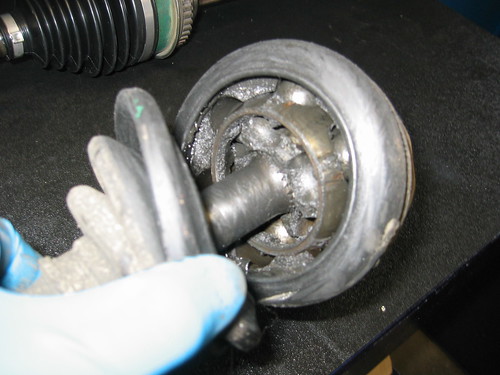
The boots are made out of rubber and do not last forever just like belts and hoses wear out, crack or become weak with age and time so do the axle boots. The right side CV boot on the front of most non turbo 4 cylinder models is the most prone to failure as it sits very close to the exhaust and heat plays a part in the failure. Typically when this boot fails grease is sprayed onto the exhaust and causes a very strong smell. There are many different ways in which a CV boot can fail from clamp failure a full rip or tear of the boot. The single best way to approach this repair is to re boot the existing O.E. Subaru axle prior to the CV joint failing. Repairing the boot failure prior to the joint running out of grease, or dirt and grit entering the joint will allow a more economical and a better, longer lasting repair than what I am about to talk about next.
A very typical thing we see is a tire or general repair shop taking out an axle for a CV boot failure and installing a “Brand New made in China” axle. This can start a lot of trouble in many cases. The quality of the CV axles made in China is very suspect to say the least. We have seen everything from vibrations at idle and very pronounced vibrations under load to boots that last just a year before they tear open again as compared to the original boots that lasted 5 to 6 years on average. Now as the suspension ages the boots may not last as long as the first set of boots but a boot that won’t make it a year without issue is really low quality. Vibration problems can be a biggie with aftermarket axles as well this can be under acceleration, turning or even just at idle. Excessive play in the inner joint allows the inner portion of the joint to move back and forwards within the inner joint housing is typically the cause of this.
Next is the one size fits all axle we see so often, with the incorrect inner sealing ring installed. We have seen this cause premature failure of wheel bearings by not providing the proper seal where the CV axle fits into the wheel bearing, seals and hub. Aftermarket parts vendors try to keep costs down by eliminating part numbers and providing one axle that can be used in both ABS(Anti Lock Brake System) and Non ABS both. The difference being the Toner ring installed on the axle outer CV joint. The toner ring spins with the axle; a sensor interprets this as a speed and inputs information back to the ABS module. By coming up with an axle that can physically be installed in either application the Aftermarket parts maker has reduced its inventory and production costs, good for their business but not so good for your Subaru. A large supplier of axles has also decided that because the older 2 wheel drive axle used by Subaru many years ago which was larger in size and believed to be stronger, has decided for you that your newer Subaru should have a 2 Wheel drive axle installed regardless of the fact that this puts the inner cv boot much closer to the exhaust and it will fail very quickly the 2 wheel drive axle in the earlier years was larger in diameter than the AWD axles.
Remanufactured axles have mostly gone away, Subaru has had a here now gone tomorrow Remanufactured axle program that has had some quality control issues as well and they are a bit pricey. A new axle from Subaru is typically over $500.00 and not always available. There used to be better solutions but the flood of cheap priced aftermarket parts brought down the price to repair but really brought down the quality of the repair with it.
It is much easier to just swap out axles and there are plenty of shops that employ Tech’s that may be scared of taking apart the axle or may not have the right tools to do the job. Or a shop may look at the potential profit of installing a low cost axle and not care that much about how long the repair lasts. Another real possibility is just plain lack of understanding. The O.E. Subaru axle that came in the car when it was new is much superior in quality to anything that can be purchased in the aftermarket and much better than a Subaru Remanufactured axle as well. Catching the boot failure early when the boot is starting to crack will keep the costs down and yield a much better repair.
This is another reason to not take your Subaru to a quick lube center for an oil change, while they will always catch a dirty air filter and suggets a transmission flush, but since they can’t repair cv boots, they won’t know what to look for, if they look at all.
Below are some pictures of some axles.

This is an AWD axle next to a 2WD axle, you can see the difference in size.
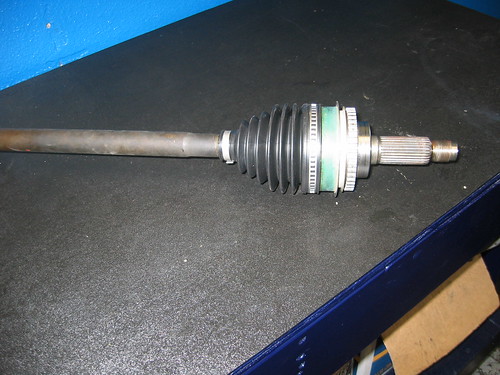
New Cv boot on an original Subaru axle
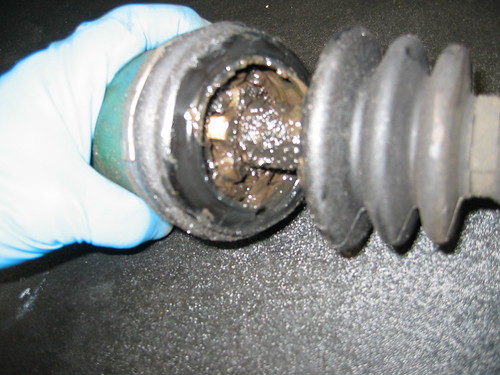
A torn open inner boot and a joint that has grit and grime inside of it now.

New Cv boot installed on the inner joint of an O.E. Subaru axle
Thanks for reading
Justin
Hi Justin,
Your blog is incredible, in its helpfulness, longevity, and your dedication. Your “recent” replies mention you testing Trakmotive axles for Subarus. I just bought a new Trakmotive front CV axle and found a long commentary in the installation manual about the cause of possible Subaru axle replacement related vibration (below). My question is whether you have ever noticed any vibration after installing a NEW OEM Subaru axle into an old Subaru vehicle? Your real life experience would identify a big hole in their explanation, highlighting vibration issues to be due to engine mount wear and why lowered tolerance *reman* parts do not have this problem.
I just bought a NEW Trakmotive CV front axle largely to use while I fixed the (minor) leaking outer boot in one of the front CV axles in my manual transmission (MT) Subaru Forester (2014-2018 generation). Finding a MT Subaru *reman* part isn’t that easy but I’m now rethinking my plan as I don’t want vibration. If they are correct, I might still have a problem with a new OEM Subaru CV axle.
Page 8 of the Trakmotive CV Axle installation manual states:
“Subaru Axle Replacement related vibrations
Subaru transmission mounts used in these applications are susceptible to becoming very spongy and work out due to the unique horizontal movement of a boxer (cylinders horizontally opposed) engine. When these mounts wear they are causing the engine/transmission to sit slightly off center and they wear the inboard joint of the CV shaft wears due to the strain.
When a NEW CV axles is installed (not worn), the axle becomes the mount that is holding the transmission in the correct location, which creates a binding vibration even possibly at idle. Most customers are convinced that the axle is at fault because the vehicle did not have the vibration before, so they will install a remanufactured unit and the vibration is much improved or solved. The reason that the remanufactured axle solves the problem is that this axle having already been worn and then reground to make the surface smooth again, so a remanufactured axle will never be as tight (articulation angle) as a brand new axle.”
The rest of the page has a picture of a Subaru hollow engine mount and a mention of many types of problem solver style Subaru transmission mounts on the market.
Thanks,
RC
Hey RC,
So no, we have only ever experienced vibration after installing aftermarket axles, never when using OE Subaru new or the now gone again reman axles.
I am well aware of the passing the buck down the line Trakmotive and other axle suppliers go to great lengths to explain. Trakmotive is still being evaluated by us and we have installed some in our loaners and some into customers cars. I cannot give them a full green light at this point.
We have had tons of cars through the years where a shop has done axle, mounts, more mounts etc only to still have a vibration. We will install a Subaru part and resolve the issue both new and Reman. It has zero to do with Subaru reman tolerances VS new, its about OE design VS aftermarket Axle companies design. If we install an axle and it causes a vibration not there prior it does not stay in the car unless in some difficult cases where we have no other option.
If all you had was a boot leak and you caught it early I would suggest rebooting your axle VS anything aftermarket. We will literally try and find a Junkyard core for our customers ahead of going aftermarket at this time.
Hope that helps
-Justin
So, now that the older Subaru’s no longer have OEM shafts available to purchase, what brand would you recommend?
Hey Gregory,
This ended up as did the last one in spam, I was doing some website maintenance today and finally saw this.
So I am aware of the issue, we have been buying wrecking yard cores and repairing the ones that can be repaired and installing. We have also installed one by trakmotive, am still evaluating these but of you still need one you might give it a shot.
Sorry for the delay and I hope this helps.
-Justin
Hi Justin,
Thanks for all the good advice on this. I have a 2015 Forester that is making cracking noises from the passenger front wheel when I turn to the right with gas pedal down. Mechanic says its the CV shaft, reports the boot has been leaking. I likely need a new shaft.
Would you recommend only going to a Subaru dealer for this to make sure I get the OEM part? Can you suggest any specific questions I can ask to gauge how knowledgeable a given mechanic is on this?
– Dave
Hi Dave,
I would only suggest a OE Subaru Shaft. But your shop should be able to install it for you, just don’t let them put any thing aftermarket in.
-Justin
Hi, I have a 2016 Subaru Crosstrek AWD. The dealership recently told me I need to replace the front passenger side drive shaft. I went to autozone to buy a more affordable one and they sold me a rear passenger CV axle. Saying my car does not have one in the front (which it does). Are the two interchangeable, a drive shaft and a CV axle?
Here are the part numbers:
Subaru sold me their 28321FJ020
Autozone: Duralast Gold 14075N
Hi Casey,
This is why you never go to aftermarket parts houses, unless its an emergency or for fluids.
I just don’t know what else to say.
-Justin
Thanks Jason. Theses ones are held in with the C clip. Trouble is the guy at the garage is telling me the transmission is knackered and probably too expensive to repair, but if I want to scrap the car he’ll buy it off me. Alarm bells ringing for me at this point because I’m thinking he’ll just know them back in and hey presto he’s got a nice green and silver outback for £200 scrap value.
Hi Justin
Question from England. 2004 Ouback 3.0R Auto. Thought i had a gearbox issue but when up on the ramps i noticed both front CV shafts had slipped out of the differential by about an 1″. My mechanic claims he has never seen this happen is 30yrs. Do you have any ideas what could have caused this?
Hello Michael,
In the U.S. the 2004 Outback CV axles were still held onto the Stub shafts coming out of the front differential with roll pins. I can only assume that’s true for the UK market. So it would have been the Stub shafts that popped out of the transmission, which would be very odd, but I have seen it happen but generally speaking only after a repair. If its the 2005+ style, its more common and mot surprising at all, generally this can happen if they are not installed properly or if there is wear.
Its hard for me to get my mind around what could have happened without seeing it, this would let me investigate what happened but that’s not really an option so its difficult to speculate. My guess is something happened at some point in time during service and then there was a event that allowed for more than usual articulation and the axle was pushed to a limit it should have been okay with if it was installed correctly, but because I believe it wasn’t it couldn’t.
Hope that helps
-Justin
Is it worth going with the oem Subaru boots and grease or will the Beck/Arnely kits work well enough for replacing torn boots? Also I’m assuming that it would be beneficial to also change out the outter boot when replacing the torn inner boot since you have to take them off anyways?
I am not familiar with the Beck/Arnley kits, but they should be okay as long as they look and fit like OE. Its always best to replace both boots on one axle.
Hope that helps
-Justin
Thank you Justin, much appreciated.
After some light research I decided to just go with the OEM Subaru boot kits since they seem to last longer than most of the aftermarket ones.
Finally fixed my car – here’s a summation of what I found
Subaru of canada has reman axles but they wanted $600 for each axle
Online retailers from the U.S were selling same reman for about $250-$300.
I ended up finding a wrecker on the west coast (canada) who sold me a good condition OE axle off a 97, one with green cups and boots that weren’t torn.
I paid $120 with shipping, got the job done in about 20 minutes.
Lesson learned: replace those boots on your OE axles as soon as you notice them failing. All prices in CAD.
I really didn’t want to go the aftermarket CV axle route and roll the dice, hope this information helps someone (97 legacy outback).
Justin — we’re now in 2020
What possible options are there left for a 97 legacy outback that isn’t any of the options off rockauto or any aftermarket stuff?
The OE option is not available (?), neither is the reman (?).
What do you recommend?
Hello Rob,
If your looking for an axle you might look into Trak Motive. We have had some success but have also had a couple of vibrations. More wins than losses at this point.
We are currently trying to resolve the availability issue, but its going to take time.
-Justin
Hi Justin,
Thanks for the intel.
With a bit more of searching I was able to find some places to supply reman subaru axles for my year Subaru – part # SOA966H900R1
Would you still recommend these over the Trak Motives?
Yes the SOA is a better way to go.
Additionally have you seen any long term front diff damage from using track motives?
Thanks again for all your help, this site is a great resource
Hello Rob,
Not as of yet, they are still new to the market however.
-Justin
Hi, Just got myself into a 2011 Subaru Legacy 2.5l…I love it!!!! Question, I think I may be having a Front right CV Axel Problem that I didn’t notice when test driving the car. When stopped or parking if I turn the well hard to left or right and move slowly as to park I hear a thumping noise as well as fell a jerk motion coming from the front passenger side of the car. could this be an indicator of a bad axel? Any help would be grEatly appreciated. Thanks!!!
Hello Fernando,
That could be many things and axle is one of them, I would suspect a sway bar end link or a bushing, or a caliper slide pin ahead of the axle with that symptom however. Also if its an Auto you could have a possible torque converter issue? Really hard to say without experiencing the symptoms my self however.
Here to hoping its minor and you can enjoy the new ride!
-Justin
Hi Justin…AM axle was replaced with SUBARU reman AND PRESTO!!!!! Vibration was completely gone .
WHO KNEW…….You did !
Thank you as always for your expertise
Cindy
Norfolk, Va.
Glad I could have helped
-Justin
AXLE UPDATE…..Had my AM axle removed and my reman Subaru front left axle installed today!
WOOOO HOOOOOO Vibration is gone????
Justin should I be sending you a check for this spot on expert advice? It’s the best and I’m so grateful.
you do know your subaruuu’s
Thank u????
Thank you very much Justin. Have ordered part and looking forward to smooth idling again .
Once again you are the SUBARU GURUUUUUU
THANKS Justin????
Justin…HI..Cindy in Norfolk, Va. You helped me sooo much.
So my beautiful 05 LLBEAN outback had to have a Axel left side replaced.
When I took it to shop it was quiet, smooth idle couldn’t tell it was even running.
Drove away within 30 seconds noticed that in DRIVE vibration with stearing wheel at stop sign 1/2 block after I left. Took it back they had no clues. I said….hold on I brought this vehicle in driving perfectly. And now its vibrating!!!! Took it to another place.
$1,250 says it’s my motor mounts all 4.
But I came back to you….Tried and True and look what I found!
It’s the AM Axle isn’t it?
Thank you Justin
Hey Cindy,
Glad I could help!
Yes thats the text book experience you will have when the axle is replaced on the front of your Subaru with anything other than a new Subaru or Reman Subaru axle. Can’t even begin to tell you how many cars a week we still see with this issue.
So don’t let anyone replace the engine mounts on your Subaru, thats just not a real thing that gets done very often. Take it back to the shop that put the axle in and ask them to install a Subaru new or Subaru Reman axle for you and the problem will be solved. They will probably do this kicking and screaming.
The next step is to try and find an Independent Subaru Shop near you.
Hope that helps
-Justin
One further Q…..
Yes new are pricy but you think reman will be ok? You have said in other post maybe don’t go with reman
Thank you❤️
One further Q…..
Yes new are pricy but you think reman will be ok? You have said in other post maybe don’t go with reman go oem
Thank you
Hey Cindy,
The possible issues that come up with Remans is that they just will not last as long as the OE one did.
New is a one and done kind f a thing, and Reman is well maybe 2-5 years.
Thanks
-Justin
I have a ’05 Outback and have a vibration starting around 40 MPH only when pressing on the accelerator. I am currently in Mexico and the mechanic that looked at it here thinks that the front right CV axle and the drive shaft bearing need to be replaced. The same axle was just replaced by a Subaru dealer in the states in November as we were having vibration issues at that time as well, but not related to acceleration (based on this thread, it sounds like that was a mistake).
First question is does his recommendation sound good? Second question is how to get parts? It sounds like he is having a difficult time finding the right parts. Subaru’s are not that common here in MX and there are no dealers. Do you have a recommendation on where to order parts from in the US? I want to make sure that we aren’t getting junk.
Hi Megan,
Sourcing parts is going to be tough, and the Subaru axle that was put in was most likely a Reman. It would be better to opt for a new Subaru Axle.
The only tough part is if the diagnoses is accurate, it sounds like it could be, but because there are other possibilities, I cant tell you without seeing it for my self what’s actually wrong with it.
Shipping a New Subaru Axle shouldn’t be a big deal, just not going to be super inexpensive either. If you want you can fill this out and explain where it needs to be shipped in the comments section and my Parts Manager can at least give you a price. https://allwheeldriveauto.com/request-a-part/
Hope that helps
-Justin
Thanks for your reply Justin. I just submitted a parts request so that we can at least get a quote and make sure with the mechanic that those are the parts that he needs. I think at this point we don’t have a lot of options other than to assume his diagnosis is accurate. Hopefully we can at least get the car fixed enough to get us back to the US!
my problem may be different than most. You see we encounter -50 f temps often here in Fairbanks and North Pole. All the manufactures seem to design for heat since most left Detroit and Canada. COLD is a much tuffer environment. I need cv boots and other type parts that can handle the cold. here we plug our cars into outlets to keep the engines warm or the engine gets so cold that the tolerances get so tight the engine won’t turn. Most of the rubber parts become brittle. Did you ever see a 15 foot extension cord stand straight out? Anyways I need parts that are tough and made for the artic. Any ideas?
Hi Greg,
Ya that is cold alright, but to my knowledge no one makes a component designed to combat that issue. It’s just one of those things that in extreme warm or cold climate maintenance and repairs goes increases.
Sorry I cant offer any suggestions.
-Justin
Hello,
I have an 04 forester xt with a 163,000 miles. The cars steering wheel has been jerking to left randomly and sometimes will make a noise when it jerks: However I don’t have a clicking sounds like others experience. Also my cv boots looks good, could it be bad cv axles?
Id think maybe a separated tire?
-Justin
Justin,
Thank you for taking the time to explain all the details of what is happening with the hub failures.
I am impressed with your effort to address the myriad of issues many readers are experiencing. Owner support/enthusiasts sites are not very well informed about this issue.
I am comforted that my local dealership is not going for a ‘cash grab’ and a quote under $800 is proper market rate for good parts and professional installation. I hope for many good years of ownership.
Best wishes
’08 Legacy GT 93,000 miles stock
Hi Justin (sorry about the name flub).
Thanks – i’ll try to work it out and report back.
Regards,
Bill
Hi Jason,
I’m in the middle of replacing my 2003 Subaru (Outback 2.5L Auotomatic) front wheel bearings and axle shafts. (I went with Subaru re-man axles and Japanese bearings).
The passenger-side stub axle shaft pulled-out with the axle/CV joint assembly. The circlip is intact and the circlip and axle stub look okay, but doesnt seem to want to insert back-in properly.
I confess that I did something really stupid when pulling the knuckle assembly and used a 3-jaw puller without disconnectiing the knuckle attach points – don’t ask me how, It was actually the second side and i just got it in my head that i was pulling the wheel hub out of the knuckle and it didn’t matter that the knuckle was fixed. In other words, I believe that I pressed the entire assembly in towards the differential and cause the stub shaft problem. It didn’t move inward more than 1/2 inch.
So, I plan to:
1) Get a new circlip and try to insert stub shaft again.
2) Pull the good side stub shaft and compare fit.
Any suggestions are much appreciated.
Regards,
Bill
Hello Bill,
The name is Justin and the only real advice I have is to make sure you use a lot of grease around the cir-clip, be careful with the side seal.
-Justin
My 2011 Subaru Outback is making an occasional rubbery sounding squeak, with an immediate loss of power (like it’s a bike out of gear) and then “catches” again. I brought it into the Subaru dealer (who never heard the squeak) and they upgraded the computer software, and then did some work on the battery, cleaned the throttle, and performed an idle relearn. Today (two days later) the squeak happened six times, with the slight pause in forward motion before continuing forward. They said that my tie rod and axle boots could be the problem, but reading early in the thread (2010 – 2011, then I scrolled to the end) I don’t see anything about a squeak and pause, but rather a smell of rubber. The squeak is definitely rubber-sounding (so I thought it was a belt). No dash lights are on. The dealer estimated $1200 for the inner tie rods (not sure if this includes the axle?). In other comments, they indicated the left head gasket is seeping, and the heat shield should be replaced. Does any of this sound like it will fix the squeak and slipping? Before I spend more money (spent over $500 already), I’d like to know that I’m fixing the right problem.
Hi Becky,
I would not let them make the repairs until the Tech has heard the noise, is not guessing and they have proved whats wrong.
This may require you to take the Tech on a test drive, something they will do kicking and screaming, but its your Money, you get to choose how its spent.
-Justin
This is a long thread and you may have already answered this question but i stopped reading the replies after 2010.
I’ve just been told by the dealer that my 02 WRX passenger axle is torn and needs to be replaced at ~$600.
I contacted my independent Subaru mechanic and he quoted ~$200. For that price they are sure to be using after market axles.
As it’s now 2016 are there any suitable after market axles for a 02 WRX that come close (or exceeds) the OEM part that you would consider installing for a customer?
Its currently booked in to have the complete axle replaced, however based on your post I may go back and have them just replace the CV boot so I can keep the genuine axle.
Hi Jon,
There just isn’t a real good solution in the aftermarket, and we see lots of issues with the chines axles still. No doubt the $200 option is Chinese. If the boot is torn wide open and its lost grease and the joint has overheated its possible its o late, but I can’t really know that for sure with out seeing it for my self.
There should be a Reman Subaru option that should be less than $600? You might ask.
Hope that helps
-Justin
Hi Justin,
Thanks for your quick response.
Just got off the phone with my mechanic and they use ‘Empire’ axles. My mechanic said he has seen very few issues with these in all the Subaru’s he’s installed them on.
Not sure how bad the tear is, definitely loosing grease as i can smell it but no strange noises or crunching.
For now I have asked them to just replace the boots – hopefully they will check the condition of the joint before rebuilding and advise accordingly.
I found a cheaper alternative fix. It would look great next to that rotten air filter you have sitting in the lobby. 😀
https://www.z06vette.com/forums/f5/duct-tape-ziploc-brown-paper-bag-cv-boot-126131/
Yes, thats a great fix..
I had this exact problem on my 2002 Outback after a mechanic friend of mine changed out the CV joints/axel with after market parts (probably around 100K miles). The car started vibrating at idle (at stop lights), the very next day. For about 6 years now I have been shifting in to neutral at stop lights. I just learned one of the CV rubber boots is torn again, so I will be replacing them with Subaru OEM parts! Side note, I also learned my steering boots have failed as well. Mileage 183K. Those have never been replaced.
I have owned 8 Subaru’s. Two of them were Foresters and sadly I own one right now. My first one had this axle BS issues …yes you heard that right. I had to pay for 5 and 4 were warrantied or simply taken care of as a courtesy to me by dealer. . Fast forward…now own a 2013…at 40K miles right front axle had to be replaced…at 96K miles ditto again same axle…this time take care of by Subaru America…last week left front axle went…this time they refuse to help out. I don’t care what anyone at Subaru says to you…they have a design flaw with their axles…and also their ridiculous comment every time I had an oil change how the “care was engineered to burn 1 – 2 courts of oil between oil changes”…how utterly stupid to do that sort of thing. Imagine buying a brand new car…it hits 4500 miles and you are down a quart of oil.
Oh by the way…I have never taken this car off road…not once.
Love the car’s handling in bad road conditions. In fact better than any pickup or Jeep I have ever owned but this is my last Subaru for sure. I will give kudos to the dealer I bought it from and their service dept. Bill Kolb Subaru is one classy place. I just wish they woudl read opinions of people with that oil insanity prior to making comments about “how the care is engineered that way”.
Good luck with your car. Hope you do not have the same luck I have had with my Foresters.
Hi Ted,
Actually the service department is the entire issue. So some dealers have guys that are smart and capable of rebooting and or rebuilding a CV axle, and others do not so they use a Subaru of America rebuilt in Mexico by the A1 cardone company, this is nothing you would ever find in Japan only in America. The mere fact that they are telling you the “axle went” tells me this very thing, it should be the rubber boot is starting to leak some grease and we should address this for about $200 before it turns into something more expensive, I think most understand that rubber boots, just like your rubber tires have a life span.
A typical scenario is this, during an oil change it’s noted the right front CV axle is leaking grease at about 100k (some sooner, some later) the good tech suggests rebooting the original axle if caught in time, and this repair lasts 4-5 years, most longer some less. Eventually the left side goes, usually about the time the right is ready for round 2. If this is done correctly, meaning it is suggested before the boot tears open, losses it’s grease and damages the joint, or someone who is lazy just wants to put an axle in it DOES NOT service the car, all you will ever do is replace CV boots every 4-5 years or so, some more some less. Every front wheel drive car or most AWD cars have this occur, CV boots are a common repair on all makes and models, my 2004 GMC was both sides at 60,000 miles.
If instead the Remans are used, depending on the era some last just a year some last a few years.
The car was not engineered to use oil, you will find no document from Subaru stating such, you will find what is considered an “acceptable amount” of oil use. People have demanded lower ownership and less oil changes, the government has demanded higher fuel economy. Increased oil use is a result of this, it has started to subside in newer models, Subaru again is not alone in this, google oil use in newer cars!!
The Service department should instead tell you the truth.
“Hi Ted based on how you are using the car, you really need to change the oil at the 3 month and 3000 mile mark” You probably wont use oil at that interval.
We try and convey this all the time, its why I wrote a “Why the 3 month oil change” is a must for some drivers article, because its the truth.
So you bought a good car, but the way the Dealer goes about the service has left a little to be desired.
I will add that we face a skilled labor shortage in this country and the Dealer may have no choice on the CV axle thing!!
-Justin
What happens when you continue to drive your Subaru with a bad cv joints?
Eventually it breaks and could cause more damage to the drive train.
-Justin
For sure, in hot climates the inner boots tend to cook. Been there, done that. Would additional heat shielding on the exhaust pipes be a help? Has anybody tried this? Too bad Subaru cannot route the exhaust differently, but with their boxer engine design, and mounted in front of the transmission, this might not be possible?
Hi,
Slight change of topic here (but is about a “boot”). Both the steering rack boots are cracked on my 2000 Subaru Forester. The mechanic just pointed this out to me and said he sees some grease coming out but no power steering fluid. Quoted me $300 to replace the 2 boots and do the alignment he says I would need afterward.
The car has close to 200,000 miles and I’m hoping to drive it for another year or two. I just spent a bundle replacing timing belt, head gaskets, etc. A few months later, the radiator cracked. Now I’ve got another as yet undiagnosed oil leak and the cracked boots. My question is this: how important is it that I replace the steering boots? Am I likely to make it another year or two (about 20,000 miles) without replacing them? Is it dangerous (e.g. would the steering go out suddenly?)
Thanks, Terri
Hi Terri,
The boots covering the inner tie rod at each end of the rack and pinion are called bellows boots. They are not lifetime components and the price seems fair, if you wait, you could end up damaging the Rack & Pinion and that’s quadruple the price.
The purpose of the boot is to keep the grease in the inner tie rod end, and the road grit and grime not just out of the tie rod end, but away from the shaft of the rack, if enough grit gets on the shaft, the seals can become damaged causing the rack to leak, lose its fluid and thus you will have no power steering.
There should not be any un diagnosed leaks?
The head gasket leaks most likely led to the bellows boot failures by the way.
Hope that helps
-Justin
–
Hi Justin,
Thanks for the article. We had both front CV axles on our ’08 Outback replaced with aftermarket axles. There is definitely vibration when you shift from park into drive or reverse. Can you explain how this can be caused by the axles, even though the wheels are not turning? I want to feel I’m on more solid ground when the mechanic claims it can’t be caused by the axles.
Thanks,
Mark
Hello Mark,
It’s because the joints have to much play or are non OE type. This will cause a load on the drivetrain.
Any good Tech will understand this, but a parts changer will not.
Bottom line, if the vibration wasn’t there before the axles the axles or the installation of are at fault.
-Justin
Hey Folks
just bought a 2005 outback 2.5 with 121500 klms on it.
Have a problem with vibration under acceleration from approx. 20 to 40 klmh.
it appears to feel as though its in the back of the car.
Goes away when it changes to the next gear and is nice and smooth there after
Can you help as Im down in Australia and just bought this car
Hi Pete,
Unless you can fly me in to have a look there isn’t much I can do for you.
-Justin
Hi Justin,
Great article as usual! Yesterday morning, I noticed a clicking apparently coming from the rear of my ’14 Forester 2.5i when driving through some very sloppy mud. The clicking only happened as the VCD indicator was flashing as the vehicle attempted to gain its footing. Once the footing firmed up and the VCD was no longer needed, the clicking stopped. Despite living in an area known for its snow, I’ve not had the need for the VCD to engage so I am wondering if this is normal or an indication that the CVs may need some attention.
Thanks for all your great information and tips.
Keith
Hi Keith,
Don’t see many issues with rear CV’s especially on something that new. But we have seen a small hand full of propeller shaft issues. The car is still under warranty and if you can reproduce the symptoms for the Dealer id get it to them and Let Subaru foot the bill rather than you.
-Justin
Dear Justin! Thanks for the great article with tons of valuable information.
I have a 2006 outback 2.5i with 105,000 miles. When replacing the timing belt and struts in December 2014 I noticed the inner boots were torn, yeah both of them :-/ but they didn’t look dirty so I had them replaced and hoped I fixed it in time. A couple months ago the front end started shaking under acceleration and sure enough you can now feel a gap in the inner cv.
My question is this, should I just replace the inner cv joint or would it be better to replace the whole axel? Of course I mean OM Subaru parts in either case 🙂
Inner cv joint is 175$ and the drive axel is 400$. The inner boot is essentially new so I could re-use that, (for some reason the inner boot is pricy compared to the outer boot?). However the whole axel is easier to replace so replacement cost should be less than replacing the joint. The rubber of the outer cv boots look like they are in reasonable good condition, no signs of cracking, but they are almost 10 yrs old now…
Any advice on what to do?
Hi Erik,
I would opt for either a new axle from Subaru or at least a Subaru reman and really nothing else.
We have tied just about everything else out there and nothing seems to last much longer then a year if its aftermarket.
-Justin
Hi Justin!
First, I have to say thank you for this post from all of us who have been feeling the effects (while trying to hold our breath) of the CV boot issues you’ve discussed. You have been replying to posts for 6 years now which I call going above & beyond, great work and great post/replies all around!
Now for why I found this page… my 2008 Forester Sport X(non-turbo) with 150k, is having similar issues as many others posted:
1. That Smell!
2. Clunking from the front passenger side (this is more dramatic after car sits for longer, and is worst when first driving then dissipates slowly the longer the car is moving, and is also better at higher speeds.)
3. There is a grinding noise from the front end when braking that feels like overdue brake pads but when inspected there is still a fair amount of pad left on both sides.
4. Steering components all appear to be in good working condition and turning does not seem to have an effect on the symptoms.
With that being said, what I don’t understand is while I didn’t get my hands on the boot to check for tears, from a visual inspections the boot looked intact and was totally dry as opposed to finding residual grease at the source. I do have a slight oil leak from either the pan gasket or the oil cooler unit which could be the cause of the smell.
Have any opinion? Also, do you happen to have a link to any instructions/guides for removing the axles on a 08 forester, as I want to take a look inside those boots either way seeing as it appears to be a very common issue for Subaru’s.
Thanks Justin!
-Joel
Hey Joel,
Might be more then one issue?
Look for grease on the exhaust and usually look down at the axle from underhood to see the tear.
The grease has quite a pungent smell however, not like burning oil
Keep looking
-Justin
Hi Justin,
A while back my head gaskets went on my 1997 Subaru Legacy Outback and I replaced them with your kit and I have had no problems since!!!! 20,000 miles later. However my front drivers side outside cv axel boot tore in half and now my front left outside cv joint is making the classic popping noises. So my question is, is it worth trying to replace just the outside cv joint and boot with oem parts from a supplier, or should I replace the entire axel with new inside and outside joints all OEM? My car has approximately 150,000 miles. Thanks for any help and assistance!
Hi Gabe,
For you car if you can locate a new OEM axle from Subaru I would go that route, the second option would be the Subaru reman.
We have tried just about every Chinese axle none are really very good.
We tried the ones from the company in Colorado and had issues with those as well.
-Justin
Subaru 2002 outback Wagon slapping clicking noise only when car is in motion.one click per rotation, gets faster as I speed up and once in awhile-every 15 sec or so a real loud clunk- thought it was the CV joint, we replaced -axel- on the front both sides didn’t fix the noise so than we replaced a bolt that was broken on the rotor on the passenger front side still didn’t fix now don’t know what to do.
Hello Will,
Check the wheel bearings and hubs and or take it somewhere that can diagnose the noise, you cant expect as a driver to be able to diagnose and repair every noise or symptom that occurs with your Subaru.
-Justin
Hi Justin
I have an 01 Forester. During a hard right turn, backward and forward, there is a grinding in the right front of the car. I read most of this thread and have since inspected the inner boot and of course found it to be split. Per my fathers suggestion, once the tire was off the ground after jacking up i checked for play by holding the tire at 3 and 9 o clock and found very little play. According to most of what I’ve read so far it sounds like dirt has gotten inside and might be causing this grinding. What do you think?
Thank you for any info you share.
-Mike
Hi Mike,
There are lots of possibilities including the hub, wheel bearing, cv axle, brakes as well as a potential differential issue. From here without hearing it it’s difficult to know. If you have some how narrowed it down to the cv axle then the best thing to do is replace it with a new one from Subaru, nothing aftermarket.
Taking care of the split boot is of course important but I would hate to see you replace the axle because of the perception that the joint is the noise only to find out it was something else?
-Justin
Bought your head gasket kit for my Daughter’s 2001 Legacy. Pulling engine today.
While under car I saw newish looking NAPA axle on right. Maybe original broken boot axle on left. Shot tie rod boots too.
Possible to inspect the left one and just reboot it, if not too dirty? Just yank the NAPA one, no matter what?
The “local” pick-n-pull has about 10 late 90’s to 2001 Subarus.
What years would fit my car if I can find no cracked boot green ones?
Ever try shaftec from the UK axles?
https://www.rockauto.com/catalog/moreinfo.php?pk=5886945&cc=1375084
Hello Rod,
I would really stay away form anything aftermarket on the CV axles. If you can find a couple of used OEM ( green joints) 2000 to 2004 is what would fit.
-Justin
Is there any kind of rubber conditioner out there that could help these boots to last longer? Thought would be to apply it at every oil change.
Hello Ruddy,
I am not aware of any chemical you could ever add to a moving part such as the CV boot that would allow the boot to last longer.
-Justin
I am scheduled for an passenger side front axle replacement. I am very disheartened at USA Subaru and the dealer. I was told by the dealer the warranted axle replacement covers only a rebuild. This would be THE THIRD AXLE IN 60,000 MILES! I called USA subaru and they heard my story and said “out of good will” they will replace the old one with a New Subaru axle. Is there any way to tell if the axle is from the factory? Wish me LUCK!
Great write up. I’m replacing my rear wheel bearings based on your bearing article and found that my rear CV shaft is leaking grease at the boot clamp area at the boot nearest the differential. The boot isn’t ripped and it doesn’t appear that dirt would be allowed in, so should I do anything to this shaft other than reinstall it? Car only has 65k miles and the shaft doesn’t appear to have any wear issues.
Hi justin!
Ive been having a problem with the front driver side (rattle noise when turning or accelerating). my friend said its the axle. i took it to the local mechanic because my usual subaru dealership said that they did not have a mechanic at the momnent. the local mechanic said the axle is loose in the joint so he is ordering a part from New York and im from Canada. thats the only place he said he could find a part. after reading these posts im wondering if he is getting an OEM part or aftermarket..? should i be worried that its just a short term fix?
Hi Lindsay,
That’s a question for the Shop, as I have no idea what they are using.
-Justin
Hello,
Is it possible to rebuild the outer front cv or are you SOL. I popped the rears no problem but read the alldata repair manual & if I recall correctly stated outers were non rebuildable.
Also tried on a previous outback, big hammer and thick piece of wood to try to pop the circlet out but no dice. I destroyed that shaft but I’m in the spot that my outers on both sides are torn.
Any input?
Hi Mike,
The issue is component availability, you won’t find the individual components for the out CV joints aside form boots, clamps and grease. We used to “part out” axles and rebuild in house, but we had to give up on that due to there just not being a steady supply of OE axles to take apart available to us.
I would either see if you can obtain Subaru reman or Subaru New and truly nothing else.
-Justin
Hello excusse the spelling please i just got back from the shop with my 02 outbach the car was making a squeaky sound the mechanic tolf me after checking the car out that i had a bad drive shaft in the back that eventtualy would have to be repleced but for now he greased the s… out of it and told me i and the car should be ok for a whille it s sumer time up here and i do a lot of driving to go fishing and i do not want to get stock in the boondocks with my car on the limb should i liesten to him or get the job donne now(at a cost of a 1000 dollars)thanks
Hi Tony,
I would probably try and budget for the repair rather than wait for it to break somewhere, as that wont be any fun.
-Justin
I have completely dissassembled and cleaned the front axles on my Subaru 2006 3.0.
I know that most people just buy new axles and that the cheap ones are crap.
On inspection, mine look fine. I have 6 of the 8 balls installed on each, can’t get
enough space to push the final 2. Looking for advice on coaxing the ring race to
open up more space.
Hi,
Have read all these helpful posts but not come up with an answer to my problem. Help appreciated.
Impreza ’02 has thudding on both R and L hand turns, and on turning in reverse. No noise when driving straight, not sure if noise is present at 3rd or 4th gear. Worse when engine is warm.
Hello Ak,
It’s hard to tell you what a noise I cant hear is. It’s possible it’s a CV joint, wheel bearing, loose caliper, hub, transmission etc. If you are unable to determine what it is Id suggest you may want to have someone local to you have a listen? Have you looked at the front axles?
-Justin
Hi, because I am an incorrigable diy’er, I am not only replacing the boots but I completely
dissassembled the outer CV joints to clean them thoroughly. However, I am not succeeding in putting this rubric’s cube back together. I can get at most 4 balls back in
before things tighten up impossibly. I notice that the ring race is thinner at one edge,
and that the inner race has a sharp shoulder on one side.
I assume the sharp shoulder is meant to hold the axle c-clip, so I have it on the inside
(deep side) of the cv. I’m prejudiced to think that the thin edge of the ring race should
be on the outside (showing) of the cv. Anyway, its certainly not coming together. any help is appreciated.
2006 outback 2.5 200,000 miles, slight vibration during acceleration from 35mph to 60mph. Gets really bad at 60mph and above. Checked ball joints, tie-rod ends, CV boots, all good. Balanced tires, no alignment yet.
Alignment? Axels?
Thanks,
GH
Hi Glenn,
How were the axles checked, are they factory or chinese aftermarket? Who balanced the tires, were the tires inspected for radial tire runout? Has anyone looked at the propeller shaft or rear driveline? Alignments wont cause that kind of symptom.
Lots more to look at.
-Justin
My car has been diagnosed with torn CV boots, but I didn’t get them fixed and I have driven at least the last 6 months with torn boots. How do I know if I have damaged the CV joints and need to go with an axle replacement, or if I am still fine with just replacing the boots with the original axle? I don’t seem to hear the “clicking” noise that I normally hear with damaged CV joints yet.
Hi Erik,
The joints will need to be examined during the course of rebooting to determine if they are worn as a result of the torn open boot and possible loss of grease.
-Justin
Hello,
I have a 1990 front wheel drive manual transmission Legacy wagon. On a recent drive, a faint clunking type noise was heard from the front end, and within a couple miles escalated to a quite a prominent, loud clunk/click type noise at axle speed frequency. The noise only occurs when the wheels are being driven, and is the same whether driving straight or turning to either side
First guess was the infamous aftermarket CV’s on the car. In trying to determine which side was the culprit, it was found the noise was from the midline of the car. With the car on a lift and wheels being driven, we alternately stopped each side’s wheel rotation, leaving only the other side’s wheel being driven to try and determine which was the bad side. The clunk-clunk-clunk sound was the same with either wheel held stationary.
Am I correct to think this test would preclude it being a problem with the CV’s/halfshaft/etc and is pointing more towards a differential/transmission issue?
Is the clunking sound described a possible symptom of a damaged/broken differential tooth?
Hi Pat,
It’s difficult to say what the trouble is without seeing it. I don’t think you have ruled out an axle at this point either but if you allow a car to run with aftermarket axles sooner or later the front differential may fail
Sorry but that’s not one I can help with from my keyboard. I would have to drive it to know whats wrong. Sorry.
-Justin
It is the same pitch,
After letting a friend test drive it with me in the passenger seat, I was wrong in the drivers side being the area of the noise. It is right at the passenger front side were I changed the CV-axle with a aftermarket. Now I am really leaning to the aftermarket CV being bad.
The pitch-groaning is constant or equivalent do to speed.
After it sits for a while (night) and I pull out in reverse it sounds to me the grinding of the CV joint as if it failed and is now on its way out. (with only 10-12,000 miles on it.)
Aftermarkets are ONLY $89 but OEM are $290-320, is my findings correct on pricing?
Thanks again guys!
Matt
Hi Matt,
The point of this article is to tell you to run away from aftermarket CV axles and you have an apparent issue with one already.
The aftermarket axles at $89 are not even worth their weight in cow pies.
New axles from Subaru are typically $379.99 MSRP
-Justin
Left front (drivers side) makes a slight grinding noise or rumble when I drive on bumpy or humping type pavement. as the weight is taken off and put back down on the front end I hear the noise. Is this a CV issue or wheel bearing.
Thanks for any advise!
Hi Matt,
Just not sure without hearing it my self, it could really be either. Does the noise gain with speed, is it obviously rotational or is the grinding the same pitch regardless of speed?
-Justin
So why did my previous submission not get posted?
Your last post just like your first post are moderated.
If you saw the type of things that came in behind the scenes you would understand, non moderated blog sites lead to Viagra sales posts from China, links to porn sites, Get rich from home posts and more than I could possibly ever comment about. If you spend enough time on the Internet you will see what I am talking about.
-Justin
It seems that you are the recognized expert for Subaru axle problems. Last week my wife complained of a noise and jerking while driving. I assumed the axle since it had been clicking for a while already. I replaced the front left axle (reman) without incident. The noise is gone but the jerking motion persists. It occurs intermittently only, when decelerating (coasting) but not actually braking. The steering wheel will suddenly jerk to the left for a split second only. Could it be ABS? Brake pads grabbing? Transfer case? I’m stumped. This is on a 2002 Forester.
Thanks,
Hello Hans,
I would start by inspecting the tires for separation or radial tire run-out.
-Justin
Interesting. I think I will rotate the fronts to the rear and see if that makes a difference. I’ll let you know – thanks.
So I ruled some things out which in itself is progress. Rotated the tires front to back with no change. Only one tire showed signs of wear and that was the front passenger (which is now on the rear passenger side) but the wear was even across the tread – no alignment problems that I could see.
I then removed the entire ABS sensor from both wheels and tied it out of the way with a zip tie while I made a test drive – no change
I also don’t think its the brakes as it does not feel like a wheel drag, just a sudden, momentary jerk to the left.
So now I am thinking steering rack. I did see evidence of some sustained leakage at the rack seals and steering gear. Both boots were torn although the tie rod ends and ball joints were good. Fluid level was good.
Could an air pocket or a malfunctioning valve inside the rack cause a sudden push or pull to one side?
The only other possibility is the differential. I checked the runout of the half-shaft because when I replaced the left axle I pulled out the stub shaft along with it. The retaining ring seemed deformed slightly. I measured slight lateral movement of no more than 1/8 inch at the differential but I noticed the same amount of play with the right axle which I had not touched.
Looking forward to your comments!
Hello Hans,
If you have a rotational type issue It cant be the Rack, the next thing that comes to mind is either the Wheel bearing or Hub, if the Axle it self is okay, have you tried swapping the Axles left to right?
-Justin
I have a 95 legacy awd 2.2l and recently replaced the tranny. About a month later I was coming to a stop and started feeling some heavy vibration from the pass front andas I got close to stopping it felt like the pass front axle had popped out and was banging around. I pulled over and looked but the axle was still in tact amd couldnt see anything wrong. I started to roll the car to see if I could see anything and I could see the motor moving like it was being pushed. Kinda like thw axle was stuck and pushing the motor forward. I replaced the axle n the problem went away for about a month and now its doing it again. Could it be the axle or maybe the tranny is no good? Also I know the tranny mount I bad and causes some vibration and I plan om replacing it as soon as the dealership gets me the part could that cause my main vibration problem
Hi Ryan,
Could be the Axles, Could be the Transmission, could be the Mount.
If replacing the axle seemed to make it go away for a while maybe try and get that axle warrantied as a starting point if you are unable to diagnose the cause?
-Justin
Very enlightening discussion. I have a 1989 RX All Wheel That has had a click since I got it 30,000 miles ago but never understood what I was hearing till recently. It has gotten bad enough now that I am hearing it even on the straight away, and I am seeing wear on the front driverside tire that I am not seeing on the passenger side. Checking the Subaru site said that the OEM is NLA. About the only sources of supply for anything down here on the Central Oregon Coast is either NAPA or Carquest, or let Les Schwab do it and trust them to try to get something decent or rely on their own warranty. From the discussion above things don’t sound promising, but I can’t really afford to give the car up, either. Besides, I really like it. Despite it’s age, it has less than 120.000 on it. If there are any other better options, I’m open to suggestions.
Hello Sam,
For the Older model Subaru’s where there is no longer any support from Subaru we have tried the Axles from Empi, the results have been somewhat mixed however.
-Justin
Just my two cents…
I don’t understand how we can trust Subaru who is driven to satisfy the Subaru owners is ignoring the axle/boot issue. I have two Subarus (2005 LGT ad 2005 Outback XT) and living in SoCal.
Both inner boot is torn in every 30000/4000 miles on the clock from the heat of the engine. The rest of the boots are perfect, with 130000 and 180000 miles on them. So why Subaru doesn’t want spend a couple bucks extra to make the front inner boots from a heat resistant silicon based rubber? It is OK to charge for a new axle $399 dollar or go to the stealer ship every 30000/40000 miles to spend couple hundreds bucks on the fixing the boot, right?
On the other hand the dealers are selling the REMAN axles, which also a POS, so how we can trust them either?
I don’t know – seeing couple hundred posts on the axle issue – doesn’t make me a happy Subi owner. On the other hand there is not one reputable Subaru independent shop in SoCal and the stealer ships are awful. I love my Subis, nothing make me happier when seeing people fooling with the chains or know I was the last one coming up to Big Bear in a foot of snow, the rest stuck somewhere. I think the parts and dealer situation is destroying the reputation of an otherwise awesome car.
BTW, I wish I can take my car to service by your shop. I checked you guys are 1100 miles from me(one way)
Hello Peter,
So on the Turbo models the drivers side axle is not really affected by exhaust temperature as much as the passenger side is, next every 30k is extreme, I wonder if anyone has inspected for any other causes, or if aftermarket boots are being used.
Yes the Reman axles are not our favorite and Subaru does go through CV boots more so than most other makes due to the Design of the Boxer engine, its one of three trade offs.
If the boots were made of something else I fear they would gain in durability as it pertains to heat only to suffer from too rigid a boot to flex when cold and would tear anyways.
For the record the inner boot is thicker than the outer in most applications.
Our 2005 XT only had to have the CV axles rebooted once in 150k and even then it was because they leaked at the clamps.
So the first time this happened to you it should have been covered under the 5 year 60k powertrain warranty? I wonder if OE boots were in fact used or if the Dealer that did the work may have bought them from an outside vendor or if the Tech is not making sure the air is purged out as the clamp the boots to the axle?
Why I realize to a Customer any Dealership is Subaru, but they are merely franchises some corporate franchises in fact. While the do have some structure in place I have observed plenty at the few I worked at to discourage any from frequenting until the model changes.
So cal is a huge area and there are a lot of Subaru’s, I promise if you look you will find a good shop the market place demands it.
-Justin
I have spent two hours reading all of the comments and I will say you are a lifesaving gentlemen.
Here is my story: a month ago I bought a subaru Impreza, AWD 1995 manual transmission so the car needs to pass inspection so I took it to a shop in a gas station to do inspection car I bought was from a senior so to be a 1995 he put only 96,000 miles on it but before taking it I asked a friend to tell me of the car would pass inspection, he said YES that the car was in excellent conditions, the guy at the shop takes the car and starts checking the car so I left the for 3 hours when I get back dashboard has a no light every light shows okay but the dashboard light is no longer working(which was when I took it there) then he says that stop lights were not working which I am super sure they were, then he tells me that the rear axles are okay but it would be better to replace them at the end he comes up with a quote of over 900$, so I told him thanks and left, I fixed everything myself(well husband) but we bought aftermarket axles and they didn’t fit and then when to every auto parts in the area to compare the axles with theirs and is the same one I bought I honestly cannot afford OEM as you have suggested.
My concern is that when I see pics of the axle Same year same model and even go with VIN# it comes up the same part I already bought and is slightly different, but when trying to install it doesn’t go all the way in and a friend told us that if we try to push it, might result damaging something, my question is why this difference and should I leave the new part even though is different, I read your add to late if I had read this before I would have changed the boots only as you suggested, my husband ripped one boot is it to late to just replace the boot now? Thank you so much for your time, we need more people like you around here
Hello Josselyn,
Your a little all over the place here, you replaced the rear axles not the front?
Hard for me to determine what is going on with out seeing it but I am not picturing what you are trying to describe when you say it wont go all the way in?
Do the new axles match the old axles in length?
Any CV axle bought at a general parts store any more is going to be made in china and of low quality, I understand budgets but we actually don’t always have the choices we think we do in parts.
-Justin
I, like so many others on this thread, took my trusty 2004 outback to the shop for regular service and was told I had a torn cv boot. So made an appointment with my very trust worth mechanic to have the axle replaced. Lucky me he had the part in stock amd had done 7 already that month… that should have been a sign, one size does not fit all. Got her back and heard the clicking/creaking. Called, returned it, and he checked and saw no problems and heard no noise. I took her back and the noise got worse. So I returnedy xar to my mechanic and put my foot down about the noise. Don’t call me until you figure out what it is. He said it was a defective axel, ordered a new one, and replaced it again. Not even 10 miles down the road this evening and the clicking has returned. I’ve got a trip out of town planned for the weekend, 500 miles round trip. Will my beloved subaru be okay for this length of travel or should I rent a car?
Hello Nina,
Yes its the same story we hear about and observe all to often as well.
I hesitate to give advice about the travel-ability of any car without seeing here at the shop.
Here is what needs to happen The shop needs to credit you back the money you spent on the Chinese garbage they put in your Subaru, towards the installation of a new Axle form Subaru, do not pass go, do not collect 200 dollars and do not try anything else.
Sorry to be blunt but there are no other options.
-Justin
I was just told by my mechanic that the grease spewed over my driver side inner wheel is the result of a torn CV boot, BUT that it is o.k. to drive a 150 miles to take a flight and another 150 miles return. After reading your comments for over an hour, I’m calling him to ask if I am not risking damage to the axle if it isn’t already damaged. I’ve been driving it with the slight smell for up to 500 miles over a month, I would guess. “Thank you,” cannot express the gratitude for the time you take to help us so far from Seattle.
Hello Jacquline,
While I don’t want you to panic, your right in that the joint should not be allowed to run dry and thus overheat and fail prematurely. It sounds like you are on the right path to getting it repaired properly. The next part is avoiding a chines axle if its damaged already.
Thanks for your post and kind words.
Justin
Just a note, after reading through I’m realizing the advice is probably going to be spend the money on a Subaru axle! I looked at their parts website and it seems like they’ve discontinued them for this car. We can go to pick-n-pull and try to get an axle off one in the yard, would we need to make sure it’s the same year and also 4WD? The wider range of cars we have to choose from the more likely we’ll find one in decent shape!
This articel explains a lot of the problems we’ve been having, but it also kind of make me feel like our car might be approaching the age of unfixable! We have a 1991 Subaru Loayle Wagon, 4WD. We bought it two years ago and first thing we’re told the axles are broken and need to be replaced. At this point we hadn’t done any work on it, so we trusted our mechanic “friend” to do the job. The replacements lasted for less than a year before we started hearing a knocking sound when we turned. My husband is a decent hobby mechanic, so he took out the axle himself this time and it was broken at the CV joint already. He replaced it with a cheap remanufactured one, and then a month later the other side broke. Same story, replaced it with a remanned. Went about 3-4 months, then they both went out. This time we took it to a mechanic to make sure it was installed right, mechanic said it looked good it was just a cheap part. He replaced them with slightly better ones, and they lasted another 2 months. Both were replaced, lasted about 2 months again. So my husband broke down again and replaced both of them, this time they lasted 3 weeks!! Granted, our commute has increased in the last few months so we’ve been putting more miles on it, but we’ve got to find a better solution than new axles every month!
We’ve tried parts from O’Reilly and Napa, same results from both. We called a Subaru dealer and they wanted $400 for each axle, which we can’t afford right now. Long story short, is there any axle we can put in this car that will last?! It’s currently our daily driver right now, but we’re restoring a 1981 Toyota Land Cruiser BJ60 that we want to use as our daily once it’s finished. We’ve put a lot into keeping this Subaru running and want to keep it running as a second car for a few more years at least. Any suggestions would be incredibly helpful!!
Hello Crista,
Thats awful!
Any Subaru loyale axle from 1985 to 1994 will interchange as long as its not 2WD, or Turbo and there are some variables with the Turbo models that get complicated to explain so I just omitted them all together, I mention this for the enthusiast that wants to post that this one year turbo axle interchanges and I am wrong, lol.
If your car was here we would try the EMPI brand, lets be honest its difficult to locate a new Subaru axle so we are stuck with a Chinese one, I have fund EMPI to be a little bit better than the rest and feel strongly they should last at least a couple of years.
If you are unable to locate any, email us and my parts manager Ken can take care of you.
-Justin
Thanks for making the WWW beneficial, your information is always enlightening!
Can you post what conditions the joints would have to be in to replace vs new-booting? Obviously my ignorance here…can the split in the boot be separated enough to identify the color of the cv joints…eg green is genuine???
Thanks very much in advance
ray
Yes the Green joint would typically signify its Still OE.
And no the joint needs to come apart and to look at all of the components of the joint to see if they have become compromised.
-Justin
Hey Justin,
I have an 02 Outback Wagon, 2.5L Auto. A few months ago during normal oil change, the tech noticed my front left inner CV boot was ripped and grease was sprayed everywhere. Not knowing any better, I had them replace the CV Axle. A couple weeks went by and started getting clicking/clunking when turning sharp left. Eventually it started happening more often… even while driving straight. After more trips back to the shop, they finally agreed to replace the CV Axle with a brand new one. This one makes this noise even worse. It clicks only when I’m accelerating while turning left or driving straight. It makes no noise with my foot of the gas, in reverse, or neutral. I found your site yesterday and realize my ignorance… will no replace with OEM CV Axle. Should I be worried about damage to my differential?
I meant to say it only makes noise with my foot on the gas… while accelerating. No noise when I let up on the gas.
Hello Rob,
Sorry to hear about all of the trouble. But I am glad you found this post.
As long as you get the made in China Axle out soon and replace it with a New unit from Subaru you should be just fine, its when the faulty axle stays in for a long period of time is there going to be an issue.
Hope that helps
Justin
Both my front boots are torn and I just bought the car (96 Legacy, 2.5L, AWD, Auto). There isn’t any knocking at all yet so I don’t know how bad it really is. Had the exhaust replaced as it was all rusted out and the mechanic wants to replace both front axles (285ea parts & labor–this is Brooklyn, NY so prices are higher). Clearly he’s not thinking about installing OEM axle assemblies. If I purchase a new assembly (looks like I can get one for $400) I’d need two to replace both, right? So $800? Is there any way I can independently assess whether or not the whole assembly actually needs to be replaced or if I can just do the boots (w/a good cleaning and re-grease)? I am taking it to another shop for a second opinion.
Incidentally, is there any simple way that I can tell if my subaru has OEM axles or not?
Thanks!
Subaru OEM axles will have green CV Joints, that’s the only way to Identify them.
As far as can the y be rebooted, that’s best left to a Subaru Tech to determine, many Techs for some reason unknown to me will gravitate to just installing a Axle rather then re-booting.
Justin
I had a 1998 outback sport that I bought new. My first CV went at 18,000 miles and wheel bearings at about 24,000 miles. Both were covered under warranty – so no big deal. Second CV went at 37,000 miles. Out of warranty, but Subaru replaced free of charge. Wheel bearings were again replaced by Subaru at about 50,000 miles. I got no more than 20,000 miles out of my cv’s up until I sold the car at 125,000 miles. All were replaced by Subaru and they weren’t cheap! I never knew what a CV was until I bought a Subaru. Because of my Subaru CV problems I now own a Jeep Wrangler – no CV’s (solid front and rear axles). Of course, now I have a host of other issues, but haven’t had to replace a CV in 100,000 miles!
Your right the 1998 Impeza did have right rear wheel bearing issues, and add to that the tool Subaru came up with to lesson the time it took to make the repairs resulted in a very short repair life.
One glaring example of why the Dealer should never be your choice when paying for repairs, as they will fix it the same way when you pay for it as when Subaru does.
The cv axle thing puzzles me a bit but because you are not stating what happened to the Cv axle its hard to comment on, if you used it off road and the boot became torn, thus allowing the joint to fail that all makes sense and yes you would be better off if your Jeep if thats how you use the car, but I would rather be in the Impreza in an accident.
Justin
HI Justin,
great article. We replaced the boots and bearings at 100k miles. At about 135k miles, the car started making a clicking noise on hard Right turns. I took it to the dealer and they said it was the boots and bearings again, so we had them replaced AGAIN. However, the clicking did not go away. I brought my car back for another service yesterday at 146k miles and asked them again to look at the clicking and AGAIN they are saying it is the boots/axle and saying both front axles need to be replaced. What is going on? Is it possible that the clicking is not coming from the boot/axle because it didn’t go away with the last replacement?
Hi Haley,
I am a little confused by the post.
If boots only were replaced there is no way the clicking noise would have subsided if the joints are noisy. The axles don’t have bearings, but your Subaru has a Wheel bearing at each wheel.
So if now the suggestion is the axles due to the joints being noisy that would be correct, the question would be why were just boots done if it actually needs joints?
Now if Aftermarket axles are being installed at each visit then yes also that would explain the noise.
The only way to really long term take care of a axle noise issue is to replace the axle with a new unit from Subaru, nothing re-manufactured, nothing aftermarket.
Hope that helps
Justin
Justin, I do find your blog site info very valuable.
RE: MY question about how much grease goes into the reboot of an axle …
My local Mpls. MN Subaru dealers do not sell reboot kits. They sell boots and clamps as separate items. They do not sell grease packets. They use bulk barrels for their needs.
The service tech guys are somewhat less than forthcoming with info as to how much grease to use.
I will just use my best estimate of how much grease to repack based on how much is in the boot when I remove it and hope for the best.
Thanks … Brad
Hello Brad,
3 oz should about do it.
Justin
i experienced a diff seizure on a Subaru Legacy B4 1999 Model and so i organized a new diff and prop shaft. after replacing them when testing the vehicle, it was vibrating just for take off and became more at speeds of 40km/h. checked again we discovered a worn out gear box mounting. i replaced that as well but there was slight improvement though the vibration was still there. what else can we check i have used 2 repair shops and we can’t resolved the issue. please help
i experienced a diff seizure and so i organized a new diff and prop shaft. after replacing them when testing the vehicle, it was vibrating just for take off and became more at speeds of 40km/h. checked again we discovered a worn out gear box mounting. i replaced that as well but there was slight improvement though the vibration was still there. what else can we check i have used 2 repair shops and we can’t resolved the issue. please help
When replacing a CV Joint boot, aside from repacking the bearing, how much grease should be put in the replaced boot ? Pack full of grease? … Fill 1/2 way with grease ? Any help appreciated. Thanks … Brad
The boot kit should have come with a premeasured packet of grease.
Justin
Hi, great read and wish I’d come across this earlier. I have a 2006 Outback 2.5 with 138,000kms on it (live in Australia). Couple of months ago, noticed the burning grease smell and had a look, sure enough the drivers side boot was split. Took it to a mechanic for new discs and rotors and replacement boots. Soon after, the car started vibrating on acceleration and at around 80kms/hr, and felt sluggish. Worked out the drive shafts needed replacing so I had it done this week at Pedders Suspension (a nation wide suspension franchise).
Picked it up Friday, immediately noticed the car sounded like the exhaust was loose and when in drive, vibrated badly. Driving was much better, car felt responsive again. But the vibration is not normal. I took it back saturday, the technician first tried topping up the tranny fluid, then checked codes, then suggested the car was relearning after having the battery disconnected. I’ve maintained I think it’s the driveshafts, as it was simply not there when I dropped it off. They use Whiteline shafts rebranded as their own.
I still have the old shafts, is it too late to get them rebuilt, or have I left it too long? Does my symptoms sound like this problem using non oem shafts?
Thanks for your time
Shaun
Hello Shaun,
If the original components vibrated on acceleration the inner joint was most likely failing, which would make it tough to “rebuild” as the individual components are not really readily available.
Whenever there is an axle related issue I generally suggest new CV axles from Subaru, its a one and done kind of a thing.
Justin
i have a 2000 outback ltd and recently i get a loud vibrating/rattling sound whenever i slow down or idle. it gets louder when i have to slam on the brakes. my actual brakes/pads are fine thouh. Any idea whats causing the rattling noise?
thx in advance for any help
My kid has an 02 outback with 4 cyl and auto trans… lots of miles. It was doing fine till Sat. when making a 1 mile trip to the store, all of a sudden it started clunking in forward and reverse and is undriveable. The clunking comes with vibrations but isn’t quite constant as to how far the wheel spins. It feels almost like its a gear skipping a tooth.
Anything else you need to know just ask.
Thanks,
Rick
Could be the front differential or just as simple as a CV joint that is broken, id start with inspecting all four CV axles.
Justin
Hey Justin.
my question is will front axles from a 2005 legacy gt fit a 2004 baja. both are the 2.5L turbo w/ 5 speed manual transmission. Thanks for your time.
Dan Broeckling.
Cant answer that without knowing the Date of production from both, and then a physical comparison may be needed.
Justin
thank for not answering my question
Truly sorry fo the slow response
I am really busy this week at the shop with one Tech on Vacation and having to fill in for him, as such the web questions have to wait until I have time like at 8:52 on a Wednesday after helping my son with his Science project, who by the way has been sick all week and its due tomorrow.
So your welcome, and ill answer the other 73 questions around yours instead.
Im always here to help, but on my terms and when I can.
Justin
Thanks for being an assclown, TERRY!
I just got done replacing my left inner axle boot on my 99 outback. the boot had been torn for a while but the inner joint showed no signs of wear.Im getting a vibration from 25 to 35 mph.is it possible to over tighten a front axle nut? I didnt use a torque wrench. and tighten it till the nut bottomed out on the axel shaft.
Have a vibration on my 2000 outback. Feel it through the whole car as opposed to just the front and its most noticeable at highway speeds. Mechanic who did not have a lot of Subaru experience thought the vibration was coming from the main drive shaft. He said they have to be replaced as one complete the unit and are around 900 hundred dollars. Does this make sense to you. Thanks eric
We replace the rear drive shaft typically post 200k on many Subaru’s, its usually a u joint but they are not replaceable.
Justin
my mom has 05 subaru outback wagon. i have been watching both front inner CV boots leak for about 7K miles. (only 49K on car! – she drives it about 6K miles per year). i originally suspected the metal bands were not tight enough and the boots were leaking out thin grease which was heated to drip point by close proximity to the hot cats. this last inspection, both boots have large rips/cracks in the accordian area. all other boots (6) appear pristine and normal. so, i conclude, it is in fact the proximity of these front inner boots to the hot exhaust which results in premature failure. and, it is not just thin grease but an actual degradation or “cooking” of the rubber boot material.
we are currently looking for a local shop to replace just the boots with OEM subaru boots i will be ordering tomorrow.
my question is this: has anyone explored having an exhaust shop move the cats back a few inches to keep this problem from happening again? say it costs $500 to have both boots repaired every 50K miles, it might make sense to pay an exhaust shop a hundred or so to have the cats cut out and re-welded a few inches farther away from the boots.
any thoughts or experience with this approach?
thanks for your site and your time.
ampsucker
Forget about the Exhaust thing you will affect how the Catalyst perform and possibly set a check engine light. The Cats need to be close to the Cylinder heads to reach light off.
The car is also 8 years old which makes the boots 9 or 10 years old, rubber only lasts so long.
Justin
At what average mileage should a person with a new ’13 Outback begin to expect boot issues. I live in Arizona. Also are there any preventative measures I can take to prevent boot failures? Sounds like regular routine (@oil service) inspections in order to head off axle problems. Do the axles just fail at some point anyway? Thanks.
Hi Doug,
Thats a great question and something I have not brought up until now, the newer Subaru models have the Catalyst closer to the cylinder heads to help maintain higher exhaust temperatures, as such the right side inner CV boot should theoretically last longer.
I would say that the 2010 to 2014 Legacy and Outback should require CV boot replacements as maintenance every 100k or so rather than the right front inner at 60k, its possible to get more mileage, and its also possible that a boot becomes torn earlier especially if used on forest service roads. I am basing this on the current expectations of the boots on the left side of an older NA 2.5l Outback
The Axle itself should last the life of the car if the boots and thus the grease inside are maintained.
Thanks
Justin
Thank you! I am seriously considering a ’13 Outback and just trying to know what I might see down the road. Leaving a 05′ Passat wagon tdi with 130k+. Every 50-60k I’ve had to replace cv boots & a axle. Don’t want or need another maintenance queen, which I feel the Passat has been to some degree especially in this area.
Hi,
great information here…I agree with a few who wrote here…wish I had read this BEFORE I had my front axles replaced at a Tune Up Masters shop (bad idea). I had them replaced there to immediately eliminate the origination of smoke that was coming from under the hood, since the boots were torn. Check. Then it was determined that it was actually the head gaskets that were leaking and causing the smoke. I took it (Subaru Forester 2002, manual) to the Subaru dealership: head gaskets, clutch plate (because I told then I was feeling a “gripping” when starting to move the car, after the axles were replaced at Tune Up Masters), timing belt, break pads, alternator (because they blew it out when mis-connecting the wiring after re-installing the engine) and…what else…?…that was all. So then (1 month after axle install) I start to hear a clicking from the wheels with acceleration and turning left. I knew it was the axles as I sensed were wrong the instant I drove it with the new axles (which I now know are some knock-off axle company called Under Car Parts, not OEMs). Tune Up Masters replaces the left axle…next day, clicking. Engine is humming great when disengaging the transmission/axles. So the Tune Master guy is perplexed, “never happened before” etc. Talks to his “master mechanic friend” who says it can’t be the axles. Perfect. So now he is discussing with his boss about what to do, etc. I just want the OEM axles put in and I will pay the difference in the cost. Question being, what if the OEMs are installed and there is still a clicking noise? Could there be ANY other reason other than the axles? These crappy axles have got to be it, especially from what I have read here. Thanks!
Hi Isaac,
Without driving it and hearing it I cant answer that Question but most likely its just poor Quality Axles, and I will leave this information as well, the longer a poor Quality Axle is left in your Subaru the better the chance of it damaging the transmission. That’s the part that a lot of shops just don’t understand
Justin
That’s what I figured, since it is all connected. Makes sense. I will get on it with these guys and for the education of all who are reading your forum, I will write in the future the outcome of all this.
Isaac
I have had both front CV’s (Chinese) and ball joints replaced four months ago in 99 Legacy SUS, and the front left has been clicking again when I turn left, and seems to be getting worse as the weather gets colder. It seems to be when i first start the car, but not necessarily if it is driven a bit and “warms up”. I brought it back to the place that did the work, they said it has no play and is very tight. They told me it is the transmission, and that I don’t have to worry. I am EXTREMELY wary of this diagnosis, and am searching for some insight! Aside from putting on the actual Subaru axle, which I intend to do after reading this thread, have you ever heard of a transission clicking?
No the transmission wouldn’t click, and if it did it would only do so for a very short period of time before it was broken.
Justin-
The joint on the Drivers side front completely broke apart at the wheel. I had checked the boot recently and it wasn’t torn or anything. I don’t think I can just reboot it because it must have failed for a reason. Now I’m stuck having to buy a new axle. I was going to spend the $170 to buy a reman Subaru axle from the local dealer until I found this blog. It seems that you don’t really recommend them. I don’t want to pay a premium price if it’s not worth it. For someon like me where a reboot is not an option, what do you suggest? Subaru reman or some other aftermarket brand. I can get a used one off of eBay for about $50 also. What would you suggest?
We would suggest a new axle from Subaru if the car was here, the axle should be around $380.00 plus labor.
Typically a good new Subaru Axle will last the life of the car.
Justin
Have 2005 Outback. Both front axles and left rear axle have been replaced. They are NOT Subaru OEM. Having most of the problems stated above. Dealer has reman axles, but cannot get new ones. Should I trade, take my chances with what I have, or replace with reman?
Justin, Great Info Here.
I have a 04 Forester 156000 miles, and need to replace the cv axles.
I am a DIYer and read your article and posts in preparation to do this repair. I have located some OEM axles and also in my search I found after market EMPI axles. You mentioned earlier you like the EMPI boot kit.
“I like the Empi boot kit or The O.E. Subaru boot.
As far as a Japanese axle the Tsunami put that on hold there is no supply as of right now.
Justin”
Would EMPI axles work or should I go ahead with OEM?
I also don’t know if the axles on this have been changed out with the cheapies prior to me.
Thanks in advance
Jayson
Hi Jayson,
You are better off with the OEM.
Empi for their reasons uses the larger 2WD style joints as they consider it a heavy duty design, we have found this to cause all sorts of trouble.
Justin
Excellent site and information. Based on your expert info I got my timing belt replaced (2006 Baja Sport 5spd, 122,000), along with the tensioner and idlers (the dealer balked a bit but when I asked for a lifetime warranty as you suggested, they complied)….they mentioned that the “left front axle boot is significantly torn” and should be replaced….I have 2 questions: 1. how long can I wait ? (I have to wait at least a week to get another paycheck to pay for it)….2. Is it best to just have the boot replaced and keep the original axle if possible ?
If I lived anywhere near WA I would bring it to you guys
Thanks !
Yes, it is a better longer lasting repair to replace the boot ahead of joint failure and avoid the Subaru Reman or Aftermarket axle if at all possible.
A Subaru mechanic told me I need to replace my front CV boots; they’re torn. How many hours does it take to replace both boots? I was quoted a price of $715.00. Is this reasonable? What should it cost?
Hi Wendy,
If you think you are being given a questionable price you should check around in your part of town to see what the going rate is.
We dont charge anywhere near that.
I would also suggest that you develop a relationship with a good shop, so when a repair comes up you dont question it so much.
Hope that helps
Justin
Hello,
I have a 2005 Subaru Outback 2.5i. A bit of a long story here…just looking for some advice. Back in February, I had my car in for an oil change and was told that an axle boot was cracked and that both boots were needing repair. I got that work done. I stupidly did not ask what side they repaired. Fast forward to May. I got new tires at a tire shop and they did a check and found that I had a torn boot on the passenger side of my car and recommended replacing the axle. I called my dealer back and they said they replaced the driver side axle. (One of my questions is, can a boot completely tear within just a 3 month period?). So, me not knowing the difference until seeing this forum, had the tire place replace the axle on the passenger side. I have been having problems with vibration at idle ever since. I brought it back and they did not believe me. I brought back paperwork from this forum and they replaced the axle today with a Subaru reman, but they said the vibration is still occurring. (I am picking up the car later today.) So, is my only option left to get an OEM axle? If so, where would be the best place to get one from? I am kind of tied to the tire place to do it as they will not charge more labor since they originally replaced it. It’s so frustrating…I was just trying to do the right thing and take care of a car problem and instead have come in to more problems because of it. I just want my Subaru to drive the way it used to. Any advice you have would be much appreciated.
Thank you,
Kirsten
We have seen some issues with the Subaru reman axles, I would ask them to swap the axles right to left and see how it is.
Justin
I got around to replacing my drivers-side axle this week in my 2003 Outback. I figured out why the old axle was leaking cv grease – not cause the boot was bad, but because the previous owner installed the wrong axle!
Wrong length and very poor construction such that the metal cup/receiver on the inboard side which holds the joint had a break in it. There was a little metal disc floating in the cup and the cup itself was wide open on the differential side. This allowed grease to come out and made it look like the differential seal was leaking. I took apart the inner joint and it was the wrong kind of joint. Instead of the very robust OEM tripod-style joint, it was a 6-ball-bearing style, but with very small bearings and a terrible cage. As soon as I pulled the thing apart, all the bearings fell out. The outboard joint was very notchy and sticky too – probably from overheating. There was evidence of the wheel bearing grease flowing on that side due to improper sealing as well, so I will probably need a new wheel bearing at some point. So far no symptoms.
I don’t know what brand axle this bad one was, but I swapped it with what I think is a Cardone (my old passenger-side that I rebuilt with new boots) and it works great now. This axle has the proper tripod-style inner joint at least. The passenger side on my car was already swapped with a RockAuto/Cardone axle which is still working after a year.
With the bad axle gone, there is no more vibration at idle and no leaking grease!
I would prefer to have OEM axles, but luckily the Cardone ones I have are working OK. Hopefully they will last more than a year or two. If not, I’ll just get the OEM axles.
Thanks again to AWD Auto!
Cheers,
Dan
What a awesome site! Your information is really helpful. But at this moment a little scarey. Our 2nd vehicle is down for the count and my subaru has 265,000. miles on it. The back right hand side is making a sound similar to a cv going out but above you mentioned its most likely the tranny. I’m bringing it in to my local shop fri. to check but with my mileage. is a rear cv possible? Thanx
Justin,
Thanks for all the great info! I recently bought a 04 OBW with very low miles (17,000 FL granny special). I have put 24,000 on the vehicle in the past 20 months (41,000). Last week the fan belts shredded due to the harmonic balancer seperating at the rubber mold. I fixed all of that, thanks to your info! However, the passenger cv boot cracked also at the same time. Fresh grease on the exhaust. Would you recommend rebootng (since the milage is low) or going with a remanufactured?
My ’03 OB Sedan had 112,000 miles on it when the right front CV starting the ominous “clicking” under power in turns, vibration, and the left front had cracks and grease on the way out.
Like some others here, as much as I love my Subaru, $500 for an assembly is not just too high, it’s irresponsible to my family to spend. I picked up 2 Cardone complete assemblies and swapped them in myself for $150 My car has several thousand smooth miles in mountainous northern calif (I drive a 17% grade everyday to work) .
I’m Certain, that a Subaru OEM new axle assy is the best, but the Cardone rebuilt assembly is a good deal – realistically, if the rebuilds were so unreliable Cardone would be out of business, and they operate just 2 hours from me in Sacramento Calif – so I support local economy this way also.
Anyone with a little auto background can change one out also – don’t be scared off the job so easily. Worst one I ever changed was rusted spline to hub and just took some Kroil, puller and time to soak in.
Great website and articles, I Love My Car!
Its $349.99 for a Subaru Axle and it will last the life of the vehicle as long as you take care of the boots before they tear open , loose the grease and the joint becomes damaged due to lack of lubrication.
The A1 is a cheaper option that someone warrantying the job themselves can take the risk on, I do not suggest anyone buy those parts and ask a shop to put them in or any shop use them. They simply will not last as long as the OE.
We have seem them break, I have never seen an OE due so under the same type of use.
I am glad you were able to make your own repair and are comfortable with the outcome.
Justin
Hi Justin,
Thanks for the informative article. I have an 06 STi and seem to have this problem.
I’m curious what the clicking noise is from? WHen the CV boot rips or eventually deteriorates what happens that makes the noise people often hear? Is something seizing up?
THanks for the good info!
The joints wear and develop excessive play causing the noise.
Justin
Hey Justin,
I have an 02 WRX. I had a failure of the driver side inner CV boot, and after reading the forums I feel comfortable that I can get the axle off. You sold me on replacing the boots (not the whole axle) because of the quality concerns. So I plan on replacing all 4 front boots at the same time. But I’ve heard this can get really messy…also, the boots I bought at Napa come with a bunch of little clips and rings.
Any advice for a first timer like me on how to proceed? Do I disassemble the boots and clean all the old grease out, then regrease with the contents of the grease package provided with the boot? One forum recommended brake cleaner to finish the cleaning job, yes or no? Do I need to pay attention to the re-insertion of the axle with any particular alignment?
Thanks for any help for a newbie here!
I would return the Napa boots, and buy Subaru ones.
It needs to be disassembled, cleaned, re greased. Care must be taken to install the axles properly there is a roll pin to remove to remove the axle form the stub shaft.
Justin
hey Justin,
bit the bullet and bought a 380$ new axle from the dealership for my 05′ outback(last one). For anyone out there who thinks they can go to autozone and buy a 75$ axle and have good luck your crazy. These parts are machined for a precise fit and continued reliability BY SUBARU!!.
John,
Thanks for posting your Experience
Justin
Hi Justin! First, many thanks for your site. I’ve bookmarked you and made you my new best friend. I recently acquired my beloved ’99 Forester who was having the right rear wheel bearing issue when I got her. My mechanic replaced it and she was great. Then the front left axle started clicking at left turns. I got a new axle from the parts store that I haven’t had the time to put on the car yet. I wish I’d have thought of just replacing the boots and regreasing the joints sooner so I could have avoided further damage. Just yesterday it started clicking while traveling straight. Does it sound like my Subaru axle may be too damaged to repair? Well, I’m going to look at it once it’s off the car anyway. I’m definitely not using this most-likely Chinese axle. I’ll return it and hit a few local junkyards to pull another Subaru axle to repair in case I can’t fix the one I have. Thanks again for sharing your knowledge with us and I’ll be reading more soon!
I have a 2004 Outback with 2.5L engine. I too was blindsided by my local mechanic over worn CV axles and he replaced mine with an aftermarket product. I noticed problems right away including engine vibration and binding when turning the wheels (which evolved to a squealing noise). I returned the car to the mechanic and he agreed that the axles he installed were “defective” and I insisted he replace them with Subaru parts (after visiting this site), which he claimed he did. Unfortunately, I am still having engine vibration when stopped in drive with the engine idling. I am obviously very worried about what damage these axles may have done to my car. Any ideas what could be causing this vibration? The vibration disappears when you put the transmission in neutral or park. There were no vibration issues with this car prior to the axle replacement. They had also changed the oil and added 5 full quarts instead of the recommended 4.2 quarts. I noticed the overfill right away and they drained the excess too. Could this lead to vibration issues? If this isn’t enough, the local Subaru repair shop had pointed out last year some minor seepage with both head gaskets. The car only has approximately 29,000 miles now and I have kept up with all maintenance since the car was new. They said they would monitor the situation. They also added Stop Leak earlier this year. I have not had any actual leaking, no stains on the driveway, etc. I know the older models had head gasket issues, but have you seen it in a car with such low mileage. Anyway, I need to address the vibration issue with the local mechanic; any ammunition you can arm me with?
An 04 with 29k will be more likely to have a HG issue than an 04 with 100k.
Is it possible they are just seeping oil, that’s the typical on a 2003 and newer, and if that’s the case coolant stop leak wont help an oil leak.
As far as the axles go, unless you paid $450.00 to $500.00 a side you don’t Have new Subaru Axles.
If the boots are replaced on your original axles prior to joint failure you wont have any problem, if not and the axles are replaced with made in China, or Subaru Reman in Mexico you will have a problem.
There really isn’t any thing else I can say about the axles its cut and dry in my opinion. I feel bad that you have had to deal with the Vibration issue I dont know if your axles had questionable joints or if the shop has a ” afraid to take axles apart mentality”.
I will tell you its a very competitive business with low customer loyalty, do to price concerns the shop may have a “replace the axle with made in china” policy to be competitive with what everyone else quotes out, save for a few top tier shops. I know this doesn’t completely excuse the chines axle in place of a made in Japan component but i am merely trying to provide some insight into the industry.
Justin
Hello, I have a 1997 sub Imp Outback sport, and have a general question about our axles. How can one tell if the axle it’s self is bad upon removing it from the car for inpection, when replacing the CV boots. Thanks Roch
After you take the axle out, remove the boot and inspect the joint and housing for wear. That is the only way to know.
I have a 97 Outback, auto, AWD with 152k miles. I replaced the front right cv shaft and transmission mount which was broken. The cv shaft was a cheap chinese replacement.
Unfortunately the car now makes so much clattering noise from the cv shaft that I have to put almost a half an inch of spacers on the transmission crossover to drop the transmission down just to eliminate the cv clattering. I also have to run the car in FWD mode otherwise I get the same cv clattering from the front and rear shafts,like I have a bad cv joints. I am stumped, any ideas ???
Paul,
If you have a cheap Chinese axle in it and now have symptoms, the place to start is by taking the axle back out shipping it back to mainland China or throwing it away (You can decide which).
Buy a good axle not from China, from Subaru instead install it and take things from there before you tear up your drive train and have to get your wallet out for some serous repairs that can be avoided.
Or maybe you have something else entirely going on such as an issue with the Transfer clutches if its an Automatic or the Viscous coupler if its a manual? But since in your post it sounds like you are stating the issues happened since the axle I would say not?
Justin
I have a 2001 Forester S, and I recently went on a 800 mile road trip with a heavy friend of mine in the passenger seat. Halfway into the trip, the car just starting making a humming sound that starts getting audible around 40 mph and gets louder the faster you go. It seems to be coming from the back, though I can’t tell which side. Sounds like I’m driving with oversize tires. I suspect rear wheel bearings, side unknown. Should I take it to the dealer, or is this an easy fix for most shops? Should I ask the shop to lube them first and see if that helps? Any chance this is a rear differential problem? Thanks to anyone who responds.
Hi Jon,
The wheel bearings are not serviceable and if the have started to make noise they instead will need to be replaced. With out hearing the noise its not possible to advise on the component affected but will add that the wheel bearings are common and the differential not.
Justin
It was the wheel bearings, the left rear. Replaced it with a genuine Subaru bearing and the car is quiet again. Thanks much.
Hi Justin,
Your article is great. I have a 1984 GL 4X4 wagon that is in really good original shape and low orig miles but, I too have had the axle problem just recently. I’ve replaced 4 sets of front axles with the cheap aftermarket ones only to experience all of the simptoms that you have described or others have mentioned. Do you know where I can buy the OE Subaru axles? I’d gladly pay the $400-$500 dollars to get them rather than continually replace aftermarket junk with more junk. Please let me know. I’m in the Tacoma area. Thanks, Mike
Hi Mike,
There are no Subaru axles available for the Older GL’s I am afraid. I have had few readers tell me good things about Raxles.com but I to date have not used any of their products its just an option you might want to explore.
I have seen some old stock of Subaru parts show up On E-bay every once and a while but do have to stress that you really need to get the Chinese axles out before they damage your drive train.
Sorry I cant offer more, there just are not that many options for an almost 30 year old car.
Justin
Justin, I replaced the cv boot on the left front. No problem. While I was in there I noticed a slight leak in the axle seal. I’ll be the first to say it… I did what should never be done, I moved the plate to replace the O-ring but forgot to mark it (or count the turns for that matter) I know, I know. I’ll wear the hat of shame for a few weeks… Now what do I need to do to fix it? Is there a torque that the axle should rotate at? I would love to bring it to you but I think the shipping charges would be a little high from TN. lol Any help would be great (or even a point in the right direction) lol Many thanks, Stephen
That’s a tough one, there is a pre-load that needs to be established, that’s not one that I can guide your through I am afraid. I would buy a one day pass at all data or the like and down load the differential section of the service manual.
Sorry I cant offer more
Justin
Actually, That is just what I needed to hear!!! I was headed to buy a factory manual but thought I’d give you a shout just in case there was a magic number I needed to obtain… Every place I have searched on the web says “Don’t do this” but offers no fix if you have gone past that point. A few of your posts have saved my bacon in the past. Thank you for being such a valuable asset to the Subby lovers. Many thanks again! On a side note, how can I get one of your shop stickers? I would GLADLY support your business (even from the deep south). lol
That would be great, if you wanted to use the contact form and send your address ill send you a sticker, very happily I might add.
Justin
Own a 1998 Subaru Impreza Outback. The passenger side DOJ boot just went at 115k miles. Smoked and smelled real bad, but you could look down and see the crack in th boot and the pile of grease on the car frame. Sprayed around inside the engine compartment a bit. Subaru dealership quoted $320 to replace and repair.
Justin,
Thanks for the thread, this kind of stuff has been helping a lot lately with maintenance. I am with Carole Bailey from Maine in wanting to know more about the Japanese axles, as I am from the mountains of Pennsylvania. Subaru driver for 27 years, 27 years of taking care of my CV boots. I just had my wheels aligned at a local shop. 2 weeks later I went to change my oil, lo and behold there is grease sprayed about the wheel well from a small hole in the boot. Bastard probably had a wrench slip. Hope he got a bloody knuckle… I’d like to tackle replacing the boot myself. Please point me in the direction of the best replacement boot and advice on the technical part of the replacement. Really appreciate your time on these things…..Mike
I like the Empi boot kit or The O.E. Subaru boot.
As far as a Japanese axle the Tsunami put that on hold there is no supply as of right now.
Justin
hey…
ive been ignoring this problem of my car for years. im in the military and always busy at work. now i have a chance to fit it or get it fix. i have an 04 STi and i think i have a problem on my CV joint also. I was reading all the threads in your website and they are all very helpful. So you are advising everybody to get the Subaru OEM axle which as around $400.00 better that the china made one. I probably agree to that one also… Now if i have to get that fix, how much approximately would be the cost to get it installed by a professional. If i am doing it my self, where can i buy besides the dealer an OEM Subaru axle for my car? If i have to do it, is there any website or instructions that i can follow that you can recommend so that i can install it myself the right way?
Your thread is really helpful and i appreciate your help..
The New Subaru Unit is the best way to go, We dont have a Do it your self guide published any where for this, but if you head over to some of the Forums you may find what you are looking for there.
Justin
Can you provide info on the Japanese made axle- i.e. where can they be obtained, cost, etc. I am on east coast (Maine) and apparently in need of axles for a 2005 Forrester XT.
Thanks so much for this thread- it has been a life saver for me, as I had no knowledge of this repair, even though this is my 5th Subaru. Have replaced CV boots on previous cars, but this is new to me.
Carole Bailey
The Subaru dealer will sell you a Original Equipment Subaru Axle new, but you have to specify new and not reman.
Justin
Of course the independent mechanic and the Subaru dealer who have worked on the car have diagnosed the problem as worn out axles. My feeling is that the non OEM axles are just not machined to the exact size of the Subaru parts resulting in too much play and thus the clunking. The problem is that neither mechanic or dealer take the car for a test drive after the repair. I have also recently rotated the tires and had the wheels balanced and then front wheels re-balanced upon the second axle repair. At this point I am about to give up on the car and buy new. The problem is that I really like my car and would prefer to fix it. Should I just have the axles replaced with Subaru parts?
We dont use Aftermarket Axles unless their is no other options such as the customer cant afford the new ones from Subaru.
I prefer to purchase wrecking yard cores and put together our own axles as we can, this always depends on availability of good cores, right now for example we are having a tough go buying 1995 to 1999 axles from the wrecking yards.
If you dont mind the cost and really want the BEST repair you can buy I would purchase 2 brand new axles from Subaru , Not the Remanufactured by A1 Cardone versions but actual new axles which are also becoming harder to locate, for us they always seem to be on the East coast and we have to wait for days.
I have been as we speek been working with a parts supplier on a new Japanese made axle for the Subaru, the situation in Japan will cause a delay, the axles we demoed were good replacements s s except fot the outer boot material wasn’t up to our standards, we replaced the boot and put the axle in most of the loaners cars at the shop and have really put them through the paces and the axles so far have proven to be finally a good quality no vibration solution. The axles will cost about 65% of what a new axle from Subaru costs but more importantly will be available which the new axles from Subaru will not be for much longer only the Reman ones.
I would for now so you dont do any drive train damage go with 2 new Subaru Axles.
Justin
Justin,
I noticed you mentioned a source of new axles from Japan in the above posts any luck? I was looking at the subaru remanufactured for my 04xt due to cost but now I am thinking twice. Also there is a discrepencey in the reman for the xt subaru list part number# SOA966h1200r1
any thoughts?
I think I need to just pay up and get the OEM new CV from subaru.
thanks
sean
Hello Sean,
We had some limited success with another axle but are currently unable to source it Best bet is a new Axle from Subaru.
-Justin
Justin,
I have a 2004 Subaru Outback with 94000 miles. I had my trusted local mechanic replace the front driver side axle 3 mos. ago upon a loud clunking sound when turning left. The clunking returned, he replaced the axle but to no avail ( i returned the part, he returned my $), I now had clunking on rights, lefts & at hi speed. Took it to the Dealer who replaced both front axles & boots with a non-Subaru part that they have had a good track record with. They assured me this would work. They gave me a one year warranty. I am still experiencing the clunking, now just driving at low speed. This was just done last week. What to do now?
May be its not the Axle?
Usually the way it works is you take the car in, someone diagnoses the noise, gives you an estimate on what it will take to correct the vehicle, you authorize the repairs, the car is repaired you pay the bill and drive away with a repaired vehicle.
Our shop just like all of my local competitors offers a warranty so would a Subaru Dealer, I would start with inquiring there.
Justin
Kint,
The O.E. Subaru Axle lasted 12 years in your RS.
There is not much chance the Subaru Reman will last that long. They have not been proven too! So I dont know how any one can say that, I will tell you I prefer the Subaru Reman Over a Chinese Aftermarket though.
It will take a couple of years for me to be right, but the other side of this situation is there can be other issues that pop up as a result of the Reman Axle.
Justin
I have 00’s RS, the dealer told me to get their Subaru Remanufactured one ($148 vs oem new $500) and they told me they are just as good as the OEM.
Is this true? Is tough because the saving of a brand new oem.
Thanks,
Kin
Hello D Windsor,
There is no easy answer to that question.
We typically try to catch the boots when they are cracking, So if we see one boot on one axle we at a minimum will suggest both boots on one axle.
Justin
hi,
Is this a repair that if there’s one bad CV all the other should be replaced?
thanks.
Help!
My 05 Sub Baja check engine light went on. Took it to Prec Tune because they had just changed the oil and I thought the problem may be related. I needed new boots and axels. Done. Next day, while driving I hear a clunking noise that gets faster as accelerate.I go back have another new, aftermarket set put on but same thing happens. Then they think it’s the trans, so I go to trans specialist but they can’t resolve and don’t think it’s trans. Next I finally go to my mechanic and they think it’s a poor axel and I should get another brand. I go back to Prec Tune. Reluctantly they will replace but want to buy the same brand again! I say “No!Buy a different brand.”
I could use some help here. Subaru parts are so expensive.
Thx.
Patty
Hi Tim,
You bought a $50.00 Dollar Axle from an after market Supplier, most likely made in China this as compared to $400.00 for a new Axle from Subaru.
As I have mentioned in the article the Chinese axles in you car leave a lot to be desired.
When you save money on a part, there is a good chance if you don’t know what you are buying you are buying a very inferior component. You may get another axle and it may last a few months, but there just is no aftermarket axle that will hold up as well as the original axle that used in Your Subaru during the course of production has.
While I understand trying to save money, there has to be a balance between cost and value.
Im just not sure what else I can say
Justin
I just replaced my front left inner driveshaft and used a $50 replacement from CostLess to fix the sheared inner CV boot and now less than two days later, I have the exact same problem…what would cause the boot to fail so quickly???
Hi Chris,
You can take the axles out and inspect the axles for movement if its a vibration its usually the inner.
As we both know, if it wasn’t there before, than the axles is the most likely cause, but also an iffy wheel bearing can reveal it self during the course of the repair as well.
But to answer your question, for us here, we know what a “bad axle” feels like VS a wheel or differential bearing.
Sorry
Justin
Hi there,
I just had the left axle replaced (aftermarket), and i noticed the pulling, the cracking noise, and the noise in the engine right the way! The car sounds horrible! The mechanic says that he never heard of this problem before.
Do you think the noise coming from the engine has to do with the axle? i also had the timing belt replaced.
I’ve asked him to order a new one from Subaru. How much would that cost?
Thanks,
Paula
If you have a noise that wasn’t there prior you should ask the shop what the noise is. Without hearing the noise I have no idea what system is being affected.
Justin
Justin, you seem to know your stuff. How can I tell if my front axles are non-genuine? ’01 outback 217000
Hi Dan,
Been on Vacation and no way to set a Vacation mode on the Site, Anyways look for Green CV joints, if they are green they are OE.
Hope that helps
-Justin
Thanks Justin, I was on vacation too and didn’t realize I chimed in on 3-4 yr old posts! Thanks for your reply.
I’m getting the engine shimmy at idle in drive, not park or neutral. Drivers side front CV is Not green. Pass side has the torn boot but the green joint . first time owner , bought my outback at a rummage sale and drove it from Wisconsin to the Washington coast with no additional issues.
If I go to the salvage yard Ill look for the green CV. Thanks again. I’m sure I’ll be picking your brain more.
So as a mechanic at an independent shop, we just encountered a 97 legacy 2.2 AWD which had new aftermarket axles installed at another shop, and is now complaining of a vibration. What method would you recommend to isolate the problem. We are a little leary to tell the customer to take their car back to the other shop. It would look bad if big $$ was spent on genuine subaru axles and the problem remained.
How much should it cost to replace CV boot?? I need one on my front right…
It’s a 1999 subaru outback
thanks!!
Great article. I have owned 6 Subarus over the last 25 years, and needless to say, I have gone through my share of CV boots and CV joints. After reading your analysis, I think I know why. My mechanic has been trying to save me money by using after market CV boots.
Hi Bill,
It would be very unusual to replace cv joints on the rear of a Subaru.
You are actually most likely describing Torque binding, if you have an automatic transmission vehicle.
You want a Subaru expert to look at it or the diagnoses may be incorrect.
Justin
Justin really appreciate your knowledge. I have a 2015 Outback 3.6R with 109k. A local shop does all repairs on all my cars, very competent and trustworthy. I am getting the same ticking noise on tight turns at low speed described here (in front). Thanks to your advice, I am insisting he go with the Subaru parts, not “Dorman” (the cheaper option). My question: would there be a need to replace both front and rear axles? Seems to me overkill to do the rear if it is as he’s suggesting, preventive because they all go eventually.
I change my own oil to save money and have never inspected my cv joints. Now, with 90k miles on my 2002 Subaru Impreza Outback Sport, I suspect my rear cv joints have gohne bad. The only symptom is that at very low speed – like while slowing down to a stop or backing up – I hear and feel a faint but distinct bumpy, grinding noise. I am living from paycheck to paycheck which means i really need to keep this car in good shape but it also means I have no money to spare. I’m concerned enough now that I’m willing to pay a shop for a diagnosis (cv joints? shocks? differential?): would you recommend the dealer (far away, more expensive, and requirng me to make special transportation arrangementw for getting to work) or a local repair shop that seems to do good work and be honest?
Sounds more like a wheel bearing than a CV
Problem. I changed mine on my Legacy
Not a hard job
when you find out what this is,please let me know because i have the same noise coming from the front end of my 2004 subaru forester.it only happens at very slow speed on a pumpy road.
I have this exact same problem, mine is an almost new 2018 forester with only 11,000km but that vibration/rubbing noise keeps coming up, not every time, seems as it activates itself for a while but then its not noticeable, when it does the noise, its clearly better heard when going very slow 10-20km/h on slightly rough roads..
Gary
Get rid of the Made in China Axles, either buy used Subaru Cores at a wrecking yard or Brand new Axles from Subaru.
If you allow it to vibrate you take the chance of damaging the drive train.
Justin
Or just buy American and you will not have this issue!!
Eric,
The Cliche “buy american” is great in principle and I am all for supporting American business, but unfortunately in the “Global Economy” There is no way to buy American when it comes to cars. The big 3 US automakers merely assemble components made in other countries and worse many US domestic Vehicles are actually made in Mexico and Canada.
Justin
Buy American? My truck is a Ford but my car has been a Subaru since 1982 because of the superior quality.
2001 Subaru outback. Had front brakes fixed. Thereafter had slight vibration when at stop. Irritating and just enough to aggravate me since it didn’t do this before.
Researched all the motor mounts etc. possiblilities. 1 year later brakes in rear were problem. Same mechanic replaced both rear axles as he said it was cheaper then fixing rotors, etc. So, now I have a car that vibrates horribly with foot on brake at stop only. Subaru says only have replacement full price axles for $357 each, no remfg. for them. Only remfg. for front axles.
Car is not hardly worth it even though at 100K everything else seems fine. Spent $1300 for a leak and the rear brakes fixed to now have this intolerable issue I believe is axle related.
Hello Phyllis,
I am sorry but your post just makes no sense.
Brakes have nothing to do with axles, so if you had front brakes replaced why are we talking about Axles? If you had the front axles replaced by some hack that used Made in China Garbage then yes you will have a vibration at a stop. The only way to fix it is to buy the part that should have been put in the car to begin with. So then the rear brakes are worn and you let somebody replace your axles because it needs rotors? Either you don’t understand what has been done to your car or something else is way off. Let me try to help, the brakes are the things that slow the car done when you press the brake pedal, the brake rotors are a crucial part of the brake system, the axles are what connect the wheels to the drive train at each corner and apply power to each wheel under acceleration.
When you say the car is not worth it? Do you really believe that spending $357.00 X 2 plus labor is more money than buying another car?
-Justin
Well, the car is 2001. 100,000K miles. I brought car to Subaru dealership for vibration and they could find nothing related and said the head gasket is leaking! So, the guy that “fixed” the valve cover gasket leak and replaced my rear axles for brake job ($1300) didn’t even find nor fix all causes of leak. So that if it is head gasket leak, isn’t bad as I have been watching and checking all fluids but something surely is still causing burning smell. NO major leaks in driveway but could just be a drip or two.
I am so disgusted. The car runs just fine, everything works and it looks o.k. But no one that stops at a red light wants to have this vibration. Vibration at red light is only lessened by turning steering wheel right or left slightly.
You speak as though you are knowledgeable enough to pin point a problem I’m having the same problem i replaced the wheel bearing and CV axle only to have the same noise and i have chased the noise to inside the differential so is the front diff repairable or do I need a new tranny (13) Subaru Legacy CVT
Hello Mark,
The issue is the there isn’t a lot of “hard part support” from Subaru for components inside of the CVT or even the front differential portion. I have had some limited success here locally at getting it apart and finding enough components to repair, but other times have not.
Have you taken a gear oil sample to confirm metal type shavings?
-Justin
Great info..I rate it an 11 on a 10 point scale!
I have just obtained a 2005 Baja stick(74K miles) from a brother-in-law and he told me he put the china “Garbage’ CV boots/axles on the car and I should replace them in 10K miles. In second gear from 2000rpm to 3000rpm, there is a quite noticable shudder vibration, and a longer range if under a load going up a hill. ALso, with the let up of the accelerator, there is a looseness in drive train…are these from the driveshafts or something else??? Thanks
Gary did you find a fix to your vibration issue?
I have had the same issue arise with my Subaru 2005 legacy.
Thanks
I just bought a 2006 Subaru Legacy and experience a very slight but noticeable vibration every 25-30 miles or so. It doesn’t seem to matter how fast I’m going – sometimes 30 mph or 60 mph, and it only lasts about 2 seconds then stops. Car only has 37K miles on it – boots look new. Could this be an axle issue?
Hello Aaron,
It’s tough to know from here, if the axles are OE, aftermarket or reman, but generally speaking I wouldn’t suspect an axle but a wheel bearing is possible. Usually a Intermittent Vibration wouldn’t be from the axle.
-Justin
Hola from Mexico Justin, I own a 2013 Subaru Crosstrek and it needs a new Outer CV Joint, my question is ¿do I need to replace the complete Axle or just the Outer CV Joint?
Hello Higino,
There is no support for the Outer joint from Subaru, so if it has failed you would need to buy a new Axle, an I am only going to suggets the one from Subaru.
Hope that helps
-Justin
thanks for the tips my forester had ripped both front boots @110k miles was putting grease in them for 2 weeks until i could change them used duralast reman axles @ about 125k miles rf wheel bearing failed on a trip from brooklyn to florida damaged the hub too fixed that with the help of some friends had this popping sound until i changed them the out for another set now the rf is making clicking sounds under light braking i know why now going to get genuine oem from now on out thanks
just this week the right side inner boot cracked, and i,m on a fence post about which way to go ,lucky for me i caught it when the smell started. Am i better off to replace the whole axle or since i did catch it early just replace the boot i have put more grease in through the crack and will do everyday until i make the repair 2003 outback wagon with 70,000 miles–BOB
its not really up to you to decide… if the shop removes the axle and prepares for a new boot, if there is wear on the inside they should not do anything but replace the axle … anything less would be crappy busines!!!
Hey Am new to this but I love my Subaru. I am no mechanic but my forester is 2012 . I am hearing a slight clicking when I take a right S corner at slow speed.. My mechanic says change the CV and that will require I change axle too. He says the booth is intact and looks brand new and there is grease inside. Do I really need to change the CV? Is it even bad? My Subaru is not even getting any rough treatment.
Hello JJ,
Without hearing the noise I do not know what is wrong, but if the CV joint is making noise the only way to resolve it is in fact with a new CV axle.
Hope that helps
-Justin
I have an issue with my 05 Outback, When I accelerate from coming from a complete stop and making left or right turn I can feel like a thumping that feels like is under my feet. I cant afford to put it into a garage so I have my back yard mehcanic helping me. He replaced both front axles and control arms and sway bar. And it is still doing it :(. Ball joints are attached to the control arms so those were changed. And now I have to get a front end alighnment because control arms were changed. At this point it probably would of been cheaper to go to a garage. Can anyone give me suggestions on what it might be. Cant afford a new car 🙁
Lorraine
Hi Lorraine,
No one can diagnose your symptoms with your Subaru over the internet, thats why it needed to go to a pro even if it was just for an assessment. My gut tells me it’s loose caliper bushings but it still needs to be diagnosed locally to you.
-Justin
Have had boots replaced twice on my ’01 Forester. The first time it was caught by the strong smell of burning grease. The second time there was an engine noise that sounded like a spark plug miss firing. It only happened on acceleration under a load. Turned out to be dirt in the axel after the boot failed. My repair shop in Califoria now routinely replaces boot AND axle as needed. And they only use Subaru parts.
John, u seem like u know ur stuff. i got this problem with my 06 1.5 impreza ts. Recently I’ve been gettin a burning rubber smell from the right front wheel and have I have seen smoke coming out from that side as well, also when I drive over 120 km/h the steering wheel starts shaking. can u give me possible problems and solutions?
Great info. Thanks.
If anyone can help that would be great I have a 1998 Subaru Forester with 140k miles on it great car unfortunately I had a problem about two weeks ago we had a storm here where I live and out of no where I heard a ruff sound on the driver side tire next thing you know my car won’t go faster then 15 mph and it was making a rattling sound on the bottom of my feet I though it might have been the cv axle so I got a used one at the junk yard and replaced it but now when I start the car and put it in drive it won’t accelerate only if it’s in first gear also it’s an automatic any thoughts anyone
I just wanted to say our subaru forester cant drive over 15 miles or 30 mph. I thought it was the cvc axle but after reading your im wondering what your outcome was
No problems yet with my 2003 outback, but now I know what to watch for.
Don, Salem, OR
I wished I’d read your article on Subaru Boots and axle problems awhile ago. I had one of those “aftermarket” (unknown to me) axles put on my cars front right and although it seemed to aleviate the immediate problem, more problems are arrising. I then had to have a new bearing (probably the original problem) and now the wheel makes little rubber squeaky noises and tends to grab when I turn it sharply. I feel like I need to start over from scratch!
We also replaced our front right side axel and now have bearing issues on the left wheel.
I am wondering if there is a connection. I am no car techie so have to rely on the folks unfortunately
Wheel bearings go bad on all cars. I had to change them after 150,000 miles on most of my customers cars including mine
I replaced my right front cv axle on my 2016 Outback around 100k, got one from the junk yard of a Subaru with 30,000 miles. Every since that repair I’ve got Christmas tree light up on my dash. Code P500, the speed sensor. Replaced wiring on the front right, no luck. Did the left and… no luck again. After reading this post I finally have some answers. Must be the ring!
My left is now starting to knock. I’m going to order two genuine Subaru axles, replace both and maintain the boots via appointment at your shop. Feel like I own you the world, no one, not the dealership parts counter, my local repair guy, or the Subaru forums could give me an answer. You made my day! Thank you!!!
Hey Jennifer,
Glad I could of help. See a lot of toner ring issues for sure. It could be the wrong axle or juts a damaged toner ring. But yes installing two new CV’s and maintaining should last the life of the car.. Replace the boots as they show signs of cracking and you will be in great shape.
Thanks for the feedback!
-Justin