Subaru practices lean manufacturing, and as a result if they can eliminate part numbers to keep things simple they will greatly lower their costs, but there are some unintended consequences sometimes.
Nowhere is this more obvious than their oil filters and how they have changed, superseded and morphed through the last few years.
The O.E. oil filter you buy for your older model Subaru today looks nothing like the one it came with or was installed for years, but in Subaru’s quest to keep things simple they have decided to not make available the older oil filters, but instead have shrank the size of the filter and dropped the older part numbers from production and inventory.
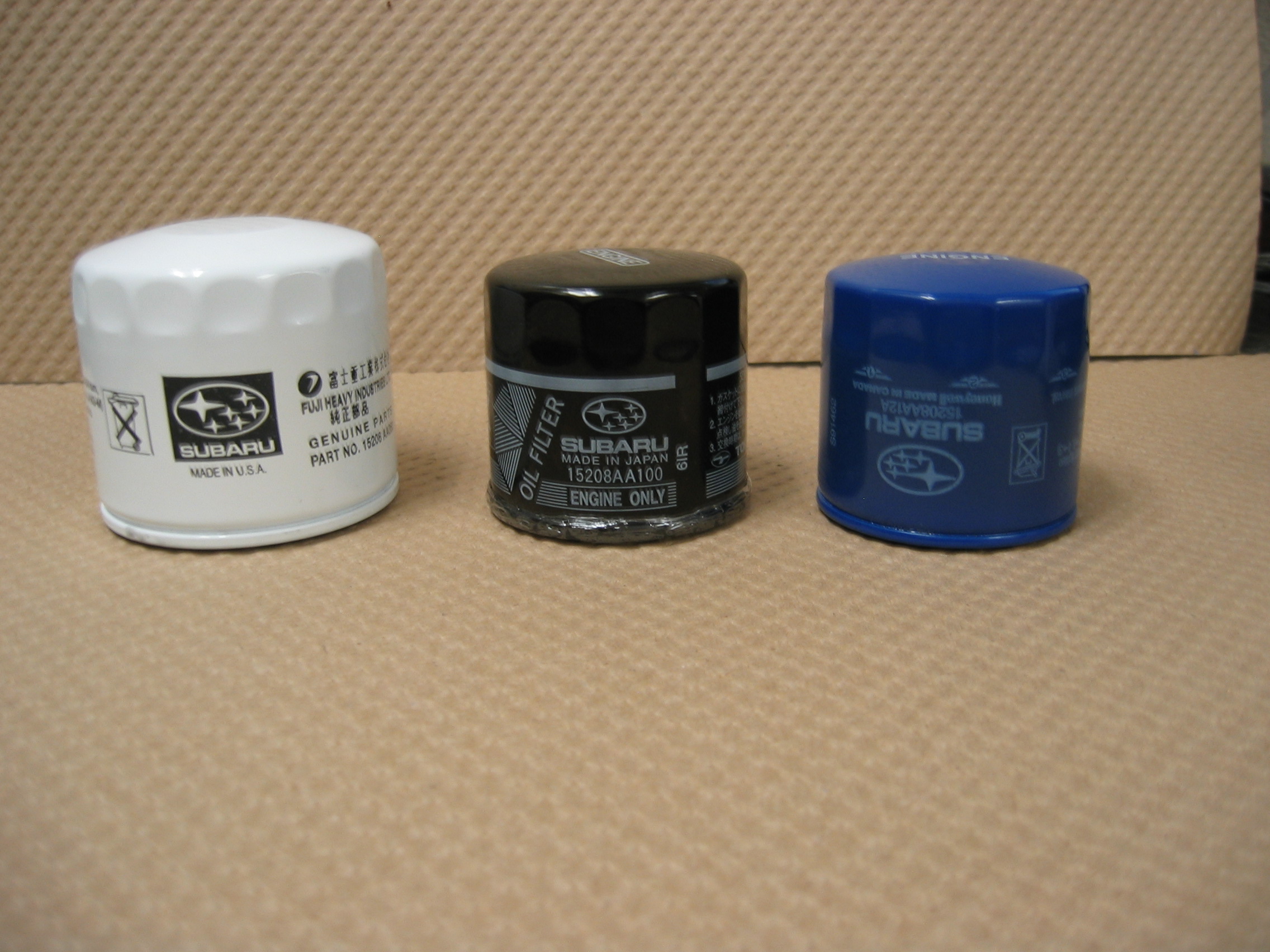
Pictured below are the last 3 oil filters used by Subaru for the 4 cylinder model. The black one in the middle was first used on the 2002 WRX turbo models, the reason for this is the Turbo models exhaust system runs very close to the oil filter and it was necessary to shrink the filter down to keep the oil filter from getting to hot and thus increasing the oil and engine temperature. Here is where things have gone from there, we used to install the black filter on the turbo models, the white filter on everything else except for the H6 and the Loyale. Then Subaru dropped the white filter from production, but wait a minute any one can see the white filter is bigger! The oil filter now used by Subaru on all 4 cylinder models is the blue one, which is even a little smaller than the black one and yes still much smaller than the white one that was used on your non Turbo model Subaru for years. I also want to point out the location on the engine for the oil filter on the 4 cylinder Subaru models has not changed since the Legacy came out in 1989.
If you own a Turbo model Subaru and don’t change your oil and filter at least every 4,000 miles you will most likely buy a Turbo or worse an engine, this is the current theme in the 2005 and newer Legacy GT, Forester XT and Outback XT models.
Before there is any argument about synthetic oil and oil analysis, the oil filter used by Subaru is very small and will not last the 7,000 miles your synthetic oil may last, oil analysis has no way of catching the slow clogging of the oil feed line to the turbo. Damage from extending the oil changes can happen very gradually over time or can ruin your trip in mere seconds and be very costly.
If you change your oil twice a year versus 3 to 4 times a year you will save roughly $800.00 over a ten year period. The bad news is you will most likely buy a Turbo and the Turbo will cost over $1200.00, just for the part! Add to that labor, gaskets and the possibility of the Turbo damaging the Engine just for fun.
If you own a older model Subaru (pre 2005) and the dealer is now installing the blue filter you are now cutting the filtering capacity and oil capacity down from how it was originally designed, and if you exceed the ability of the filter to filter, it doesn’t filter and contaminants in the oil will circulate around in the oil rather than be caught in the filter, this is done as the filter becomes restricted by the bypass to protect the engine from ever being starved for engine oil.
Subaru changed the exhaust lay out of the header pipe in all of their four cylinder models to resemble the Turbo models and now all of the 4 cylinder models have the exhaust system running very close to the oil filter rather than on the turbo models. So all current production models get the small oil filter as such there is no need for Subaru to keep making available the bigger oil filter even if it would be more beneficial to your 2004 Outback or your 1992 Legacy.
At our shop we use the Blue filters on cars still covered under A Subaru warranty to just keep things simple, and try to explain that the ramifications of going to long with the little blue filter won’t show up until the car is out of Warranty and its all your car. We install a large oil filter on models that don’t have a turbo or newer exhaust system. For turbo and 05 and later models we use a filter closer in design to the black filter as the Blue filter leaves a lot to be desired and anyone (minus the engineer who designed it) when holding the blue and black filters in their hands side by side will agree the quality of the filter is just not the same as it used to be.
The good news is Subaru did lower the price of the blue filter a little.
When I see things like this I will always try to find a solution to deliver more value than just going along with a corporations desire to cut costs. While I will also never claim to be as clever as the engineers, I will also never lose the argument that reducing oil capacity and filtering capacity is a bad idea. I kind of seriously doubt accounting ever consulted the engineers anyways.
Thanks for reading
Justin
Is there any reason not to use the H6 filter 15208AA031 on an FB25 engine instead of the 15208AA15A?
Hey Gulzeb,
Physically it may fit, but the H6 filter utilizes a different Anti Drainback than the 15A. You might starve the chains for oil on start ups after it has sat. I have not tried this becuase we use a better version of the 15A at the shop.
-Justin
Hi,
What oil filter should I use for a 93′ Legacy 2.0 ?
Hey Miki,
The ones we sell here
https://awdautoparts.com/product/1990-2004-2-2l-2-5l-six-star-subaru-oil-filter-3-pack/
Hi Justin,
98 RS 2.5 USD what was the first original oem subaru oil filter part number?
15208AA060
Hi Justin,
Which oil filter should I order for a 2021 Crosstrek?
Can you update the oil filter page with this info?
Thanks for the great info.
..Mike Smith
Hey Michael
Yes I will do.
Thanks
-Justin
Hi Justin,
Which Six Star oil filter fits an FA20D in a 2021 Crosstrek?
Any chance of updating descriptions on the Six Star oil filter page so I don’t waste your time with silly questions? 😉
Thanks for your time; you have an informative site!
..Mike Smith . Silver Spring, MD
Hey Michael,
15208AA15A and yes we should have that there, will work on when I can.
Thanks
Justin,
We recently purchased a 2014 Subaru Forester base model with 67xxx miles. What recommendation do you have for engine oil brand and oil filter brand? I’ve been using valvoline recently in some Toyota’s and Castrol in some older subarus (80s-mid 2000s). Think this one was serviced with magnatec and a cheap filter. Any thoughts on oil brand or filter brand(fram supertech wix OEM etc)?
Thank you
HB
Hello Hb,
In your Forester we would use the Six Star oil filter. https://awdautoparts.com/product/2011-2017-2-5-2014-2017-2-0-forester-2012-2017-2-5-leg-outback-2012-2016-2-0-imp-xtrek-2012-wrx-2-5-six-star-oil-filter-3-pack/
As far as oil, we are using the Indemitsu, but Valvoline, Castrol, Motul are all decent options as well.
Hope that helps
-Justin
Justin,
I appreciate the reply and the link. Thank you for all you do. Have a great day.
Thanks
HB
Good Morning Justin.
I own a 2015 legacy 3.6R. What filter do you suggest. It has 71k miles and due for next oil change soon . Thanks.
Hello Neil,
This may be to late to be of help, I had a Back end Website issue I had to have help with before I could reply to any Posts. Anyways the Tokyo Roki filter sold by Subaru is the best choice for all H6 Subaru’s.
Thanks
-Justin
First time owner of a 2017 Subaru Forester 2.5 which is just out of warranty. What filter would be a good choice to use long term for the diy person and if you stick with major brand OW-20 full synthetic, is there much difference between them? Current filter is a 15208AA15A.
Hello Jeff,
I would suggest these filters available at our Online Parts store for Subaru’s. https://awdautoparts.com/product/2011-2017-2-5-2014-2017-2-0-forester-2012-2017-2-5-leg-outback-2012-2016-2-0-imp-xtrek-2012-wrx-2-5-six-star-oil-filter-3-pack/
These filters are more akin to the Tokyo Roki Filters found in Japan.
As far as oil, Id suggest like you mentioned to just stick with the name brand oils. Look for Dexos certified.
Hope that helps
-Justin
Hello there,
Great write-up! I completely agree with you, in order to reduce costs and produce more, they are sacrificing quality – very sad! We have a 2016 Crosstrek , bought brand new, 38k miles on it. I have been using the Blue filter so far..change it every 3,5-4k miles. I am about to switch to 5w30 full synthetic oil and also came across a couple of 15208AA160 Black oil filters, very reasonably priced, in fact same as the blue one. Since the information online is so overwhelming, i would appreciate if you give me your professional opinion if that -AA160 black filter could be used on a Crosstrek 2.0i FB20B (I believe)? If bypass valve psi matches with the blue one and fit in general? Thank you i appreciate your time
Hey Diylan,
The AA160 was superseded by he 15A. If you found some old stock AA160, there is no reason that you cant use them.
Hope that helps
-Justin
So what filter is recommended for a 1997 outback ?
I’ve got 180k kms on a recent engine replacement. My shop told me that I should be switching from 5w30 to 10w30 because of oil consumption i pointed out. Using about 500ml/1000km with all highway driving.
If that makes any difference.
Hello Justin,
I have a 2013 Subaru Impreza Base 2.0L non turbo automatic with 18,000 miles. Since I am out of the 3 year warranty period, I have changed my oil and filter myself and used a high quality aftermarket filter that has wire backed, full synthetic media and says it lasts for 15,000 miles. However in reading some posts, I understand that the Subaru OEM filter for my vehicle has a 23 psi differential pressure bypass valve setting. However my high quality aftermarket filter seem to have a setting around 10 – 12 psi. Am I damaging my Subaru engine by using this aftermarket filter with a lower than OEM spec bypass valve pressure setting?
Do you sell to the larger and better black Subaru engine oil filters for my Subaru that you have posted about? If so, how can I purchase them?
Thanks so much for all your wonderful insights. You have helped me learn so much about my Subaru.
Doug
Hi Doug,
We don’t as of right now offer a larger filter for that application, but we are working on it.
Thanks for the feedback and I hope you continue to enjoy your Subaru.
-Justin
Hi Justin,
I’m just up the I-5 from you in Vancouver BC. A couple of weeks ago I bought a ’98 JDM Impreza WRX STi wagon. I’m a complete Subaru newb, but I’ve been intrigued by these cars ever since I was taken for a blast around the autocross pad a few years ago in a fixed up early 2000’s WRX.
I’ve read an awful lot about the oil filter controversy surrounding these cars… black vs blue etc. I’d like to use the largest quality-filter that’ll fit. There’s currently a regular Fram filter installed. I want to get it off of there. What oil filter would you recommend for use on this factory original turbo-charged EJ20K engine?
Thanks.
Hey Patrick,
Check these out
https://awdautoparts.com/product/2010-older-subaru-oil-filter-for-turbo-engines/
-Justin
Hi Justin,
Great article!
You guys actually know your stuff! (been a mech for many many moons)
Question on the filter sizes. My 14, and 16 XT foresters have the filter up front now, and everyone (dealers) is putting the blue little filter on it. Is there a larger filter that I can put in it’s place since its out in the open? Would you “recommend” the RX-8 filter for more filtration? therefore longevity of oil? They’re all .5 microns, the anti flow back and pressures to bypass are different I believe..
Mobile 1 vs Idemetsu?
I did this with my old Danger Ranger and put the ’87 size filter on it instead of the ’05 tiny thing. its sitting at 330K
and Heads up.. if they break after warranty, they’re coming to you !
Derik
Hi Derek,
While the car is still under the 5 year 60k Power train warranty I would use he Subaru Filter. I know…
Same thing with the oil, its just not worth the risk if there is an issue,and the Idemetsu is good oil by the way.
-Justin
Justin,
Hey man thank you!
I forgot it was 5/60, I was thinking 3/36… but that also puts a *&!! in the mix. Okay, I’ll stock up on filters, and do a 2500 swap on them and top off the oil… grrr…
And thank you so much on the Oil.. huge fan of M1 and until recently hadn’t heard of the Idemetsu… You folks are the experts on Subi’s so I’ll take your word ( For now 😉 LOL)
Great stuff !!
Derik
G Day Justin from down under great page mate hey are you familiar with Subaru Genuine Part 15208AA160 which is off a current model impreza its just like the black 15208AA100 from above but taller, more oil capacity for the turbo models. Questioning if i should keep using the standard black AA100 or the switch to the taller AA160 on my 03 EJ25 Turbo Forrester.. Service is almost due again now 🙂 Thanks
Hello Zac,
In the U.S. the AA160 was superseded to a 15A, I see no reason why the 15A cant be used as the bypass appears to be the same as the 12A which is the superseded Part number for the AA100. The superseded part numbers are a SOA (Subaru of America) thing only, I am glad to know that the good filters are still available to you in Australia.
I just picked up a 2005 GT with a blown engine and had planned on running the 15A over the 12A once I am done rebuilding the engine.
-Justin
I have been reading and reading and i am still very confused about whether or not a bigger filter will help in feeding oil to the turbo better. My 2005 Legacy 2.5 GT has 150k miles and it has a brand new turbo which is now about 6-7000 miles old. I really want to maintain this vehicle and avoid any problems. Any advice will be greatly appreciated! Thank you
Hello Raymond,
The filter we use has more filter media than the one currently offered by Subaru, out side dimensions are almost identical and are limited in size to the placement of the exhaust around the oil filter.
A good quality filter is whats needed and the understanding it needs to be changed every 3000 miles.
Justin
Thank you
Bought a 2014 Forester. I drive abt 10,000 mi per yr. Sold a 2000 Honda w 140k mi & have an RV – Ford – V10 engine with 80k mi. For the last 10 yrs I have used Amsoil and K&N filters. Changed oil and filter every June. Can I do that with my non turbo engine? Neither vehicles use any oil (each are down 1/2 way on the dip stick). Neither vehicle vehicle driven hard.
Over the years I’ve done a fair amount of cutting apart of oil filters. I found that the media and various small oil filters actually hold up very well at 7500 miles. I’ve run extensive test using plasma spectrometer’s and other methods for determining how many impurities are left in the oil and whether the additive packages continue to hold up.
What we’ve noticed over time is that the mobile one oil filters do a very good job with filtration and they absolutely hold up at 7500 miles.
In the 2013 Subaru outback, the manufacturer recommends that you change the oil every 7500 miles. The exception being the first will change should be about 3000-3500 mile interval and the second one should be at about 7000 mile mark.
No manufacturer would recommend that you change the oil in 7500 miles intervals unless they were absolutely sure the lowest common denominator would actually be able to properly filter the oil.
Interestingly, it turns out that fram tends to make many of the oil filters you see out there even the mobile one. The primary difference are the specifications of the filter the manufacturer that has requested to fill made. I can’t stress enough, that in real-world usage the reality is the oil filters actually and work without problem and filter well past 7500 miles.
There is no doubt that even the cheapest motor you can generally find in United States, will actually well at outperform the filters that you put your car.
The real issue is a question of whether the oil is being filtered and if the additive package in the oil itself is surviving long enough. It is very very rare to find any oil that has not been so seriously cleaned up and Hydro cracked to the point that it is almost indistinguishable from some of the polyalphaoliphin or ester-based synthetic oils.
I am not sure I understand where you are trying to go with your reply.
The point of the article is to help explain that the Quality of the Replacement part offered by Subaru is not of the same quality as the one that came from the Factory, interesting that you mentioned the 2013 as I am sure you are aware the 2013 Subaru engines use the Tokyo Roki filter and not the Honeywell filter. The larger Tokyo Roki filter used on the 2013 Outback may be capable of going 7500 miles, I will post when I have evaluated enough of them, by merely looking at the state of the Bypass and the filter media. I will leave the “Plasma spectrometer’s” tests up to those that want to add a certain level of complexity to something as simple as oil changes and oil filters.
Rather than be dragged into yet another oil change interval argument and type of filter with another non Automotive professional I will decline, as I have stated enough facts on this Website already.
I respect the time you have taken to form your opinion, but know that anything other then maintaining your Car based on how you use it is incorrect.
Some can people can Drink and Smoke all the way up until they are 100 years old, others wont make it out of their 50’s with that type of lifestyle. Who is right?
Justin
P.S. I don’t know if it makes any difference, but I have been using 20/50 dino oil and changing my oil 4 times a year (non turbo model, no snow here in S. Calif.).
Hi Justin,
Thanks for all the valuable info. and your dedication to the Subaru public!
I have been using the Purolator Pure One filter in my 2000 Legacy OB, since it seems to be most like the O.E. equipment that Subaru used to carry for my vehicle. Do you have any thoughts about this filter? While not the most widely distributied, I am usally able to find them with a little digging around. I wish someone would do an analysis of the various brands in comparison to the O.E. filter. Fortunately I haven’t had to try it, but Purolator does offer a ‘in case of failure’ warranty.
Thanks,
-Mal.
Hi Mal,
Purolator used to make the replacement filter for the H4 engines up until the Turbo came out in the 2002 Impreza WRX and Subaru dropped the larger filter from stock.
The factory Subaru filter made by Purolator had a o-ring type seal VS the one you are buying the last time I checked still had a Square cut seal.
Justin
We found that the best filter to use on Subarus is the one specified for the 2009+ Mazda RX-8. It is 100% compatible with the Subaru thread pitch and has both a better filtration media spec and larger oil capacity by several ounces.
The older style large Subaru filters are still available from Blank as well, but the filter media spec is actually inferior to the new Subaru filter. The filter media area is larger so it has more capacity for dirt and will last longer, but the new smaller filter does a better job of filtering when new.
51334
3.194″ height
3.252″ diameter
0.45 quarts based on exterior dimensions, but probably only holds closer to 0.40 quarts
Beta 2 test: 50% of >=22 micron particles catpured 1st pass
Beta 20 test: 95% of >=40 micron particles captured 1st pass
Standard OEM size for older 4-cylinder and all 6-cylinders; won’t fit most newer 4-cylinders due to updated exhaust system
Has more oil capacity than 51365
OK filtration.
51365
2.577″ height
2.685 diameter
0.25 quarts based on exterior dimesions but probably only holds closer to 0.20 quarts
Beta 2 test: 50% of >=15 micron particles catpured 1st pass
Beta 20 test: 95% of >=22 micron particles captured 1st pass
Standard size for newer 4-cylinders.
Good filtration.
51356/57356
3.402″ height
2.685″ diameter
0.33 quarts based on dimensions, but probably holds closer to 0.25 quarts
Beta 2 test: 50% of >=6 micron particles catpured 1st pass
Beta 20 test: 95% of >=19 micron particles captured 1st pass
Not a standard size for Subaru, but should fit all 4-cylinders and 6 cylinders. Installation may be a little more difficult on 6-cylinder due to the length.
Best filtration.
It is actually unwise for a repair shop to ever use a filter that isn’t specifically listed as the correct filter for the given vehicle, if something were to come up the shop could be on the line for thousands and thousands of dollars worth of mechanical engine repairs and no recourse as the wrong filter as per application in cataloging was used.
The H6 also requires an anti drain back valve and I don’t see that specified in your specs, with out it the timing chain and guides will suffer greatly.
I do sincerely appreciate the effort you have put in, but would caution that sticking to the O.E. type filter offered by Six star is a better way to go, as its specified for the Subaru.
Thanks
Justin
Hi Justin,
I understand your position, and that’s probably the best advice for a shop to give.
However, all those Wix filters, especially the one listed for Mazda, exceed the Subaru OEM specs in every category. They all have the anti-drain-back valve (even though they are 100% useless on 4-cylinder and of limited utility on the H6 where the filter is horizontal.)
Just because Wix neglected to mention the Subaru as a compatible vehicle on one of their filters wouldn’t change implications for warranty. For example, for Subaru to deny powertrain warranty claims simply because you used a different filter would violate Magnuson-Moss. If the filter fails due to manufacturing defect, Wix would still have to cover the warranty claim. There is nothing special about the Subaru engine that would make it incompatible with some other filter. That’s why there are SAE design specs for filters. And these filters fit the bill.
Like oil brand, it probably doesn’t matter which one you use as long as it meets the specs. Most important is just doing the maintenance regularly.
Cheers,
Dan
Dan,
I don’t really want to be drawn into an argument but do want to provide you with some life experiences.
Oil filters have part numbers, if you use a non specified part number you are assuming the risk not WIX or any other company for that matter.
I have been involved in several situations where a part that wasn’t specified for the application was installed and there is NO recourse what so ever, what many do not understand about the Magnuson-Moss act is that it is up to YOU to prove the part did not cause failure, in many cases the aftermarket parts vendor will assist you in this if you are going up against an OE who claimed an aftermarket filter caused an engine failure for example. If Subaru says NO warranty you are the one who has to fight, not Subaru, until you get a court date and ruling in your favor. If you think any company will go to bat for you when a non specified part was used, I am not saying aftermarket VS OE I am saying a part that is not listed for the application was used, I am sorry to say this but I have never seen or heard of such a thing and feel it is much to risky when there are plenty of good options listed for the application by other vendors.
Justin
If you uses a part not specified for the vehicle you and you alone are on the hook for any issues. I can argue this point for days and weeks with you and it probably wont matter you have your own belief system.
I work in the industry and have for longer than I care to comment. I have been an expert witness in court many times on both sides of warranty issues back in the 90’s when this was common. I have seen rulings handed out by judges and seen cases not even be allowed to be heard based on application errors.
If you feel this passionately about the WIX filter, I suggest you call WIX and have them add that part number to the compatibility chart for your engine and until you have the backing of the manufacture understand its your opinion only regardless of where or not you feel you have data to back up the claim.
By the way if you use an oil filter on a H6 and it doesn’t have a anti drain back valve you will buy timing chain guides, the anti drain back valve is not of limited utility just because the filter isn’t mounted like the current era H4 engines.
Justin
Thanks Justin. I didn’t mean to come across as argumentative, nor did I mean any disrespect. Your dedication towards educating Subaru customers via this website and your business speaks volume. You’re absolutely right about the warranty stuff and everything else.
Dan,
Thank you for your reply. Whenever these types of things come up I always have to factor in the diverse group of Subaru owners, and really just dont want to put anyone in a situation they may not have success dealing with if there was ever an issue.
Thanks for posting, I am always here to help
Justin
Recognizing the very limited life of Subaru oil filters, if good quality synthetic oil is used, does it make sense to change the filter every 3,000 miles and to change the oil every 6,000 miles? Or does the oil need to be drained before removing the filter?
For those interested, the Union Sangyo is still available and is a very high quality filter. It is the same size as that originally supplied by Subaru up through at least 2006.
FWIW, I’m not sure I buy the thing about a larger diameter filter causing the oil to run hotter due to its proximity to the exhaust header – the oil is already running through an engine block that is at least that hot.
Hi Tom,
So one of the first things you will learn about the Internal combustion engine at an automotive technical college such as UTI or WTI is the single highest point of temperature will be in the Exhaust. Engine oil on a normally aspirated engine is about 220 degrees Fahrenheit. Where as the exhaust will run in temperatures over 500 degrees and the Catalytic converter has to reach 600 degrees to reach its critical point of light off. Subaru moved the primary catalyst closer to the cylinder heads to increase the catalyst function. By locating the Catalytic converter closer to the cylinder heads where the exhaust is just leaving the combustion chamber an is at its peak temperature they have in fact decreased the likely hood that the converter will cool down due to a rich fuel mixture while climbing a hill, it has also shortened the time that it takes for the Catalytic converter to reach the light off point so the Catalyst can effectively happen earlier in the drive cycle. The oil filter on a Subaru sits just adjacent to the right side header pipe, and since mid 2005 the catalytic converter was placed just below this rather than post right side drive axle. The oil filter was decreased in size to accommodate the change in Catalytic convector location and higher exhaust temperatures maintained closer to the oil filter location than previous on the older design (up to 2005). You would have a situation where the oil filter would pick up the temperature being radiated from the exhaust on 3 sides of the oil filter rather than just one side as before, the oil flowing though the oil filter would thew the hot spot in the oil system. The flash point of old motor oil can be as low as 400 degrees as its diluted with fuel from the combustion process.
We have in fact conducted tests and the oil temperature climbs as much as 50 degrees with the oil filter ” touching” the exhaust system.
To try and further explain to you, the cylinder liners in the engine have oil and coolant flowing around it, the oil is one third of your engines cooling system. The idea is to keep the liner and block temperature closer to 212 to 220 degrees and “maintain” that temperature. If the oil or engine coolant is allowed to reach temperatures above the normal range major engine damage can and will occur. The explosions that happen in the combustion chamber create a lot of temperature, at higher rpms and under load temperatures can well exceed 1000 degrees, if you don’t’ buy it install a Pyrometer and go see for your self. What keeps the whole thing from melting down is temperature control.
I am sure you meant no disrespect in the “I don’t buy it” statement, but you know what? It comes across like somehow you think you know more about a profession I have spent my entire working career in there is a lot more to it than you may realize and it starts with some sort of formal education to be a professional.
The best thing about facts are:
They are true whether you “buy them or not”
Justin
If you look at the specs for the LGT turbo oil filter on say, Purolator or Mobil 1’s web site, with a little digging, you will find that Honda/Acura V6’s use a filter with the same thread, same pressure relief psi, and same diameter, but longer, i.e. bigger. I am still digging for an even longer one.
Hello Dan,
Yes that sounds correct, Subaru has Always used a good filter on the H6 for fear of premature timing chain and component wear.
Justin
Hi Justin,
I wonder if it is OK to use 15208AA031 filter on EJ25, H4 engine on a 2010 Impreza. The filter fits fine without any issues and I do not think that it is too close to exhaust manifolds. My only concern is whether this filter causes an extra pressure drop due to extra filter material, however, I do not think it could be as the bypass pressure for this filter is also the same as 23PSI. So, I would like your input on using H6 filter on Gen 3 Legacy and 2010 Impreza.
Thanks.
Hello Prlya,
As I have stated before, if YOU put something on your car other than what is specified by the Manufacture you are really taking a large risk that is unnecessary.
15208AA031 Has an anti drain back valve your model doesn’t call for as the H6 models have a sideways mounted filter and the anti drain back feature helps limit the potential for un primed engine start ups this is because the timing chain guides will wear out on dry start ups and are quite costly to replace on the H6 models.. Using a filter that is equipped with an Anti Drain back where it isn’t called for could create a problem delivering oil.
I you want to go to a better Oil Filter You can look into the Full brand, its made in Japan and a good choice over the Blue Subaru / Fram filter.
Hope that helps
Justin
Hi Justin,
Thank you for the reply. I have a couple of questions on your reply.
(1) According to literature (eg. https://www.subaruoutback.org/forums/104-gen-4-2010-present/41457-sorry-oil-filter-question-again.html), 15208AA12A does have an anti drain back valve. So, blue Subaru filter is similar in construction to 15208AA031, with less filter media. The less filter media may cause less pressure drop and better oil flow at the expense of filtering. That is my concern.
(2) Do you know the bypass valve opening of Full filter that you mentioned? Without that information, I would be not use that filter as almost all aftermarket filters have low bypass valve pressure ratings, which means less filtering and more dirty oil.
(3) Does the full filter have an anti drain back valve similar to 15208AA12A and 15208AA100?
If you say yes I would like to use full filter as an alternative to 15208AA12A, otherwise WIX 57712 is a better alternative.
Thanks,
Priya
Hi
The Ful and Six Star filters are identical to what Subaru used to offer before switching to the Blue Honeywell filter. Bypass valve is exact, not meets o.e., there are some pictures in a post on this site showing the filters cut apart.
I don’t really want to get drug into the type of discussions often found at forums, some of what I read in the link is non factual and I will leave it at that, if you are comfortable with the Wix I am sure it will work just fine for you.
Thanks
Justin
I’m trying to determine the correct filter for my 2006 LL Bean Outback (H6). When changing my own oil I have been using the 15208AA031 specified by the local dealership and also an Subaru dealer on-line source. My previous oil change was at a Chicago area Subaru dealership and today when I changed that oil I discovered that they had fitted a 15208AA130 though the invoice for the job listed an …031 (both are
Tokyo Roki, black) (their invoices for previous changes sometimes also list the …12A).
I noticed that the …130 had an anti-drain back valve of the rubber type sealing the 5 fill holes where-as all seven of the remaining …031 I have on hand have nothing against the fill holes, I just see metal a bit farther down. In your March 26, 2012 9:42PM reply above to Prlya you stated that the …031 had an anti-drain valve, stressing the importance of this feature to the H6. Is the …031 anti-drain valve located internally out of sight, has the feature been eliminated in newer production, was it left out by error, or did you error in stating it had one? If the .031 indeed does not have the valve, can you recommend another PN or model? I presume my H6 would benefit from the valve. Best regards, ks
Hello Kenneth,
The correct part number is 15208AA031, always has been, and always has had an anti drain back feature as its mounted sideways on the engine, if it didn’t the oiling system would loose partial prime and one of the reasons we don’t suggest aftermarket filters on the H6 as the engine will suffer premature timing chain and or chain guide failure.
Next the oil filter 15208AA030 doesn’t belong on the H6, it has a different style anti drain back as it’s mounted upside down on the FB series engine.
So if the Dealer installed the wrong oil filter they are clearly in the wrong. if they actually ever installed a 15208AA012A oil filter they made a huge mistake as it does not have a anti drain back feature.
The only entity in error is the Subaru Dealership for installing anything other than part number 15208AA031 which is what every H6 engine since 2001 has required.
Hope that helps
-Justin
Justin,
I am under the impression that for the 3.6R 2010 OB I should use the black filter number 15208AA031. Does that sound correct? Thanks
#15208 AA60 Please let me know when this filter will be available, I like the fact that you take PAYPAL, Thanks and keep up the good work.
Dear Justin
Do you have any recommendation as to what brand an model number I could pick up at an autoparts store?
Thanks for your time
Colton
Great explanation about the oil filters. There are 4 Outbacks in our family. Recently I researched K&N oil filters for the Outbacks as I had read that they produced a quality product. I was surpised to see different listings for the years ’00, ’01, ’04 (all 2.5L engines). Here are the specs”
’00 ’01 ’04
Height 76mm 73mm 87mm
Outside dia 80mm 68mm 80mm
relievf valve ?? 11-17 11-17
drainback valve no yes yes
Also ’01 3L engine, takes the same filter as ’04.
If bigger is better, I am comtemplating using the largest filter which is the listing for the ’04, on all the cars. What do you think?
I just had my ’05 Legacy serviced at your shop today. Thanks for the great work. Is this why the published oil level in the owners manual is less than it was in my former ’98 Outback?
Bruce and Gary,
The oil filters we use are imported from Japan and made in Thailand. They are basically the oil filters that are used in the non U.S. market which is a pretty consistent theme for how we buy our parts. Like The U.S. turns to Mexico, Canada and now China for much of its parts production Japan uses Thailand and other countries as well.
Unfortunately U.S. based companies such as Fram (Allied Signal) have such a strangle hold on the aftermarket parts channels in the U.S. it makes it really difficult to source out the best parts possible as a consumer. The places we buy our parts from do not have a retail side to them at all, they are all strictly wholesale.
As far as brand they are private label, and not available for purchase in normal retail outlets. We are going to sell the filters we use under our parts page in the weeks to come.
The part number is #15208 AA60
Justin
justin:
i have just bought a 2016 subaru impreza completed my first oil change with my last tokyo roki 15208aa160 which is also the filter that came on the car from the factory(i bought 12 when i purchased my 2012 impreza).
Anyway what filter would you put on my car if I came in for service? i would assume the blue 15208aa15a being im under warranty, however which would you put on after the warrany expires? you can email me
or text me at ….listed as my website thanks
bryan
Hi Bryan,
For the cars out of Warranty we are using a Full or Nippon filter for that application.
Hope that helps
-Justin
Interesting, and kind of disconcerting, article, Justin. Thanks for the info.
Would you please be more specific about what oil filter you now recommend and use for an out-of-warranty 2003 4 cylinder (not Turbo) Outback Wagon? Such as: manufacturer, and model and/or part number? Thanks!
Hey Justin,
Thank you for the great article above. Great timining since my mechanic and I were just discussing oil filters the other day. What’s the low-down on smaller filters increasing oil pressure, and if they do is it a go thing?
Your article mentioned “We install a large oil filter on models that don’t have a turbo or newer exhaust system.” Would you mind giving out the brand and part number of this larger filter?
I live on the east coast so using your shop for repairs isn’t likely. However, I would like to thank you very much for all the repair information on your site. This has been a great help to me and my mechanic (small independent shop) as we try to keep our three againg Subaru’s on the road in top shape.
Thank you again,
Bruce Brown
Le Roy, WV
95 Impreza coupe 200k
95 Impreza wagon 193k
96 Outback 201k