Why Does My Subaru Use Oil?
For this article I am focusing on oil consumption and not external leaks from the engine, meaning if you check your oil, find it low, it’s not due for an oil change and there are no major visible leaks found with your engine, than this article applies.
If you’re a good car owner you DO periodically check your oil, I suggest every other tank of fuel, but it’s actually suggested by Subaru to do so every tank of fuel.
Why is this important? Over time the internal components of your engine such as the piston oil control rings, valve stem seals, valve guides and cylinder walls can all wear to the point where more oil is actually introduced into the combustion chamber than originally designed. This is a completely normal thing to happen in an internal combustion engine, and as long as the engine isn’t repeatedly ran low or worse out of oil, it won’t really affect the performance of the vehicle. As the engine ages it will reach a point where the piston oil control rings can no longer expand enough to slow the consumption of oil, the engine wears a little, every day you use it. Just like the more you walk in your shoes the quicker the bottoms wear out until one day your foot is wet, one day you will check your oil and it will be low where it hadn’t been before, this is the critical point in used vehicle ownership where staying on top of your maintenance aspects will avoid costly repairs, and not will mean a new engine. Some engines won’t use a drop of oil until the 2500 mile mark and then use a quart in a few hundred miles; this is mostly because of the dilution affect of the oil in the crankcase which I will address in a bit.
The key here is to know your car, and know the point at which it may use a little oil and stay on top of it! If you don’t check your oil how will you know if it’s low? Until the current era Outback limited models there has never been an oil level sensor on a Subaru. Prior to that Subaru used a low oil pressure light, but typically no oil pressure means the damage has in fact been done.
When I worked at the dealer we dealt with new Subaru vehicles that used some oil from day one, and unless it was more than a quart every 1000 miles there were never any warranty repairs authorized. As the internal combustion engine doesn’t achieve 100% combustion as its not 100% sealed it can never not use some oil as part of the combustion process.
Factors that can increase oil consumption are engines that don’t always reach operating temperature, vehicles that have “slow” front air fuel sensors or anything else affecting fuel trim allowing the car to have an excessively rich fuel mixture or problems with the 2 different crankcase ventilation systems. The flash point of your motor oil is one major factor in consumption the more diluted the oil is with unburned fuel the lower the flash point becomes, the easier it is for oil in the combustion chamber to be burned and head out the exhaust with the rest of the byproducts of combustion. What is supposed to happen is the un burnt fuel is designed to re enter the intake manifold and be part of the combustion process, but in order for that to happen the proper temperature must occur for oil vapor to separate from oil liquid. During the winter, stop and go driving and during short trips to the store this just doesn’t happen.
The key here is to be proactive and the more modern cars become the more detached we become of the simple everyday basic aspects of a car, the need to check the oil, the tires, the fluids and the bulbs will never really go away and while systems may be added to cars they are done with a price. An example of this is the low tire pressure monitoring system that adds about $500.00 to each new car now but was closer to $1000.00 just a few years ago.
You can have an engine that uses a quart of oil every 1000 miles and run like that for 300,000 miles as long as you don’t let it run too low repeatedly, or worse out of oil just once. Understanding your car is the only way to avoid costly repairs and life without your Subaru.
Pictured below is a piston from a 2.5l Subaru engine, the lower set of rings are the oil control rings and they are collapsed causing excessive oil consumption.
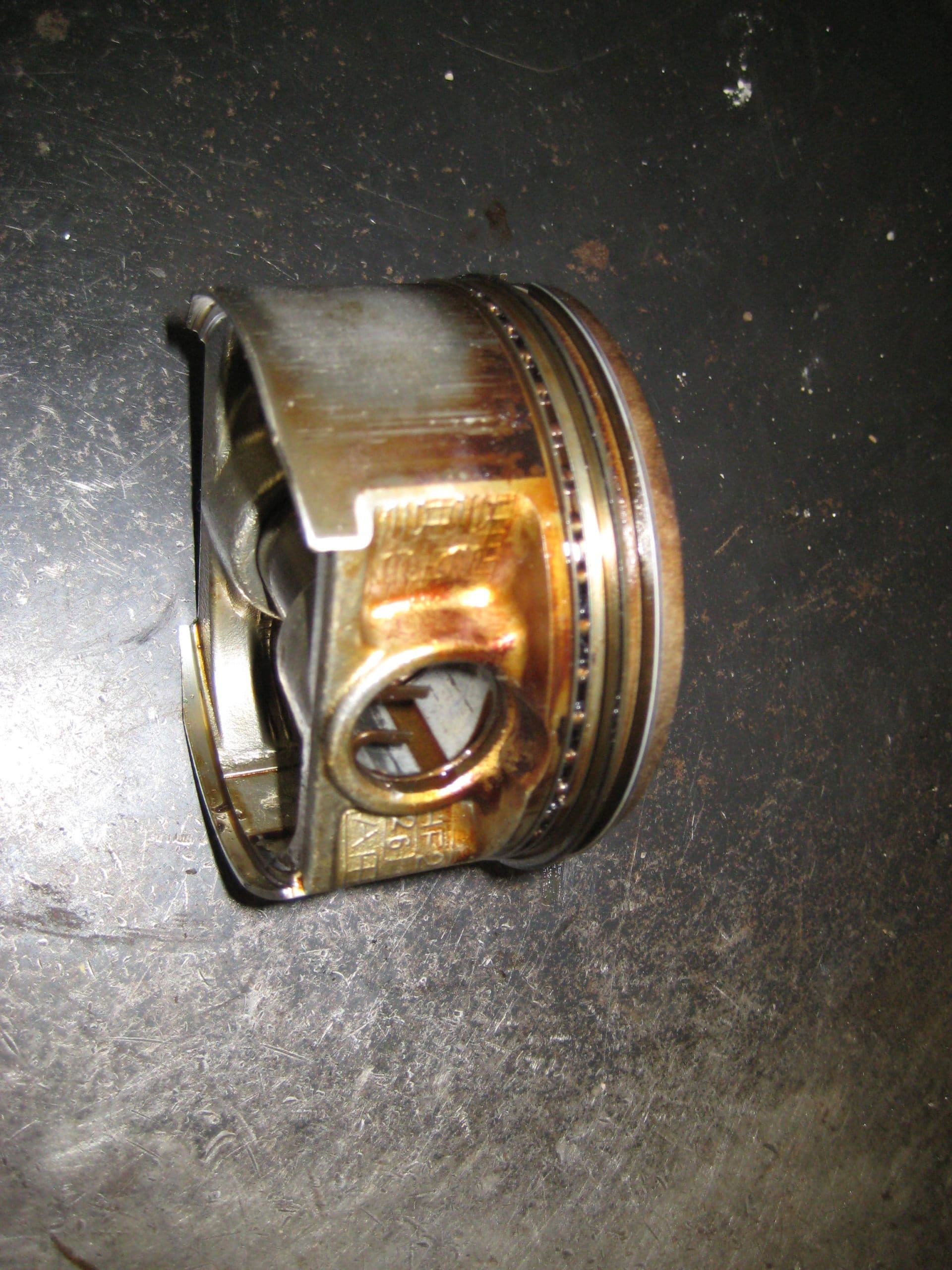 Subaru Piston and rings
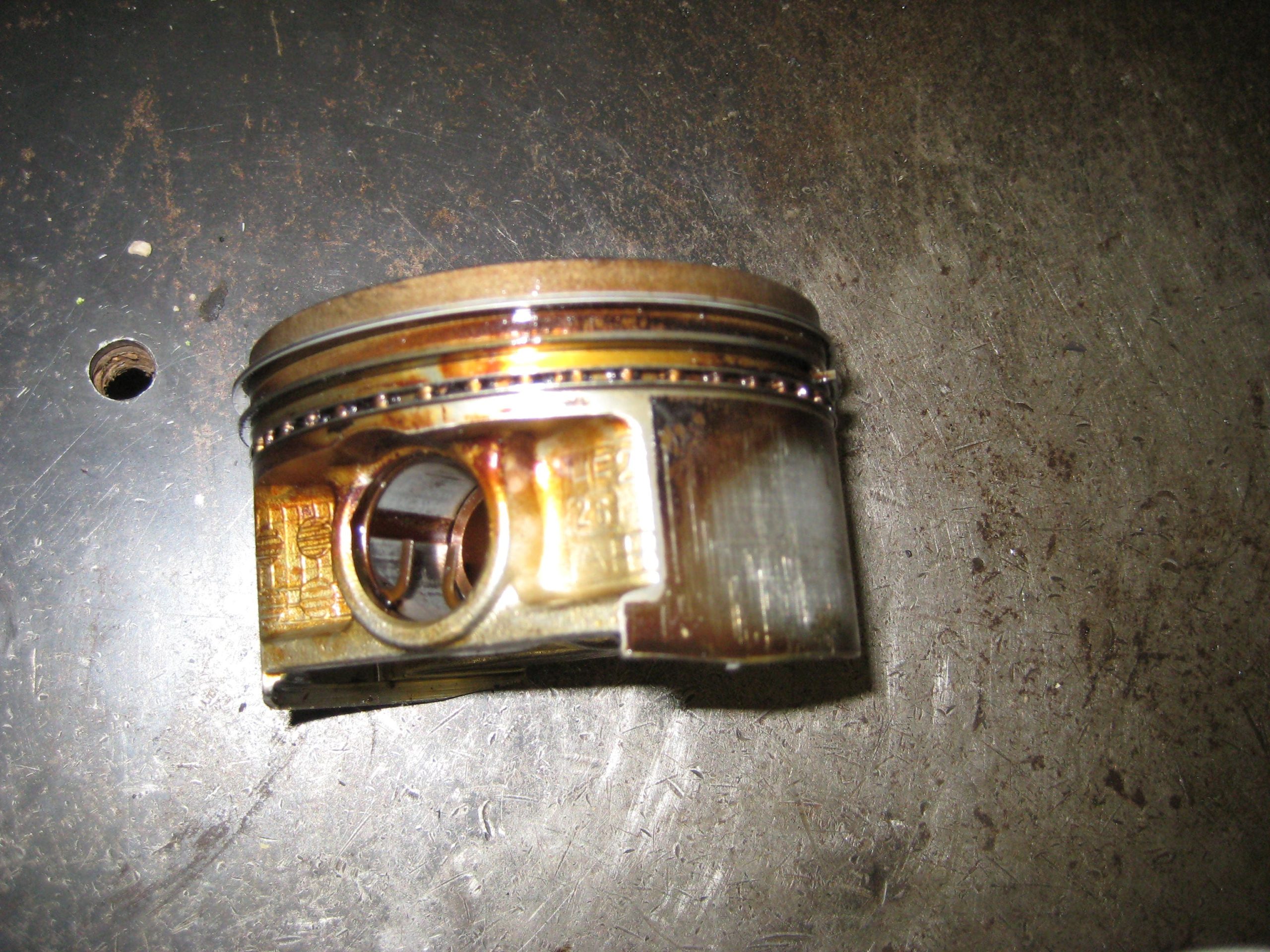 Subaru Piston and rings
Thanks for reading, and check your oil!
Justin
Update 12/31/2013:
As usual, my original intent with this article has been lost. This article is really about owning a vehicle that has some miles on it and never allowing a low oil situation ever to be anything other than a 2 minute inconvenience every so often and to never allow an engine to fail due to low oil levels. When I posted this 2 years ago what was not known was how many FB series engines would have a consumption issue from day one. We have helped guide customers local to us and even those who are not.
Here are some observations from the last couple of years based on comments from readers (even the mean ones), experiences we have had at the shop, friends and family members that own late model Subaru’s and conversations had with other industry peers.
Some FB series engines paired to a CVT transmission take longer to break in. The longer the break in period the better the chance its not going to be broken in properly and may not ever reach the proper seal we would like for the best fuel economy and low oil consumption. Oil consumption and fuel economy may improve once its broken in properly.
Subaru has made available different components, issued TSB’s and taken care of some cars under warranty that were deemed to have excessive consumption issues. If you have been denied warranty coverage and you feel like you are being treated unfairly you need to take that up with SOA. Keep in mind to any car maker the standard to which oil consumption is deemed excessive is when consumption is greater than 1 quart every 1000 to 1200 miles. You can read more here.
Something has drastically changed over the last decade with drivers that Subaru is going to have to consider and that’s how much the average driver does not want to check or add oil. Subaru used to be owned by a much different market, owned by mostly enthusiasts that has changed and Subaru will need to evolve as well. They did add the low oil level light in 2010 knowing that stretching oil change intervals out would lead to low oil levels in between oil changes.
The light itself has had some issues as well, typically with the low oil level sensor, this is a separate issue and is usually intermittent.
Info about newer model oil use.
//
//
Hi
I have a 2006 Subaru forester and I check my oil regularly. There will be times when it is a little low then a few days later there will be no reading at all on the stick. A few days after that it will be completely full without having added any oil. I always check the oil in the morning after the vehicle has sat all night and in the same place on flat ground. I make sure the dip stick is fully down and I am very consistent in checking the oil. The dilemma is that when the reading shows completely empty I don’t want to add a quart as I’ve heard overfilling the oil can be harmful to the vehicle. I’ve contacted numerous Subaru mechanics and dealers and they say it is impossible for the reading to go from empty to full without adding any oil – yet it is happening ??
Another issue that may or may not be related is that the car chatters (shakes) quite a bit when letting off the clutch. This has been getting progressively worse
The clutch, head gaskets, timing belt and water pump were all replace about 20,000 miles ago just prior to my buying the car
Any thoughts or suggestions
Thank you
Bill
Hello Bill,
You have to use a degree of patience when checking the oil on a Subaru. Start by watching this video https://www.youtube.com/watch?v=883QtCKZHaY
-Justin
I have been reading your info for a long time since I am into my 5th suby! I got a 2013 outback 2.5 inAug 2014 (11000 miles).Dealer stated to use that mileage as date for all service(oil /filter change). At 18500 I changed oil because I was leaving on atrip of 2500 mi.I checked the oil level at 22000 miles and found it at the bottom of the range so I added oil. On my previous Subarus I changed oil every 3500-4000 miles and never added any but I got the 1200 miles is normal story. I have 2 questions;How much oil is needed to take level from the bottom of the range to full ? Do you have any experience with owners getting good response on complaint or is this a dealer to dealer situation? Incidentaly, my older subarus had as much as 130000 miles and didnt require added oil.
Hi Bill,
1. Usually a quart
2. If it used a quart @ 2500 past last oil change, theres not much you can expect Subaru to do.
Older Subaru’s typically only used oil as a result of mechanical wear, and mostly to the oil control rings. Now its mostly an issue with the rings breaking in properly as a result of a light oil and lower average RPMS.
The problem facing Subaru and other car makes as well, (this is not just a Subaru thing) is the CAFE standards are almost unattainable we are using 0w20 oil to help fuel economy only, around the corner is 0w10, and 0w5.
I would continue to monitor the issue, if it gets worse before the 5 year 60k powertrain warranty then you should expect some help.
-Justin
Thanks for all of your knowledge sharing and advice! Enjoy coming to your site for information.
2007 Legacy Special Edition. 71,000 miles. HG replaced when leak was noticed. Thankfully Subaru paid for most of it due to my maintenance records and low mileage. Shop resurfaced heads at the time.
Prior to work, oil changed regularly. Never a problem. No oil use. Have done two oil changes since. Check oil periodically. No problems since. Very rarely driven. Oil has always been clean and amber, like new, when checked between changes.
Today the dipstick was dry. Took 3 quarts to bring it to Full.
Question: how low was it? Down to 1.3-1.5? Could the engine have been damaged?
Hi Matt,
That does sometimes happen, you didn’t mention how many miles it was when it was down 3 quarts since it was changed?
-Justin
Justin, thank you for your posts. I own a 2012 Imprezza with 30,000 miles. I don’t mind adding a quart of oil every 1,200 miles but I’ve been concerned about engine problems from what I thought was high oil consumption. I feel much better now that I’ve read your comments. Truthfully, I love my Subie…first one I’ve owned. I’ve owned two Hondas and the gearing and clutches sucked! My 5 speed Subaru shifts nicely and that is far more important to me than adding oil every 1,200 hundred miles. To be fair, I unfortunately drive in stop and go traffic most days so using more oil is to be expected I guess. That said, I take it out a few times a week and open it up and cruise at about 80. Damn this car loves 80 and my gas mileage at this speed is amazing! Further, this car feels solid and safe and handles very well. So, I am going to calm down about the oil use and continue to check my oil regularly. Also, I will try high octane fuel and see if that helps a bit. Thank you for taking time to help out the dumbed down masses understand how engines work…it’s tough, I know, but someone has to do it!
Justin
Thank you for this very insightful article and your comments – such a helpful resource.
If you don’t mind another question – we have a 2011 Forester, 45K miles, we’ve have oil changed every 5K and have generally kept up with the other recomended service intervals. Oil did get low once at about 25K, before we realized there was a consumption issue. We’ve been diligent about keeping it full since then. Did the consumption test at the dealership and it ran about .9 quart per 1000 miles, so nothing wrong as defined by Subaru. The latest development is that the oil is now dirty – and it doesn’t take long after an oil change for that to happen. Appreciate any insight you have on that.
Hello Chris,
If the oil is becoming dirty fairly quickly after an oil change that could be a number of things and with the consumption being almost 1 quart every 1k I think you need to call SOA and request the warranty for the engine be extended. What I worry about is the oil control rings.
I am assuming it’s the late 2011 with the FB engine and you are using 0w20?
I also ask what type of fuel do you use? Have you tried premium just to see if the oil stays cleaner longer?
-Justin
Using the Subaru synthetic oil they recommend, yeah I think its 0w20.
Have not tried premium fuel. Perhaps worth a try.
I can’t remember the exact term they used, but last time the service guy recommended some type of oil flush (it wasn’t that word) which would clear out grime and other dirty stuff. But it didn’t sound to me like something that would address the root cause.
Thanks again Justin.
Chris,
Just a thought.. One way one might get dirt and abrasives out of a engine. Would be to use the oil removal pumping system that’s used for removal and replacement of oil in marine engines.
Similar to the machines used to remove and add coolant and transmission fluid to a car.
Norton.
Justin,
Thank you for replying. It did take three requests for service, for the service department to do the consumption test. I have voiced my concerns, and described the oil usage issues every time it have brought my car for service. Now, after they have have replaced the short block, I have to return the car once again.. There is a loud tapping knock upon each cold start.
I am also concerned about the catalytic converter/ exhaust system.
Yes, perhaps I do sound ungrateful, but I purchased this car confident that Subaru was the right choice for my retirement vehicle. Instead I purchased, it seams, my first lemon.
Maxine,
Sorry about the delay in responding to your reply. to my post. In my personal experience with engine rebuilds on Subaru 2.5 . I recall having to have the catalytic converters replaced after one of the engine rebuilds on my Subaru. Catalytic converters are covered under the Subaru emissions equipment warranty. Next the Dealer might have to replace the exhaust flange gaskets. The dealers solution of replacing the original motor with a short block was not a good solution. Since Oil control ring failure and other problems likely lead to the engine failure in your Subaru. I’m not a mechanic. Just an informed consumer.
since you have stated, that you have the extended warranty, I would have insisted that the dealer rebuild the original engine instead of using a short block. I would have insist on using six star head gaskets, instead of Subaru OEM head gaskets for the engine rebuild. Justin’s shop sells the six star head gaskets. I used them on my last rebuild about 3 years ago. Next I would have insisted that the dealer inspect the value guide seals and replace them. Insure that the value guide seals are put in correctly by the tech, so the valve guide seals don’t get checked over time. Which causes problems over time. Next, the oil control rings pre-maturely fail. This has been confirmed. Inspect the pistons and valve train and crank journals. Replace and machine as needed. So I would have suggested that you had the dealer used a high performance set oil control rings, instead of the Subaru OEM’s on the engine rebuild of the original motor the car was delivered with. In my case, I confirmed the catalytic converters failed after pulling a code off the ECM using a obII2 scanner which plugs into a port under the dash of the car. The Subaru dealer I go to, sells Lucas Stablizer products at their parts counter. I would ask Justin if adding a oil cooler to your vehicle would help?
Norton.
Justin,
I appreciate that you have shared your knowledge with those of with consumption questions, and/or issues.
I have a 2011 forrester prem with 20,000 miles. It has consistently consumed an abnormal amount of oil from day one. I was until yesterday participating in an official Subaru oil consumption test. With only 100 miles to go it had used over a quart of oil.
The day before taking it back to the dealer to complete the test and find out what they were planning to do, the engine light came on, along with a car swerving light, and cruise was blinking on and off.
To make a long story short. The dealer has the car. They say the engine light, plus the other warnings were due to a misfire in two cylinders, but that it was not due to the oil issue. That there was a software rewrite to fix it. ( ” a “known” issue ) ? They didn’t tell me…..
Then, they informed me that my engine had indeed used an abnormal amount of oil, and they plan to replace the short block.
Do you agree with the diagnosis, fix, plan? I mean it’s not like I have a choice at this point, but would appreciate suggestions.
Hello Maxine,
I can’t really comment on the diagnoses with out seeing the car and the write up, but it sounds like Subaru is standing behind the product with two warranty repairs.
-Justin
Hi maxine.
From my understanding and what I’ve read. The oil consumption is due to piston oil control rings pre-maturely failing.
It’s my understanding that Subaru will replace the failing oil control rings under warranty for specific years. The fix Subaru has come up with, replacing the piston oil control ring with piston control rings finished with a different material. I would check the Subaru TSB for further information.
I would suggest when you have the dealer do the work on your vehicle. Have them use a 6 star head gasket set instead of the stock head gasket sets. I purchased a 6 star head gasket set from All-Wheel-Drive and had the Subaru dealer use them on the rebuild on my Subaru about 2 half years ago. No leaks so far. Just have the oil consumption due to the piston oil control rings. I also use heavy duty oil stablizer (Lucas) with every oil change.
Norton
Hi Norton,
Thank you for the information. However, the dealer has already replaced the short block. Evidently, the leaking oil had created a larger issue. Now the engine is making a loud tapping noise upon each cold start. Timing chain?
Norton,
Thank you for your kind reply. However, the dealer replaced the short block the first of the week. Now, I have to bring It back in for tapping noises upon each cold start. Timing chain? I don’t know, this car has had. To hung but issues. I did, thank god, purchase the extended warranty, but am afraid additives may void that warranty.
Justin,
Thanks for the great website and information. I have been considering a new XV Crosstrek. But, this oil consumption has me concerned. We currently have two Hondas (one with 175,00 miles) and oil consumption has never been a problem. I am assuming if the Crosstrek is broken in properly and the oil is checked regularly, I should be OK? But I would be concerned if it used one quart every 1500 miles or so.My real question here is If I purchase a Crosstrek, what would be the best and proper way to break in the new rings and seals? And for how many miles?
Hello Mike,
The key to breaking an engine in is creating mini warm up and cool down cycles of varying types while not exceeding to often 4000 RPMS for the first 500 miles and 5000 rpms for the first 1000 miles.
More importantly is what to avoid and this is a constant rpm and load condition, as the rings will never expand, contract and repeat, think of it as “metal memory”, if you don’t create it it wont exist!
Don’t get on the freeway and cruise for 500 miles, you need to vary the speeds and engine load. This has always been important but is much more so on the current era Subaru.
-Justin
Justin,
Just an update on my 14 OB above. As was said, first oil change was at the dealer, 3k miles and it was a half quart down. Second at 8k and it was a half quart down again. I did this change myself, using Valvoline Synpower and a Subaru filter I bought from the dealer. Dealer hours and my work hours just don’t coincide, so I bought a case of filters and will be doing oil changes on my own time. Planned on sticking with Subaru oil but I didn’t get the oil in time, had a big trip coming up, and just picked up the Valvoline from an auto parts store. Thinking about sticking with it now.
I’m at 13k and the dipstick reads full. Gas mileage notably jumped about 1-2 mpg as well around the time of that change (commute is consistent, and change occurred mid summer, not with temp swings or changeover to summer gas). I’m not necessary pointing to the oil to explain the change. Perhaps it’s more related to the car breaking in and rings seating, or maybe my foot is just learning the car. Just relaying my experience.
Thanks again,
Pat
Hey Pat,
Thanks for posting that information! I think it will help other Subaru owners immensely.
-Justin
I really didn’t want to add to this enormous thread, but after an evening at work getting paid to research my Sub’s oil issue, i decide to ask you like everyone else..
I Bought a 2010 Impreza last novemeber. the thing to note about it is that it was listed on carfax as a fleet vehicle as the only previous owner, and there hadn’t been any mileage added to it in two years as a result. It only had 27,000 miles when I got it. I needed a strong car for a long commute (1 hr each way)and the AWD was gonna be a plus for the winter.
I’ve had enough crappy vehicles in my day to learn to check my oil even when I buy a new car. I checked the oil in this one, and did a lot of maintenance to it before it even made it’s first trip. (battery, oil change, tires, alignment, etc)
I checked the oil about every other tank. I only work four days a week so typically the commute week is two tankfuls. the last fill up gets me through the off days.
Anyway, I saw absolutely no oil loss the first 5 months. On the fourth oil change I went from 5w30 dino to 5w30 synthetic, based on recommendations from people who suggested I might get longer oil life. I put the Synth in at 45,000 miles. At 47,00miles my wife had to use the car to drive from Indiana to Texas for a funeral. I checked the car out before she left. It was sudden and there wasn’t time to do an oil change pre trip like I would have liked. I told her she may have to get it changed during the trip.
Anyway she called from Louisiana and said the check engine light and AWD off light came on.. a google search yielded the answer. i told her to stop and check the oil. she called back and said it was really low. She put in 2.5 quarts and it was ok. She had the oil changed in Houston for the return trip.
I was off work for several weeks due to illness and the car is at 49K miles. I checked it last friday before my first day of work for the week and it was fine. This past Thursday I checked it again pre work and bam! 2 quarts low..in ONE WEEK???!!
The big question is: does it fit the description above for the ring issue? and is it the synthetic oil that’s disappearing..again..no visible signs of leaks, no blue smoke, and the exhaust pipes don’t seem overly carboned, somewhat more than I would expect after 50K miles, so i suspect its unburnt oil in the exhaust, which explains teh lack of smoke
Any Thoughts? Also: the nearest Subaru Dealer is 50 miles from me, I bought it an another dealership with an extended warranty. I’d have to check if this issue is covered
Hello Doug,
The 2010 isn’t really affected by a piston ring issue like some other models are. Now this doesn’t mean you cant have a ring issue created as a result of the oil control rings overheating as a result of low oil levels. This also kind of spotlights the what works for one person wont work for the next. The car doesn’t need synthetic oil and depending on the oil it may have been more susceptible to dilution and thus became more adapt to burning. If the oil hasn’t been changed its still running through the same oil filter full of contaminated filter media and until the oil and filter are changed will continue to use oil at a higher rate.
I would change the oil and go back to a 5w30 synthetic blend like Castrol and lets monitor it from there.
-Justin
thanks for teh reply. I will do that (was planning the same ting anyway. I read on another site that this model takes a while for the oil to drain back in the pan. i began checking the oil in the driveway instead of at teh gas station, and it appears this may have contributed to my startling low readings…will monitor and if you care to know the results of the next month, i will publish the results here for others to share
Hi Justin:
This is a long thread and you are one of the most patient people, based on your answers, that I have ever encountered on the Internet.
I’ve got an ’09 Forester X, 5 speed, bought it new, changed over to full syn at about 11k miles. I’ve been having the dealer change oil and bringing in my own full syn. Valvoline Synpower for probably the first 30k of synthetic use, then Mobil 1 since then. Consumption was very predictable; about half a quart after 3500 miles (I would top it off) and maybe another half quart up to the 5500-6500 mile change intervals.
I had an extended warranty, and right as the warranty timed out this April, the dealer found a slight oil seep out of head gaskets and changed them out for me under warranty at 72k miles. In the next 3k miles, it went thru 2 quarts of Mobil 1 5W30. I brought it to the dealer to check out the PCV valve (they said it was fine and would not change it) and check for leaks (none found). I also had the oil changed using their normal Valvoline non-synthetic 5W30 because I’ve read some unflattering stuff about Mobil 1 in Subarus. In 1500 miles since the change it has used about 2/3 of a quart–better but not like my “old engine”. They are monitoring consumption (I am bringing the car in every 700-900 miles when I’m in the neighborhood of the dealer).
In some of your prior answers, you mention that a HG replacement can somehow affect the oil control rings. I’m a long time car freak (had probably 40 cars in my 45 years of driving) so I always check oil. I am at a loss as to how a HG change could possibly affect oil control rings. Dealer is willing to do further repair work (tagging onto the original warranty claim) if I start using a quart in 1000 miles–the factory line. I’ll have to deal with it either way and love the car. Will consider different oil (Castrol per your suggestion, maybe a high mileage version of Castrol or Valvoline, maybe 10W30 or 5W40 in the summer and during long trips.)
Again, I am searching for some explanation as to how a HG replacement could affect oil control rings–the short block just sits there while the heads come off and go back on. Something about bolt torque changing the shape of the cylinder liners? Tiny increase in engine compression causing more pressure? I am assuming they didn’t put a handful of sand into the engine. Engine runs great, gas mileage is great, etc. HG replacement was done with engine out of the car and dealer is highly regarded Subaru-only dealer in the Detroit area.
Thanks in advance for any insight or theories,
George
Hello Justin:
I have a 2014 Forester 2.5i with the FB-25 engine and about 22,000 miles. After carefully reading your posts here as well as many others on the web, I have the following comment:
So far, I have not noted any unusual oil consumption with my Forester. Unfortunately, measuring exactly what has been happening has been obscured by the dealer overfilling the engine each time the oil has been changed (3X now with Subaru oil). They seem to be practicing “defensive medicine” by doing this, as well as advising me that I should reduce my change interval to the “new” 2015 recommendation of 6000 miles for normal driving. My dealer is well aware of the oil burning controversy, and admits this is one way to lessen low oil lights coming on and the possibility of owners having to add oil between services.
I agree with you that some amount of oil is always consumed by every engine, but expecting a “normal” burn of a quart every 1000 miles is entirely new to me. Never have had any other of my vehicles burn that much, and all are driven in a similar manner. Two other cars in my household, both Hondas, do not burn that much oil and have 109K and 90K miles on the clock.
IMO, this is more about engines for the same vehicles (lets say, my Forester) being made with slightly different quality results, and using very light oil one engine will tend to burn more oil than another, even though both are “within specifications”. To me, this adoption of oil burning tolerance as “normal” is a way of passing along to the consumer the cost of corporate quality control problems and higher CAFE standards. Sure, some of our traditional, older cars burned oil when they reached very high mileage, but my current vehicles under 10 years old have not, and the oil change interval was never 3000 miles.
So, I’m not saying cars don’t burn some oil, just not this much, especially when relatively new. I’m very unhappy with the idea of getting used to the old joke about going to the station with my new Forester and “filling up with oil and checking the gas”. That went out with my 1940 Nash, and it had 250K miles on it.
Thanks for your column. I do appreciate your comments.
Hello Ed,
Thanks for your post. I appreciate the well thought out point of views that don’t attack me rather just share how you feel about this situation.
When I originally wrote this post it was really about older cars using oil, what transpired was some understandably upset new car buyers expressing their current ownership experience.
Right off the bat I wan’t to address this normal oil use thing. One Quart per 1000 miles is the “Industry standard” to which all car makers will tell you is an acceptable amount of oil use, I didn’t make it up and it is literally in every factory Service manual I have ever read, I have seen numerous TSB’s from every car manufacturer possible stating the very thing as well. What the car maker is stating is that oil use up to 1 quart every 1000 miles should not affect the reliability of the car or any other components. There have been numerous class action lawsuits against almost every car maker thinkable for this very thing, it’s not just a problem Subaru is facing. We are here talking about Subaru’s however. Now I understand that if you buy a new car the last expectation you have is that you will need to add oil in between oil changes, I get it and for some that will be the norm. If the engine was built well, broken in properly, and is used mostly at freeway speeds it probably won’t use much oil if any in between oil changes, despite the 0w20 oil.
Now if the oil control rings wore excessively prior to seating, the car is going to use a lot of oil, most likely much more than the 1 quart in 1000 mile mark and every single one of those engines should and from the sounds of it are being repaired under warranty. Yes better rings should have been used apparently, but I believe its a combination of things, some unknown that went wrong.
The grey area here is that even a car that does not have one single mechanical engine wear issue can still use oil, this is also factual, despite the constant chatter of how many cars all of us have owned and used in the past that did not use any oil. For all of the same reasons one car uses more gasoline based on how it is used and treated that same car may also use more oil, this is based on warm up cycles or drive cycles combined with temperature and load and lastly oil dilution by the way of unburnt fuel making it’s way into the crankcase of the engine and than not being evaporated away at temperature thus lowering the engine oil flash point.
The real problem here is actually this; there is no test that can be performed outside of tearing the engine down to see if the oil control rings are worn to determine what the cause of oil consumption is, as the oil control rings sit below the compression rings. That is in my view the single biggest deficiency in the internal combustion engine, always has been the source of animosity between car makers and owners as well as any repair shop and owner later on in the cars life. We can test and try to rule out things such as fuel mixture, oil type and other deficiencies in the tune of the engine and come to conclusion it must be a mechanical issue, but even at that instant we still don’t know any exacts only possibilities.
As everything else that really stinks, it comes down to money, the car maker does not wan’t to spend the money honoring the warranty only to find it’s a use issue, the car owner will never accept it’s anything other than a engine issue. They are miles apart.
I have also owned many a car, many a Subaru that has never used oil in between oil changes, but I have also had a change in use with the very same car create an oil use increase. I have torn down many an engine while working at the Dealer after the customer finally got the auto maker to the point where this is going to happen, only to find zero issues with the rings, valve stem seals and guides the three most likely causes of oil use. This truly happens behind closed doors at the service department and the real reality here is, if there are no provable worn components the Car maker wont pay the Dealership and the dealership won’t pay the technician. Now knowing that is how the industry is set up, who in their right mind would ever decide sign up for three days of possible work with no pay? It’s not until there is a TSB issued will the dealership and tech finally be more willing. I agree it sucks, it delivers some of the worst customer service experiences and is the single biggest reason drivers switch brands. For every Subaru owner who is trading in their POS Subaru there are three looking at a new Subaru coming from Toyota, Dodge, Audi etc. It’s also the reason a good aftermarket shop like mine can thrive and as I can actually help our customers obtain warranty work by being Independent of Subaru and the network of franchised dealerships. As much as I don’t like the idea of another government agency, I sometimes think that there should be some oversight above and beyond just safety and lets be honest the class action thing in our country is tired.
To the CAFE issues, this is a huge tug of war. Most increased oil use on newer cars can be attributed I believe in some way to this and it doesn’t even begin or stop there. There are so many recalls, TSB’s and complaints about the current era of cars in numbing to someone like me who has been in this industry my entire adult life. I agree car companies should make better components and we should try and hold them accountable, but I also know that anyone that thinks 50mpg out of the internal combustion engine with out a sacrifice somewhere else such as reliability is living in a different world than the one I occupy. Everything happens in increments some prove to be wildly successful such as the Hybrid, CVT transmission, 8 speed automatic and all electric vehicles. Some such as 0w20 and lower friction components present challenges. Not to mention electric power steering racks, all aluminum construction and more use of plastics and composites. All of these are aimed at obtaining better economy. I will fully admit there are much smarter people working on this problem right now as we speak, but also accept that things evolve slowly over time, that revolutionary situations are the exception and not the norm.
I recently posted a picture of a plastic radiator that exploded without warning to our facebook page. It’s amazing how many replies I have seen from drivers who have all experienced the same thing. The truth is plastic tanked radiators offer no longevity, but do shave weight and costs. The simple addition of an all aluminum radiator will all but completely cure the issue but because we still buy cars with plastic radiators because thats what they sell us, it will never change. Over the next 10 years there will continue to be reliability issues across all brands as every aspect of the car has to change to be more efficient I know thats sad to say but from where I sit I just don’t see any alternatives. The good news is that Google will be able to put adds in cars and Apple can control the infotainment system.
In closing to my long winded reply, I believe anyone with an engine using an excessive amount of oil has the right under warranty to repairs aimed at correcting the issue. I don’t 100% know if the updated rings will fix everyone, and I don’t know how many are mechanical issues or are use issues. I also won’t get into what is a normal amount of oil, in my opinion it’s like asking how long each of us will live.
-Justin
Thanks, Justin, for your reply. Your last couple of paragraphs really confirm what I was writing in my previous post: the car companies are putting the cost of compliance with such issues as meeting CAFE standards right back on the consumer. Yes, it is not just Subaru, but that happens to be the vehicle under discussion. So, advertising, for example, a vehicle getting an EPA rating of 35 mpg road mileage can be misleading, because that mileage might be at the overall expense of a reliable engine, and also might include, within standards, consumption of a quart of oil/1000 miles of travel. That oil consumption is caused to a great extent by adopting an oil that is too light weight to adequately preclude increased consumption, in order to gain a few extra percentage points of mpg. So the “savings” is at least partially a mirage, or can be, and it might actually be a big loss instead if it causes the need for major engine repair. It also might require the vehicle owner to be putting a lot of oil into his/her car that would not otherwise ever be necessary.
Not a great endorsement of the auto industry, IMO.
Cheers,
EC
Hi Justin,
I have purchased a used 2012 Outback 3.6r, great vehicle, but noticed it consumes about 1.5 quarts of oil every 5000mi. The yellow oil light comes on between oil changes, but did not notice this light until I took it to my dealer for my first oil change. They use a synthetic blend oil and I recently asked if they would try a true synthetic oil, have driven approx. 50mi with this oil. My question, is there a particular oil which minimizes the oil consumption in the Outback 3.6r versions? Just trying to understand if I should be using synthetic, synthetic blend or standard oil and the actual weights.
Thanks,
Chad
Hello Chad,
I use Castol 5w30 GTX which is a blend. But I also change it every 3000 miles. I understand everyone thinks they use the car in a way that dictates 7000 miles oil changes, but it may not be the case with how you use your Outback?
-Justin
Thanks Justin,
I will see how the synthetic does on this oil change and go back to the blend if there is no sign of reduction. I noticed the recent law suit against Subaru due to oil consumption, but I see the 3.6r is not on the list. Any idea why this would be since it seems the 3.6r has more complaints on oil consumptions than the other models, just curious. Again, I have enjoyed the vehicle, and if this is the only issue, I will be happy.
Chad
Hi Chad,
There is a small potential class action situation, but because this is such a grey area, it is most likely going to follow the Honda and Toyota Class action oil use claims, I would research those out a bit.
I am not sure where the H6 using more oil comes from as thats just not what we see locally here at the shop, what we find that many change the oil later than they should as they don’t understand the different use requirements and once we explain to our local customers that 7000 miles doesn’t fit how they use their car, I am not really aware of any still having an oil use situation.
https://allwheeldriveauto.com/subaru-oil-change-intervals-again/
The H6 is every 3000 miles, so if it doesn’t start using oil until after the 3k mark it’s a sign it needs to be changed more often, I have no problem with you wanting to stretch it out, I just don’t want you to confuse oil use from gasoline dilution with a mechanical engine tolerance issue.
-Justin
I have an 08 wrx with 57000 miles. Head gasket blew. Warranty co had them tear the whole motor down. So I had both head gaskets replaced, timing belt, and plugs. Never had oil problems or smoke b4. Now 2 wks after the work was done I got sweet blue smoke on startup once in a while. What is causing this? Is this the garages slip up? N is it safe n ok to drive?
Hello Byron,
Most likely when the head gasket blew and the car overheated the oil control rings were damaged and not addressed, the same could be true of the valve guides and or seals. I can only guess from here however.
A little blue smoke does not present a safety issue but will create a longevity issue.
-Justin
Thanks for your running this website. How frustrating it must be for you at times. Many people do appreciate your efforts to educate and are thankful. I have just bought my 1st subie and so far it is a quality automobile. Time will tell on the reliability however my wife currently drives a Honda-great car- noisy as it can be on the road and does not handle like I would like it to, as well as a chevy pickup which has a good powertrain but does not have the quality ride, fit or finish one would expect. All cars have problems and if you do not maintain them you will have more problems. If my biggest problem with my outback is checking the oil often and adding a quart of oil every 1500 or so miles I will be happy. Thanks again for your insight.
Thanks Jay
Hi Jay, I have a few questions for you if you don’t mind:
Which Subaru did you purchase? How many miles on the odometer? Do you have to top up oil between services? How happy are you with this vehicle?
Thank you
Brian.
Hi Justin
Thank you for a great article.
I am considering the purchase of a new 2015 Forester (2.5) but I need reassurances about the oil consumption issues that appear common in these vehicles.
Our local dealer has advised me that a quart of oil per 1000 miles is not an issue and that all vehicles that run 0/20 oil consume oil.
I disagree with that statement as my Camry runs with 0/20 and it has never had a drop of oil added between services.
Do all new 2.5 Foresters burn/consume oil?
Thank you
Brian
HI Brian,
No not all consume oil, but yes many Toyota’s using 0w20 use just as much oil as Subaru.
Its’ like this, put two of the exact same car next to each other with two different drivers using the cars two different ways.
One driver obtains 20 MPG and uses oil in between services, the other obtains 27 MPG and uses little to no oil in between services. The difference is the Use.
Just because your Toyota doesn’t use oil does not mean the entire platform is Immune to all drivers.. Does that help? Google this “toyota camry oil consumption”
It’s there because it does exist regardless of your experience, just like there are many Subaru Owners who will have no idea what we are talking about.
I personally do not believe in this current era of establishing high fuel economy standards while also increasing technology is a recipe for less issues with cars, proof to that is all of the JD Powers and Consumer Reports studies showing reliability is lower right now, across the board.
-Justin
-Justin
Thanks Justin, sorry for the delay in response, I have only seen your comment now. I am a very conservative driver always watching fuel consumption, so, from what you’ve said, I likely not have an oil consumption issue with the Subaru as I have never had one with my Camrys. I really like the Forester but unless I get a solid guarantee from Subaru that it won’t consume oil (something that I’m sure they won’t do), I think the Toyota Highlander is to be my next vehicle despite it’s higher price tag, lesser AWD system and heavier fuel consumption. From research, I think that per thousand vehicles sold, there are more Subarus with oil consumption issues than there are Toyotas with that problem.
Cheers
Brian
Justin,
Regarding proper break-in, isn’t varying RPM more pertinent than speed? I have a 2014 manual transmission, and I recently broke in the rings by varying rpm from 1800 to 3000. 3000 rpm in 6th gear gets you to 80 mph. If on the highway, I would routinely slow down to 2,000 rpm, then floor it to get to 3,000 rpm, then back off the pedal to get some back pressure. I did have a chance to drive a 2014 with cvt: that transmission is designed to keep the car in low rpm, i.e. around 1500 rpm, and I would consider it a nightmare to properly break in rings.
Thanks for doing this site!
Hi Jim,
So yes its about mini heat up/expand, cool down/contract cycles within a drive cycle. It’s important to create “memory” if you will for the rings. What can happen to an engine when it’s ran to long when new at a constant speed is that the rings don’t ever expand to the full potential prior to seating to the cylinder walls or they never contract fully either, resulting in to much wear.
Your on the right track, and thanks for posting.
-Justin
I own a 2001 Subaru Forester with the original 2.5L engine, transmission, & struts that has nearly 450,000 miles on it. During the years I have owned this vehicle, I have had the oil changed every 6-7,000 miles using 10W-40 synthetic. Until this past December, I never had to add oil between oil changes. Now, I add a quart every 1,000 miles which I am happy to do so because the rings have never been replaced. If and when I reach 500K miles, I’ll have them changed.
I have driven in all weather conditions (-40 to 120 Deg. F) all over the U.S. and I ALWAYS check the fluid levels and tire pressure on a regular basis. What Justin says makes perfect sense.
I was unaware of the oil issue with Subarus when I purchased my Forester and having routinely gone over the recommended oil change mileage slightly for the past 25 years in other cars I didn’t think it was a huge deal. I also don’t check the oil in between changes because I thought this was a thing of the past. My mistake on both counts. I went about 1800 miles over the recommended 7500 and started to hear a clicking. I took it in almost immediately (I already had an oil change appt scheduled) to the dealer and was told there was no oil in the engine. Now the dealer is telling me the repair will be 10K. Fortunately Subaru is willing to help out with this but the cost to me is still going to be very high. Does 10k sound like a reasonable price to replace the shortblock? And although I understand now that I should be checking the oil with every gas fill up (which is about every other day for me) why does Subaru say oil changes should take place every 7500 miles when if it could burn oil at a rate of 1 quart every 1200 miles you could be out of oil within 6000 miles? I feel they need to inform their customers better, but I digress.
Justin, just wanted to say thanks for your site. It has taught me a lot about our cars.
I’ve owned a number of cars over the years. The only one (until now) that used a noticeable amount of oil was a mid 90’s Ford Explorer, which used about a quart every 3000 miles. It had over 100k on it when we got it and we ran it close to 200k before selling it.
We do have a 2010 Forester and have never noticed any consumption. We bought it new and its around 80k trouble free miles now.
Just bought a 2014 Outback 2.5I. Did the first change at about 3000 miles and it was a half quart down. At 5k now, and its below full again. Researching that is what brought me here. I realize this is not an alarming number and I’m not alarmed. I’m using Subaru’s branded oil, and was planning to during warranty, but am willing to change. Going to pick up a few quarts to carry with me now.
Anyway, questions. Should I expect oil consumption to decrease, as its still pretty new? Is there any particular way to run the car? I have about an hour commute and have the choice of interstate and twisty 2 lane, and unless running late have been taking the tastiest. Lastly, would you recommend switching oil?
HI Pat,
I think it will most likely get better not worse since it’s below what others have been complaining about.
We have tried some different oils, I have one I like right now, but want to give it just a little more time before I green light it like I have Castrol for years (pre 0w20) that is.
The Subaru Oil is made by Indemitsu, you should be able to find that oil and save a little over the Dealer and still be using OE oil.
-Justin
I have read the article and many other posts from other sites and after feeling like the Impreza was my next ride, I have a change of heart. I understand cars use oil, but all of the cars i have ever had the usage was very minimal. Never have I had an engine light come on for low oil and never have I needed to add even a quart between oil changes. I guess I’m lucky? I’ve had 15 cars in my 30 years of driving. Lexus, Toyota (I know they are the same thing), Honda, Chevy, Ford, Infiniti.
I really like a lot of things about the Impreza and was honestly ready to buy one today, I have the deal worked out and its really favorable. Unfortunately there are so many threads about cars that burn oil and Subaru seems to be mentioned repeatedly. I hear what others are saying, but after reading about oil consumption tests, fighting with the dealer, new engines and people having to constantly add oil, I’m out and on to something else.
BTW, I have been a member of forums for my last handful of cars, I don’t remember seeing threads about oil consumption. However, the Subaru forums that I was checking out have “oil burner” threads all over the place.
Hello JT,
The only thing I can say is if you are on Honda Forums and cant find anyone complaining of oil use is your not looking.
I could fill a page with all of the complaints about other makes as well.
https://www.driveaccord.net/forums/showthread.php?t=83361 is one example after spending 10 seconds looking.
Google Chevy and oil consumption, or Toyota.
When the Feds dictated even higher fuel economy standards, the car makes had no choice but to use lighter oil as one means of improving economy and this is part of the problem.
Yes, some of the current era Subaru engine seems to have some issues, most of which are being repaired under warranty, but if you really think this is a Subaru only thing with out spending a few moments to research further you might end up on the wrong end of a unhappy surprise.
-Justin
Hi Justin,
I’m So a potential first time Subaru buyer considering buying a 2014 2.5i Outback and I have a few direct questions I’d like to ask about FB25 Oil consumption. I have read a lot of info about them on subaruforester.org and subaruoutback.org and I am aware of the issue. The oil consumption doesn’t necessarily constitute as a deal breaker for me, but I want to understand better how bad the severity of the issue is.
Can anyone quantify how prevalent oil consumption that is deemed “excessive” by Subaru really is? Is it 1 in 5 cars, 1 in 10, 1 in 100?
Have there been many documented cases of piston ring replacement by dealers? And if this happens is it more than likely caused by a driver not monitoring the oil?
I could swear I read something in the oil consumption thread on subaruforester.org about FB25s built after a certain build date having “better” rings? Was there a TSB or anything stating this?
Is there any acknowledged “bad” build dates?
I also want to say thank you so much for writing these blog entries. They have been a godsend for me researching buying a Subaru.
Jason
Hello Jason,
Can’t really give you a number, I can only say it’s definitely not every car, but enough to create a stir.
The Dealers are in fact replacing piston rings on cars that exceed the 1 Quart per 1000 mile area typically, some with real persistent owners are being replaced without that much oil uses. IT is a big part of what is happening at a Subaru Dealer right now and it’s time consuming.
I understand the replacement rings have an updated part number. I also know that I have helped a few better break in the engine, have fuel economy improve as well as oil use decrease, I feel that the ring replacement is part taking out rings that did not seat properly but also setting a path for better seal the second time.
-Justin
Ive owned 1985,1986,1987,1992 & 2003 subarus
from 1.8L to the 2.5 in the 03
Last year we bought a 2013 forester and its using a
quart of oil every 1200 miles. (non-turbo man. 5 speed)
I made a complaint at the dealer and they said oh check
your owners manual…it could be 1 in 1000. Well they
don’t tell you that in the showroom do they.
The 2003 2.5 never used oil up to 150,000 miles.
The new 2.5 is running 0-5 full synthetic, and its getting blown out or burned. Its past warranty. I may
just use the cheapest 10-30 or 5-20 I can find.
The stereo is cheap. The seats are cheap. The tires
wore out in 25k. The base car is a price point target
suv. The safety is there, the mileage fair, and the
oil beware.
Justin, thank you very much for answering my break-in questions.
A great many dealers nowadays tell their customers that new cars are so highly precision-machined and -assembled that they no longer need to break them in.
I would much rather play it safe and treat my new car kindly for a few thousand miles and gradually work up to “driving it normally” than end up broken-down alongside the highway because I’d driven my new car too hard too soon.
Properly breaking in a new car is an investment well worth making for anyone who cares about what they’ve just plunked down so many of their hard-earned dollars for!
And, Justin, do you have any break-in recommendations of your own to add?
Thanks in advance for tackling my questions.
Hello Jos,
The key is varying speeds, but yes under 70 mph. Lots of drive cycles, avoid short trips where the engine does not get up to temp and then cool back off. The expansion and contraction events really help with ring seal. If its driven at a constant rate of speed for too long the rings expand to a point and stay there for a long period of time, they can excessively wear causing to much ring gap and thus issues.
Oil change at 1000 miles, than at 3500 then based on how you use it.
-Justin
Tuesday, April 8, 2014
Hi, Justin,
A week ago, I bought a 2014 Subaru Outback 2.5i Limited, and am just beginning to break it in. My dealer suggested that I not drive it over 70 mph for the first 2500 miles to allow the rings, bearings and all to properly seat in. Also, NO hard acceleration – be gentle on the gas for the first few thousand miles.
Furthermore, my dealer suggested I vary my speed – not drive my Subaru at any constant speed for too long, and so avoid using the cruise control until after I’ve put 2,500 miles on the car. He recommended that I change the engine oil and filter after one thousand miles – doesn’t cost much and is a good preventive measure to rid the engine of fine machining particles, etc., resulting from running a brand-new engine (my Outback had 12 miles on the odometer at delivery, so it was totally un-broken-in, to say the least.)
My question to you is – besides checking the oil level religiously at every fill-up, which I’m more than glad to do – what do you think is the BEST way to go about PROPERLY breaking-in a brand-new engine like mine, so I can give it the best chance to enjoy a long and trouble-free life? Should I follow my dealer’s recommendations to the letter?
Hi can you explain why a 2.2 legacy 1995 calls for 10w-30 oil and in 1996 a 2.2 legacy calls for 5w-30 oil. The 1995 says not to use 5-30 on the highway with sustained highway speeds. Besides fuel economy is the oil difference from changes in engine design — I believe both cranks and bearings are the same as well as the oil pump. Is it safe to use the 5w-30 modern oil in the 1995 legacy or will it ruin the engine as the manual implies in your opinion?
The valve train is different form the 1995 to 1996 models, than again form 1996 to 1997.
Justin; I’m still a bit confused. Both hydraulic lifters and solid lifters were used but if the oil is a multi-weight once warm the oil would act as a 30 weight in both valve adjustment systems so driving on the highway and valve noise/performance would appear to be responsive to the same weight of oil 30w — one would think a car would be warm on the highway so a thinner starting oil (5w versus 10w) would not be the issue once warm. Yet Subaru warned against sustained highway speeds for the 5w-30 oil seems both oils would be a 30w when warm.
Meaning the 1995, 1996 and 1997 Subaru Legacy each had its own unique valve train, with none of the three of them having much, if anything, in common with either of the other two?
Sounds like Subaru was doing a lot of experimenting around with engine design during those three model years.
Keith, although Justin didn’t directly respond to your question about whether it’s okay to use one kind of oil versus another, I think he’s at least hinting that your wisest course of action would be for you to use the specific grade and type of oil listed in each model year’s owner’s manual.
“The valve trains in the 1995, 1996 and 1997 Legacy models are all different – no two are alike – and so you must use the engine oil specified in that model year’s owner’s manual.”
Within the 1995, 1996, 1997 and 1998 are variations of the 2.2l
Hydraulic tappet, roller hydraulic tappet, mechanically adjustable lash.
Now add single and dual port exhaust and egr.
Now add California, federal and high altitude.
I don’t want to ever be a replacement for the owners manual, if your manual specifies 5w30 use it.
It wasn’t so much of an experiment as it was complying with OBDII that came to be in 1996. The subsystems took away from the power and efficiency levels, Subaru did what they could to try and maximize in other areas, as did most other car companies, it was a bad era in reality for many makes.
-Justin
Hi I was wondering if you know why the oil requirement for a 2.2 legacy in 1995 is 10w-30 and 1996 Legacy its 5w-30. Besides a potential slight mileage increase the manual for the 1995 say not to sustain highway driving with the 5w-30 (which it says is for extremely cold temperatures. Is the the 2.2 in 1995 vastly different then the 2.2 in 1996. I believe it takes the same bearings and crank — the 1996 manual seems to indicate the car will drive happily on the highway on 5w-30 but the 1995 manual seems to indicate it will damage the engine. Is my belief that today’s modern 5w-30 oil would work for both years?
Decent article with a lot of truth, however the fact is a lot of the oil usage issues were way above what is normal. Should a driver check their oil after every 2nd fill up? Sure… Should a new car owner expect to add a quart of oil every 1000 miles? Hell no!
My wife and I unfortunately got stuck with one of the worst examples. Our 2005 Forester XT started using oil to the tune of a quart every 1000 miles right away. With a 5000 mile change interval, that’s literally adding more oil than the engine oil capacity. We brought it to the dealer and they told us it’s common for Subarus to use a lot of oil. Really? That would’ve been great to know BEFORE we purchased the car. In addition, the warranty wouldn’t cover this.
Once the car hit the 100,000 mile mark, more problems developed. A cracked turbo housing, cracked heads and by then it was using so much oil, we had to buy it by the case and keep a few quarts in the car on long trips.
We decided to keep the car and replaced the engine and turbo (upgrading to the STi turbo!) and the new engine uses no oil between changes whatsoever.
Was the first engine “normal” or was it defective? One quart per 1000 miles for a new engine is clearly defective…
Hello Chris,
That’s all fairly typical for a XT minus the cracked head, that’s not very common and I can only assume it was internally failed HG and that wasn’t relayed properly.
No one would fault you for being upset.
You own a Subaru that used oil, but in reality no manufacturer is going to do any warranty work until the oil use is above the 1 quart per 1000 mile mark.
Everyone has a different normal, and the oil consumption you had really had nothing to do with everything else that happened as that stuff happens to the XT’s that use little to no oil between 3,000 mile interval oil changes.
The coined phrase “it’s normal for a engine to use up to 1 quart of oil in 1000 miles” the other part of that is without any sacrifice to engine longevity in the car makers eyes.
Its good to hear the new engine is doing well, I am sure you agree its a fun car to drive and that’s most likely why you repaired it.
Thanks for sharing
-Justin
Justin,
I promised to due some additional checking on my 2003 Forester oil-burner by trying different weights of oil.
To recap, we have a 1999 Legacy Outback with 160,000 and a 2003 Forester with 130,000. Both were bought new, both are maintained by me. The 99 outback still goes 3000 miles with no notable consumption, but the Forester….
At 60,000 the oil burning started. I took a sharp corner and saw the oil light flicker. It was dreadfully low — I think it took a quart and a half to reach the dipstick. Prior to that it was like the ’99. On the highway, here in the west where it is posted 75 but we drive 80, at 500 miles I need to stop and add a quart. Around town, it uses 1 quart per thousand. It seems to be stable at this level After 6 years, I know it doesn’t leak the oil. It turns black and sooty after 500 miles. I checked everything, asked you (Justin) for advice, etc. No weight of oil makes a meaningful difference. Synthetic vs dino makes no difference. And yes, the dipstick leaves a lot to be desired. It is alarmingly inaccurate.
I was as upset as many other folks are, as no car I ever had started burning oil at 60K. It is annoying to carry extra oil and check it at every fillup on highway trips. I was sure this expensive XS model would never last 100K, much less “forever”, as I planned.
Some things, as much as I don’t like them, are just the way they are. Nothing is going to change them even if I cast the evil eye at Subaru. While I wonder how the cat converter handles the oil, it does, and after 6 years of this the engine shows no signs of death.
I check the oil every month or 500 miles, top off as necessary, and I don’t worry if it goes over the full mark a bit. If you hear the clattering sound when it starts — that is a warning it is low — stop then and check. Carry an extra quart at all times. If you are driving long and hard on the highway, check at every fillup and carry several quarts. If you engine brake down the Pike’s Peak highway, check the oil at the bottom. 6 years and about 100 quarts of burned oil later, I’ve learned to “Feed its habit” as it said in the old Muir VW book. There is spare oil and a roll of paper towel on the shelf by the hood. For me, $40 to $50 a year in oil plus the aggravation is preferable to 100 times that for a rebuild.
I hope this helps a few people to know that if you don’t let it run out of oil, your car may still last forever. Since this can be sudden onset, I check both cars. Just like the old days.
By the way, I hate expensive repairs. I’m on the original head gaskets in both cars without ever using Subaru’s head gasket additive. Here is a tip, which Justin may reasonably call a worthless opinion from the untrained: As soon as you see fuzz on the battery terminals, change the radiator fluid. Clean the terminals too. Do the fuzz check while checking the oil. I did a lot of reading about this and suspect the fluid gets contaminated and causes electrolysis which results in the fuzz growing and the gaskets being eaten. And, I suspect a major source of contamination is from putting tap water in the radiator. Use distilled water only. I justify this by saying it was time to change the radiator fluid anyway.
Hello Jim,
I actually wouldn’t discount your following advice “As soon as you see fuzz on the battery terminals, change the radiator fluid. Clean the terminals too. Do the fuzz check while checking the oil” That’s actually some of the things I believe decrease HG life.
We do try and use Ph strips as well as test for voltage in the cooling system and make suggestions based on those results, as suggesting to replace coolant because or build up on the battery terminals can be a tough sell. If we add to that, we found excessive PH levels and explain why that’s bad in the same way it is in a pool or a spa it becomes much simpler to explain and easy for our customers to understand, and I feel that when we have tried to explain something in a way a driver can relate to they feel better about the decisions they make. I just wish at the Dealer level and aftermarket alike more used this concept rather than trying to sell flushes.
Thanks for your post, I am sorry the 2003 uses oil but glad you are on top of it.
-Justin
Interesting. Please explain the pH level in the coolant and how it promotes head gasket degradation. Is is acidic coolant (low pH) the problem? Should the coolant be pH neutral or better? I did know about not using tap water. I use distilled or equivalent water, but this pH thing is new to me.
Thanks!
Hello Luis,
The need to monitor and maintain proper PH levels is nothing new and because the use of aluminum engines and cylinder heads in your Subaru can accelerate the degradation process of the coolant, it is of the utmost importance that this not be ignored. A general rule if that is what you are looking for is that PH levels in the cooling system that are below 9 can become acidic and begin to attack metal. Don’t overlook the fact that the coolant acts as a ground. You can use the internet as a resource to do some more research if you like. This is generally taught to a Technician in the electrical phase of Automotive technology at schools such as UTI, WTI or any good automotive technology course at a trade school or Vo-tech.
Car manufactures suggest intervals that the coolant must be replaced but inspections along the way. If during an inspection it is reveled the Ph levels are high or low it should be addressed to prolong the life on anything the cooling system is in contact with.
Hope that helps
-Justin
Justin,
First of all, thanks for hanging in there, when people are at odds with you.
I’m 65 years old and have rebuilt engines. I have had literally 60 -70 vehicles in my lifetime. From tractors to large trucks, to small cars, vans, etc.
I just bought my wife a new 2014 Outback. At 970 miles it has burned/used a quart of oil. I checked the level at 90 miles, 200 miles. 500 miles, 750, etc, ….dropping a little each time…… and it was not quite at the full mark when purchased.
I check the oil levels regularly on all my vehicles and tractors…. This 2014 Outback is the only one that has used oil out of the blocks. (Not normal)
My skepticism made me check the oil level every other day (not normal)
because I was already aware of possible issues with the FB engine.
I see your update on new FB engines, addressees this…..but a quart of oil every 1000 miles is(not normal) and should not be accepted by you and any car manufacturer. oil rings not seating are a legitimate reason, but this should be an exception and not the norm. This is just too widespread to be dumped entirely on consumers ignorance (and yes there is plenty of that)
I’m plenty stubborn when it comes to big ticket items like a car. It took 195,000 miles on my wife’s 2003 Forester before I finally gave up the ghost and opted for a new one. You weigh the costs against the fact that a new one should give you piece of mind and less likely repair costs. I put out 28,000 for a new car. One that should be rather reliable for 60 -70 thousand miles. (with reasonable maintenance). Now i have an issue with oil consumption on a brand new car…..sorry, but if you work on Subaru’s you should take a more concerned/consumer active approach to this very real issue. You could be a viable link to getting Subaru more in tune and much more responsible with this issue.
I realize this abnormal oil consumption issue has taken over your site. People are looking for more reasonable answers and while you have tried to help shed some light, the fact remains that there is a problem here! It seems that no one understands (or cares)about a responsible solution? In you opinion is there any resolve to this major concern?
Brad,
Just again to clarify.
I don’t work for Subaru, I just happen to work on them and thought it might be fun to have a place for people to come and yell at me on the side, ignore the good I try to do and instead narrowly focus on how they are being affected and not read the other posts.
So here we go again.
So your Subaru has used 1 quart in 970 miles, but we are not sure if it was full from the gate so we can’t be sure 100% about how much it has used if I understood your post correctly. My first question is what did you do to break it in, and if it breaks in and stops using oil than what? There have been some campaigns for piston rings, but they are not retrieving broken defective rings they are replacing rings that didn’t seat properly.
Now I have tried to convey right here in this Q and A following the article, that some FB series engines seem to use a little oil until the rings seat and as they do the oil use decreases and the fuel economy improves, it’s called “the break in period”. Some continue to use oil below the rate at which is considered “the industry standard” of about one quart every 1000 miles and some use more and end up having repairs made under warranty. Now, again, if you owned a Toyota, or a Honda that used oil the standard would be the same, don’t take my word for it, head over to the owners forums and read the rants there.
Thats how it works. More than 1 quart every 1000 miles indicates a mechanical issue that needs repair or engine longevity would be sacrificed, less does not, but is inconvenient and unpopular. I can’t continue to argue the definition of the word normal. Everyones normal is different.
It’s great to hear that you have had so many cars that have never used oil including your 2003 Forester, but like I keep trying to explain. Just because you have owned cars in the past that did not use oil does not mean that the guy sitting next to you that bought the one in the production line behind yours doesn’t use oil. Pick a model and google or bing that model plus the term “oil consumption”, this can and does happen to every car company minus the Tesla.
I am not sure why no one listens to this, but it remains true. I get you don’t like it but your barking up the way wrong tree.
It’s a huge fallacy to think that the vehicles being produced right now are going to be as reliable as the cars of the past, your elected officials have passed laws stating the dirty little internal combustion engine can no longer pollute and must achieve fuel economy standards through engine efficiency not obtainable with the current technology we have. Recent surveys show that the reliability of new vehicles as judged by the high number of problems per 100 vehicles are at a alarming low rate, this is widespread and not conducive to any one manufacture. Most good Techs will tell you the current era cars are nice, but fragile.
Maybe this is the first you have heard this, I don’t know. I only know it’s factual from being in the industry. Like I have also stated, based on feedback here on this site from 30 or so irate Subaru owners over the possibility they should check and add oil, that Subaru had better either break the engines in themselves or come up with a different ring design, as the modern Subaru driver has no interest in adding oil or owning something that needs to have oil added to it. The engine efficiency improvements may have to come from somewhere else as the status Quo doesn’t work for some owners who will bark the loudest.
The point of this article was to try and help you understand why an engine may use oil and the importance of checking and adding, you are at least doing that. My hope was to help Subaru owners not blow up an engine that would not be covered under warranty. You will never find one Dealership that calls post purchase and tells you you need to do this, it’s assumed you will already know and heck if you blow it up it’s more money for them.
“sorry, but if you work on Subaru’s you should take a more concerned/consumer active approach to this very real issue. You could be a viable link to getting Subaru more in tune and much more responsible with this issue.”
Brad,
I am sorry if I have not lived up to your expectations of what an Automotive Technician should be, but I know of no others that even do this.
Just a little fish in a big ocean, Subaru cares not about anything I have to say. First of all you need to understand that Fuji Heavy Industries is a huge conglomerate, Subaru is the vehicle design and production leg, Subaru Of America is the licensee in the States to import, sell and oversee production of some vehicles. Not much of what the American Consumer cares about is going to reach the shores of Japan.
I am sorry you have a new car you are unhappy with, but you and you alone have some work to do, it’s up to you to contact a Subaru dealer, than follow up with SOA until either you are satisfied and have a car that meets your expectations or you take a financial bath and bail on the car in lieu of adding oil.
Now Ill tell you a story.
I am in the market for a new Diesel truck, honestly I have been kicking this can for a while. I drive a 2012 Outback daily but with all of the Scout activities, the need to be able to tow cars, trailer etc., I also have to have a truck, not because I fear the miles but the components are getting harder to obtain. The one I have has been a great, but was made before the new diesel regulations took place in January of 2004, again in 2007 and yet a gain in 2011. I have researched, talked to my piers that work for dealers and independents alike through IATN. And heres the deal, no matter what I do I am going to have to buy a truck that gets worse fuel economy, has the requirement of using a DEF fluid and based on all metrics will not be anywhere as reliable as my current one, all selling for $25k more than I paid for the one I have now. Sign me up!
So I sympathize with your plight, I get that you bought the 2014 hoping it wouldn’t use oil even though you read it may, and are now letting that drive you nuts, I get it! No one gets it more than me, but none of this changes the way the industry works. My words while harsh and wrong to some all at the same time are meant to help.
The only thing I can do is to tell you to get to work, because thats the only thing thats going to help your situation, I don’t apply a “sugar coat”, real help seldom comes with it.
To the last question “In you opinion is there any resolve to this major concern” the answer is yes and just how I proposed through this post.
Subaru has not just survived selling cars that may need HG repairs for years, they have grown, because the real alternatives are not any better, customers shift over from something else they had an issue with to Subaru, some Subaru owners shift over to something else because they had an issue with their Subaru it’s a never ending cycle.
-Justin
I own a 2013 outback with the 4 cyl. Can I switch from 0W20 to 5W30?
Thanks
I’m sorry Justin, but, it’s totally unacceptable to justify or to expect others to accept the amount of oil that is being used in Subaru automobiles. The reason that you continue to express that it’s in the manual, therefore, live with it, is wrong.
I have been driving automobiles for over forty years and have NEVER had to worry about checking the oil as often as you are proposing. Typically, before a long trip is the only time I have ever had to check the oil level in my cars. I have driven Fords, Chevys, GMs, Chryslers, Audis, Volvos, Toyotas, and BMWs.
I have been spending this winter researching smaller SUVs to purchase and really liked the AWD and safety features in the 2014 Subaru Forrester. However, the complaints regarding the CVT and oil consumption in this vehicle’s engine on several forums has scared me off.
David,
This is a site dedicated to Subaru Repair and any repair is going to be unpopular, there is no such thing as a happy customer who just had to make repairs to any vehicle, if it was covered under warranty it was a hassle and inconvenient, if not covered it was all of that plus expensive.
The original intent of this article was to try and help drivers avoid costly engine damage by not understanding the very basics of vehicle ownership. I really can’t keep stating all of the same facts over and over again only to have those very facts ignored. It’s not an opinion that checking the oil is in the owners manual, its there. If you believe that checking the oil is not required regardless of whats written that’s your right as well.
What you are confusing is the act of checking your oil vs needing to add more than a normal amount. Your lumping it all to be one and the same when it’s not.
When I say it’s in the owners manual that the oil should be checked, that’s every owners manual not just Subaru! I am not implying it is okay for a car to use more oil than what is considered normal by “Industry standard”, not your standard. If a car you own uses more oil than what the manufacturer deems as normal, yes there is an issue that needs to be resolved under warranty.
If a car uses more than zero oil but less than an amount to indicate a mechanical deficiency many will become frustrated if that message is relayed. I get it and if Subaru wants to continue to increase market share they may have to make some changes, but it does not change how oil consumption based on use can be elevated in the same way as fuel consumption based on use. Not understanding that how you use a vehicle might be entirely different than someone else and that those differences may include increased or decreased ownership costs is the piece you may be missing. The way that you use a Subaru may not end with increased oil use in between oil changes, but someone who uses the car in a very different fashion may go though a quart every 3 months. We could take both engines out and apart and not find any major differences in mechanical limits of the components that could allow for increased consumption. This is the very reason that oil consumption to a point, is deemed normal for EVERY CAR COMPANY. If an engine uses more than the norm Subaru has in fact made repairs under warranty, what else would you have any company do?
I know that in your world it’s never been nessisary to keep up on fluid levels but to think that everyone that has ever owned a Toyota, Dodge, Jeep, Chevy, Ford, Honda, BMW, Audi or Volvo has had or will have the exact same experience might be deemed a little closed minded. I would encourage you to also visit other make and model ownership sites and learn from other’s experiences with different cars you might consider.
When I read posts like yours it really takes away from what I tried to do with this website, which is help Subaru owners. You don’t own a Subaru and you are not here looking for help just expressing your fears are preventing you from becoming a Subaru owner, which is completely acceptable if that’s where your research leads you.
The whole “Typically, before a long trip is the only time I have ever had to check the oil level in my cars. I have driven Fords, Chevys, GMs, Chryslers, Audis, Volvos, Toyotas, and BMWs.” Is like taking health advice from my uncle who lived to be 98 Smoking and drinking every day. Its great that both you and him were able to get to where you are going the way you wanted, but that doesn’t mean that everyone following that advice will have the same outcome and nor may you with whatever you buy next, especially if it’s an AWD vehicle under constant drive train load VS a 2wd that is not.
Rather then use the little time I have to post a how too video or a post about a new service campaign, I instead have been reduced to quibbling about oil use.
If any car you own uses oil that will anger you because you have allowed this to be your normal, you are not alone in this and I do not blame you for having that view. The car makers don’t want to discourage this view entirely either, instead car makers rely on some drivers hating what they own and then buying another brand, it represents a large number of new car sales every year. Someone who hats Subaru buys a Toyota or Honda, someone who hates the Toyota they bought last year buys the Subaru its a viscous cycle.
The next car you own will be what ever it is going to be, but make no mistake that not everyone will have your experience, that’s the point I just can’t seem to get home.
If you own a Subaru and it uses a lot of oil, lets talk about the steps that can be taken to get to a point where it’s considered normal or covered under warranty.
-Justin
Well said, I could not agree more. My buddy has a 2012 forester 5 speed thats consuming a full quart of oil every 4 weeks. I recently test drove both the forester 6speed and crosstrek cvt and was not impressed. To add insult to injury I found this forum and it scares the bejesus out of me. I recently test drove the 2014 rav4 and was very impressed with it. Plus its a bullet proof toyota inline 4 cylinder. I know its a rav but hey we all can’t be perfect, lol
“My buddy has a 2012 forester 5 speed thats consuming a full quart of oil every 4 weeks”
Why doesn’t he take it in for repair, it’s covered under the 5 year 60k warranty, doesn’t make any sense to complain about something that’s covered under warranty. Get it fixed and move on would be my suggestion to your “Buddy”.
Careful what you wish for I guess.
https://www.toyotaproblems.com/problems/excessive-oil-consumption.shtml
https://www.carcomplaints.com/news/2014/attorneys-investigate-complaints-toyota-excessive-oil-consumption.shtml
https://www.rav4world.com/forums/99-4-3-mechanical/87638-tsb-about-oil-consumption.html
The Rav 4 of previous design is part of a pending Class action lawsuit around excessive oil use, but I am sure you knew that? No idea if a 2014 has the same issues, just pointing out it happens.
-Justin
Thanks for your time and effort to try educating and helping people with their Subaru’s. I hope you keep doing it in spite of the negative attitudes shown by some here. I have a ’13 Outback with 6 speed manual transmission. It is using a bit of oil (just under half a quart in 1500 miles) I am considering a recommendation to use Red Line oil, same grade as recommended 0W20. I was told that Red Line oil has different additives which may help better seal the piston rings. I was told to run the car a little harder while using Red Line to help the process. Do you have any experience or knowledge about Red Line oil? Red Line oil is a bit more expensive. Thanks.
Luis
Hello Luis,
Always here to help, I like the Redline we did use it at the shop for years before Switching to Motul,
A different full synthetic oil may not help with consumption however, if it does help could you be so kind as to post that information either way actually.
Thanks
Justin
I spoke to the service manager about using Red Line oil. “Absolutely, no” He says that Subaru is aware of the oil consumption problem and they are taking action, not sure what it will be… He says they have another case of a Forester and my Outback, using some oil. He told me, I know Subaru says 1200 miles per quart of oil is acceptable but he and his shop technician agree it is unusual (out of the many cars they have sold and service, not many use oil) and they are not letting this go. Of course, their dealership is in Daytona Beach, FL where most customers are fairly smart about cars. They compete with a bunch of other car makes in the area and cannot afford to have this hanging over their heads. Not sure if they will get anywhere with the corporate office but I know they feel strongly about it. We shall see.
By the way, he gave me two quarts of Subaru oil for me to take home and add as necessary. He knows I am recording my oil usage data on a spreadsheet and will continue to follow up on this. I am pretty happy with the service manager’s response so far.
Hi, well I have also been following this thread for a few weeks while going through an oil consumption log (have gone in 4 times to the dealer so far) and my 2010 Forester has finally qualified for engine repair. The oil consumption increases with every 1000 km. First is was 200 ml, then 300 ml, then 450 ml and the last time it was a full litre. The stated amount in the manual is 1 litre every 2000 km, so my car has now exceeded the RIDICULOUS acceptable limit published in the User manual. Subaru is clearly aware that their vehicles are at high risk for excessive oil consumption and are trying to cover their butts by publishing something which no new owner would normally see until AFTER they purchase their car. This is my fourth Forester and never had any problems before, so obviously an issue with the new engine and the quest for improved mileage. By the way, the problem is known to Subaru and is due to what they referred to at the dealer’s as “low tension piston rings” , I think (or something like that). Apparently they can replace these rings and solve the problem, unless they discover other damage while doing the job. I am wondering what other subsequent problems an oil hogger like this causes to other components in the vehicle. A mechanic friend mentioned that it might be bad for the catalytic, so wondering if I should raise that as an issue. Other issues I have had with this model that were never a problem with my previous three Foresters: the ABS breaking is terrible and very easy to lose control of the car when breaking on any kind of angle on ice or snow… both the front and rear of the vehicle often slide out sideways when braking in slippery conditions, unless the car is level horizontally. I did raise this issue and was told that this was because the rear of the car is too light and that the ABS sensitivity is screwy on this model (apparently, both of these issues have been solved in newer models, which are heavier and ABS has been tweaked). Also, lost my heat a while back and this was replaced (not fun driving to the dealer’s in poor weather with no defrost available). Had two incidents with engine light/traction control/cruise control light flashing… first time they just cleared the codes and dinged me for the diagnostic (saying it was weather related), second time they did a “flash” on the computer with an upgrade to fix what they said was a problem caused by sensitivity in the thermostat (different dealer, so guess I’ll have to go back to the first one and tell them to reimburse me for what should have been a warranty job, and that they didn’t even fix what is a known issue). First car I have ever owned that doesn’t even have a temp gauge (cheaping out I guess, and I have driven some crappy old beaters in my time). And the design of the driver’s side windshield wiper is defective on this model year… if you forget to unstick frozen wiper blades, the nut on the wiper arm loosens and the wiper arm starts flailing around. What’s with two mufflers anyway on a car that only puts out 170 HP? The new ones don’t have the second muffler…. would like a new one when I trade this one in (only has 55K), but not unless I am convinced that they have addressed the multiple flaws in the 2010 model year. Car sounds terrible when you start it in cold weather (had this problem with my 2007 model also, but not with the older ones). Have been a die-hard Subaru fan for many years but not impressed with the 2010, and will be very careful before purchasing another Subaru…. By the way, now that I have had to go to ridiculous lengths and inconvenience and lost work hours, and miles driven to PROVE that my car burns too much oil (something I already knew all too well after having to dump 4.5 litres into it before taking it in), what is Subaru going to do for me? Fix my car and tell me to go away? Do they offer any kind of compensation or credit once it has been established that they have sold me a defective vehicle? Hmmmm…. probably not!
Jesse,
Subaru offers the EXACT same compensation as every other manufacture.
I know your frustrated, in my lifetime I have had to force two vehicle buybacks, both Dodge Trucks, one left me stranded in the middle of nowhere with an infant, while looking at houses with a real estate agent my wife and older boy. Even on a buyback I still paid for the use of the Trucks.
Your not entitled to anything other than the expectation that defects are repaired.
Next the ridiculous limits on oil use is called “industry standard” and you better make sure you look int ht owners manual of the next car you buy, and only buy the one that doesn’t state the same.
Here is the list
Tesla
Chevy Volt
Nissan leaf
-Justin
Hi Justin,
Thanks for all the time and effort you put into helping us all out, it is much appreciated!!
I have a question about my 2010 model year Forester, with the 2.5 litre SOHC engine. The engine has about 34k on it and has been maintained as per Subaru’s guidelines.
Just lately, (and probably more especially so during this very cold weather) I’ve noticed the engine has developed quite a noisy top end noise, the classic ‘tappety’ sound. It’s worse when cold but is still there when the engine is warm and rises and falls with engine revs. There isn’t excessive oil consumption and no other evidence of anything wrong, just the top end clatter, like a rythmic mildly loud ticking.
I know some Subarus are prone to this noise, so I don’t know whether to be concerned or not?
Question – I can’t see anything in the manual about adjusting valve clearances during scheduled maintenance. Why is this, are they self adjusting somehow? (I’m not very knowledgeable about the mechanics of valve actuation and camshafts.)
I’m coming up to near the end of 5 year engine warranty and I’m thinking it would be better to get this checked out now rather than after engine warranty has expired. Any pointers / suggestions please?
Thank you.
Hello Simon,
The valves are in fact adjustable. Subaru leaves it up to Service providers to make the suggestion and don’t really make mention of it as part of maintenance or it would add $ to projected ownership costs, Subaru isn’t alone in this by the way.
It is possible however the header pipe heat shield is the culprit.
Climb under car following all safety precautions, remove the splash pan and tap on the heat shields with the side of your clenched fist and see if that resembles the noise.
If not the valve adjustment may be the logical next step.
All of this is provided its not due for an oil change?
-Justin
Hi again Justin,
Thanks for your reply and suggestions.
It is due for an oil change right now (although I check the levels weekly and they’re fine).
Could new oil quieten the noise down? One way to find out I guess…..!! ;wink
I figured as much about not incorporating valve clearance adjustment into scheduled maintenance due to cost. I think Subaru dropped the ball there though as imho Subie owners don’t mind paying to look after their cars properly.
I can’t get under the car myself so will have the dealership take a listen.
Question – if the valve clearances weren’t adjusted for a while would that be dangerous? Or just noisy?!
Thank you.
A valve that’s out of adjustment over time can create mechanical wear else where in the valve train.
-Justin
Hi Justin,
Another great write-up! Is it best to let the car warm-up, to the point where the blue coolant temp indicator shuts off, when the car will be driven for about 20 minutes (5 miles) in stop-and-go traffic?
If one drives in stop-and-go traffic daily, what kinds of things, other than frequent oil changes can be done to mitigate engine issues
Thanks,
Ed
Hello Ed,
If you use a vehicle primarily for short trips and lots of stop and go traffic there a few things that you can do, one is change the fluids more often than you would if you were using the car in a different way, try to take it out at least once a week and get it up to speed and let the oil get up to the temperature where the excess fuel in the oil can be separated and then burned reducing the dilution. Consider Premium fuel.
-Justin
Hi Justin,
Thanks for the advice!
Do you have any recommendations for synthetic oil and filter for a 2014 Forester XT? I’d like to avoid using the blue Honeywell OEM filters.
Kudos on the best Subaru site for the informed/educated owner.
Ed
Hello Ed,
thanks for the feedback.
We use the Indemitsu Oil that is the same thing thats in the Subaru Bottle for cars still covered under the Warranty, it just keeps things simple.
As far as the oil filter, we also use the Blue Honeywell kicking and screaming I might add. NPN and Full should have filters out soon,
-Justin
My job location changed to a greater distance, and in error, I went 8000 miles without an oil change in my 2005 Outback Legacy. Oil light didn’t come on until a week before I got it into the shop. By then, it was making funny noises. Diagnosis? – very little oil, what was there was very muddy, and damaged pistons. Can’t afford a new engine at $10000, would be more cost efficient to get a new car, or a certified used car. In other cars I have had (not Subaru) I always had a light come on to let me know I was getting low. VERY, VERY unhappy that I didn’t get a warning light until it was too late! I really love my Subaru, but I would hope that Subaru would get with the program and have a better warning light system!
Penny,
Most cars do not have a low oil level light. Checking the oil has been and always will be the responsibility of the driver.
I am sorry this has happened to you and I am sorry that when you first started driving no one explained that to you. But it is a fact stated by every single car manufacturer ever producing a car with an internal combustion engine. Every one! But yet some how that doesn’t matter. I cry Uncle.
Might I suggest a Tesla as your next car?
10k for a new engine is Way to high by the way and I sincerely hope you are exaggerating.
-Justin
Justin,
You misunderstand. I bought the car new. I put the 44k miles on it. It is all highway miles. I have been doing the oil changes regularly but was unaware of this extra oil requirement of Subaru’s and am very worried that damage has been done. My question about the sound was answered as of yesterday. Despite the dealer telling me it’s a normal expansion sound, when I topped off the oil to the highest allowable level, the intense clicking while the engine is cooling down was greatly reduced. Sounds like I have been getting short changed on my oil changes and the car has been running with less oil than normal for it’s entire first year which really steams me.
I agree with others. If the car requires more oil than most, than disclose that in the manual so people are not driving around thinking they are taking care of their cars while instead damaging their engines. If I didn’t already have so many miles on this car, I would go back to Honda in a second.
What do you suppose the people that own Hondas that consume oil should do?
It’s disclosed in the owners manual that the oil should be checked every tank of fuel.
I was just researching oil loss and came across this message board. I have 2013 Subaru Impreza. I drive a lot, all highway miles. I bought the car last February and it has 44k miles on it. It does seem to lose about a quart of oil every 5,000 miles, which falls with Subaru’s normal range. Like other have said, I don’t find it normal to have to add oil to a new car between it’s regularly scheduled changes. My Honda had 363,000 miles on it when I retired it, and never once was it low on oil.
Regardless, my question is a little beyond oil loss itself. From day one, once this engine is warmed up and driven around a bit, once I shut it off, it clicks like crazy. In older model cars, it would indicate an engine in dire need of fluids, whether it be oil or coolant. I addressed this concern with the service department and the dealer and was told it is normal. It this correct? I’m not talking a few clicks and done. It runs really hot and sounds like it’s bone dry despite good fluid levels.
Hello Penny,
Im sorry but it’s not possible for me to comment on a noise I cant hear to try and inform if its normal.
Like I have stated here before anytime someone comes here and references a car that never used oil I am going to say great but.
https://www.topclassactions.com/lawsuit-settlements/lawsuit-news/1713-honda-accord-oil-defect-class-action-lawsuit/
Lastly you have no idea how someone took care of a one year old car with 44k on it.
-Justin
(Just follow-up to my earlier comment from 26.Dec.2012 which I’d tag onto that but its still with the moderator)
Just read your article Subaru Head Gaskets Problems Explained Part II. Very informative. Got educated on lots of things (and validated on some things I’m doing right), including now it seems I know why my car is getting too hot. Some of what you said seems to have been echoed by the dealer mechanic, but you provided more substance (so can understand it better). Thanks!
Justin,
Reading through this thread makes me sick on so many levels.. The first and last car that I owned which used a quart every 1000-1200 miles was ’77 Volvo that I purchased new in ’77. All the cars that I owned before and since have not used a drop of oil between oil changes. My latest BMW went 12 months between changes.
The reason I’m sick is that two of my sons own 2011 Foresters (bought 6 months apart, different dealers). I learned today that both are on high oil consumption watch.
I was on the verge of buying an Outback for my business but now, knowing what I know, I wouldn’t touch one.
From now on anytime someone comes here and post that Subaru is the only car to ever use oil I am only going to reply with links to Forums of other makes with oil consumption complaints.
I think maybe if I do this enough maybe it will sink in, or maybe not?
To your BMW
https://forums.bimmerforums.com/forum/showthread.php?1649253-burning-oil
https://forums.bimmerforums.com/forum/showthread.php?1838752-2012-F02-Oil-Consumption
https://f10.5post.com/forums/showthread.php?t=610446
Hi Justin — Glad you’re here.
You’re a wealth of information.
Issue – Leaking into the engine.
My car is a 1996 Subaru Impreza Outback Sport 5-speed AWD. It has 345k. And it still ran great, good engine response (for merging onto freeway, going up steep hills, or just from one stop sign to the next). The only big problem was that it was leaking oil. Its what every mechanic who looked at it said needed to be addressed, as splash on the underside concealed where the leak was. But I didn’t want to mess with it, since otherwise it was running so well. But then, I started to get a new problem. It was running hot. When I’d check the oil, I also checked the water level. It never overheated, just warmed up, then stayed right in the center of the temperature dial. But I noticed it was starting to need a lot more water. Then, I made a mistake.
Once, when I was obviously not paying attention, I didn’t put the radiator cap back on. As I drove to work that day on the freeway in rushhour traffic, the temperature dial seemed to start to get too high, then with air on the engine, would cool down. After it did that the second time, I was pulling off the freeway, when the engine turned itself off, on the exit ramp. It had pushed up to bottom end of the red zone, never went out the top. I opened the hood, and after a while, was also able to turn on the ignition, so the fans turned on, and cooled the engine further (so I didn’t crack the block putting cold water on a hot engine). Was already carrying water with me, but it used more than before, about 3-4 gallons (6-8 liters). Of course, some instantly became steam. Anyway, figured it was now time, to take it to the mechanic, and see about getting that oil leak addressed (as long as I didn’t more severely damage my car, it letting it get too hot). Put the radiator cap back on, and drove it straight to the dealer mechanic.
After cleaning off the engine, they learned it was leaking from so many places, that it just made sense to replace all the engine seals.(!) And as long as they had it apart, the transmission seals as well. And I was able to get it done with a deal on the labor, since all the stuff you’d normally have to take out, to get to what you needed to fix were also being fixed.(!) At first, it seemed to have handled the problem of “getting too hot”. Because when I checked the water level (for several days, then up to 2 weeks) it was unchanged. But I soon learned there was now a new problem. Oil was being consumed at a horrendous rate. In as little as just a two hundred miles, I had to add oil, a quart at a time, until I went through two 5-quart jugs.(!) That was nowhere near acceptable. And it seemed to indicate that there was some faulty seal, that the oil was leaking into the engine. So, I took it back to the dealer. They said they looked it over, there was no external leaks, that they would put dye into the oil, and I should come back after another 1000 miles, so they could track where the oil went. Their looking did change something, because by the time I brought it back, the rate of oil leaking had slowed to one 5-quart just in 1000 miles. Still unacceptable.
Now they say, that because of the high miles, it is leaking around the piston. Mind you, this doesn’t seem based on any actual test. Just a statement of “fact”. Also, as I told them when I brought it back, after 1000 miles, there was new noise, seeming to come up from out of the gearbox. Not from power steering, which they had said was the cause of the noise. But that answer makes no sense, because it sounds like a metal-on-metal whirring, followed by a shesh at the top of first gear, AND it goes away, whenever I push in the clutch, and disengage the transmission. Also, for the next 3 days, when I drove the car the 2-miles to the train station, I found parking spaces that were clean, but once I moved my car away, they each had dark new oil puddles (about 4-inch across, under the center of the car, up near the front, about aligned to the back of the front wheels, so its right about where the engine lines up with the transmission). Mind you, there is no apparent loss of power. Just these new noises. And now these new oil leaks. Wonder if its transmission oil? If they only checked the engine oil?
So, I just don’t trust them. Because in addition to the mechanic saying it didn’t leak, when it did, the director of the facility, who said he is also a technician, said that I ought to switch to 0w30 fully non-synthetic oil, as the thicker oil might slow the leaking around the piston. This, after he told me they put in 20w50 since that was recommended (to which I answered that I’d been putting 5w30 full synthetic, since that came in 5-gallon jugs). Also I since double-checked the owners manual. It says 5w30 is “preferred””. Bottomline – I really don’t get behind their “go to” answer of it being linked to the miles on the car. I even asked something like “so, is it just coincidence, that this piston problem started at the same time the seals were changed?” (One of your answers helped provide some insight on this). The owners manual also says to be careful not to over-tighten the oil filter not beyond 3/4 turn, as that could cause a leak, or if you fail to put oil on the seal for the stopper out the bottom of the oil pan, that could cause a leak. So, this weekend, I plan to double-check their work. My husband says that would negate their being required to fix their previous work. But I just don’t trust them. For instance, what if they now say something like “yeah, the seals are all fine, its the transmission that has tanked.”
So, there’s the whole gory story.
Any suggestions, for Next Steps?
Hello Tedi,
So I have read the post a few times trying to figure out how I can really help, there just isn’t much I can do without seeing the car.
Here are my thoughts.
When a car overheats in can and will damage the oil control rings, its not uncommon for a car that was allowed to overheat to start to consume oil, the mileage can add to the house of cards effect.
The piston ring clearance can only be checked with the engine torn down, the rings removed from the pistons than placed back into the cylinder liner and measured. So its only a guess even if its an educated guess, when anyone speculates the oil rings are worn. Compression rings can be checked for leakage in the car with a leak down test, but keep in mind the engine has both compression and oil control rings on the pistons so we cant just say rings we need to be specific about which rings are believed to be worn.
As far as the oil leaks someone just needs to determine whats the cause of the puddles? If its one of the seals just done, sounds like a warranty situation. Now bear in mind, if it has both an external oil leak (visible) and a oil consumption problem (oil is being burnt) repairing an external oil leak will not address an engine consuming or burning oil, you may have more than one issue.
As far as the noise someone needs to evaluate where the noise is coming from..
I would start with looking over the invoice, first at the parts breakdown and than the labor description of what was done.
I promise they did not replace all of the seals, but what they did do will be on the invoice, and if what they did replace has failed they need to correct it. This may or may not involve a second opinion.
The type of oil thing.
A 1996 should be using 5w30, if it reaches a point where the internal tolerances have become greatly worn due to age, mileage and even neglect a different oil can be used such as 10w40 or in extreme cases 15w40 or even 20w50 but this is done to get a few more miles out of an engine we know to be in need of a rebuild. That’s the part that is missing from a Tech or advisor when they suggest you trying a “thicker oil”.
Thicker oil does not solve anything, it hopefully buys you some time, in some instances the internal combustion engine will run for miles and miles with tolerances that have been exceeded, in others the instant the tolerances are exceeded its all over but the screaming and shouting. This has to do with wear, use and load.
Sorry I can really give you anything that’s definitive, but hopefully you can use what I have said to at least better judge what you need to do from here on out.
-Justin
If the dealer says that using 1 quart every 1500 miles is common in Subaru’s, I would not have bought one.
I have owned multiple cars in my 50+ years on the road. Mostly toyotas and hondas and I have never,,,,,,never had to add oil between 3000-5000 mile oil changes.
Hey Subaru, how about something on the dash to advise you to check the oil,,,,, every, 500, 1000, 1500 miles.
My first and last Subaru.
Hello Bill,
I am sorry your experience is so regrettable.
Of course since you have had cars for the last 50 years you are aware that every car maker has the same information in their owners manual? Please take a moment and Google Toyota or Honda oil consumption issues, or don’t and continue to believe its just Subaru.
What is it specifically about checking your oil level gets you so upset?
-Justin
Justin,
I have read through all these posts and have learned quite a lot about what the dealers are not telling me about my 2010 Forester. Mainly the fact that high oil consumption can be considered normal in a Subaru. I am ready to live with this fact and my wife also can acknowledge this is normal, even though we are constantly being told that this is nuts. One thing she is not too pleased with over the last 3 years is the manual transmission in rush hour traffic. Mostly because of this we are deciding to trade our Subaru in.
We are still convinced that a Subaru is the safest car for us to have. Winter tires and AWD provide great confidence, something she has never had on the highway before 2010. But we are not ready to break the bank at this time, and are looking at buying a used vehicle. Knowing that it is common for people to not check their oil regularly, especially on a vehicle that requires it to be done, makes me wonder about some of the used vehicles being offered.
My question to you is how can I be sure that the vehicle I buy does not have a damaged engine? We would like to keep it for 10 years, about 450,000k.
Hello Travis,
Yes a manual transmission can be a real bummer in traffic, it influenced my decision to sell my 2005 Legacy Gt wagon 5 speed and buy the 2012 Outback I currently drive as it was becoming unpleasant to drive.
I know that for some cars that use oil make them feel like something is really wrong with their car. I really want you to focus on buying what you like the most, what you see your self still being ok with in ten or more years and if thats a Subaru great, but if its a Honda or Toyota they also make good cars, but you could just as easily end up with one that uses a little oil, Subaru doesn’t own the market on this if you will.
I completely support moving on from your current Forester as the manual transmission thing will make you start to hate every other little thing that pops up, it’s just human nature.
There had been some grumbling about piston ring “break in” on the current era Forester with the FB series engines that affect a few. Nothing on the 2013-2014 that I am aware of as of yet so I feel its a car to consider.
It’s not that any modern car shouldn’t last, its just whats the journey going to be like, smooth and convenient or bumpy and frustrating.
We used to be passionate about our cars, and almost everyone that owned one cared for some of it themselves, some still love their car so much they wont let anyone else touch it. Over the last couple of decades this has shifted partly due to todays cars being complicated to service, and many drivers not having a place to service them at home and time has become so precious. The love lost has really created some hate and disconnect, its not to say that we should love to put some time or money into our cars, its just that it didn’t just to be as loathed as much as it is today.
I strongly believe if you find something you truly enjoy, buy it! Ask to have it for longer than 30 minutes to make up your mind, some good dealers will let you have a car overnight or even for the weekend, if thats not an option consider renting one.
From there once you have the next car find the place that you will have some pleasure in seeing for service. This does not have to be the Dealer but if thats your preference buy your next car from the dealer you want to have it serviced at as you will get more good will if it ever comes up.
Thanks for posting and I hope the search goes well.
Justin
Justin
Just thought I would let you know that Subaru has finally acknowleged that there is an issue with the 2.5 FB engine consuming excessive amounts of oil. They issued a TSB on 09/25/2013 which states that they made a change to the surface treatment applied to the oil control piston rings. This change was made due to findings of unanticipated wear of these rings. Oil consumption will be higher than normal and consistent, if this wear occurs, the condition remains until repaired. Previous wording was taken directly from the TSB issued by Subaru. It pertains to Foresters with the FB 2.5L engine from 2012-2014. It also gives a VIN# when problem first started. TSB continues on with list of parts required to install new piston rings. Major job-Subaru lists it as 13.6 hours that can be claimed under warranty.
So there is a known problem and finally a solution to what many customers have been complaining about. Hope this information helps some of you that are experiencing this problem. I will be waiting until the 2015 Forester comes out and monitoring the Subaru owner’s websites to make sure problem is solved for good before buying my new vehicle(hopefully a Subaru).
Hello Melvin,
Yes I am aware of the TSB, many will find that their car may not fall under it.
Subaru has stated this applies to a limited number of vehicles, maybe something widespread could occur but at this time Subaru is claiming its very minor. The TSB is part informing a Tech what to look for but also clarifying there stance on whats considered normal, and what to do in the case where you have a clear definition of abnormal.
“This bulletin provides information regarding a change made to the surface treatment applied to the oil control piston rings for 2.0L FB engines. The change was made as a result of some limited findings of unanticipated wear of these rings. Oil consumption will be higher than normal and consistent, if this wear occurs, the condition remains until repair. Unusual swings or variations in oil consumption are not consistent with this condition and may be the result of vehicle usage rather than the condition described here. Additional information is supplied in this bulletin to assist in the assessment and determination if vehicle usage is a reason for this varied oil consumption.”
There is another TSB for valve guides/cylinder heads on some engines 02-115-11r as well.
-Justin
Hey justin how much is subaru paying you to be a asshole ? I have never had a engine use oil like the 2.5 FB the engine is a piece of shit!!!!!!!!!!!!!!!!!! Period!
Hello Mr Norris,
Not a dime. Thanks for the feedback.
-Justin
Ken: grow up and treat others as you wish to be treated. You are an embarrassment. I cannot believe the disrespect being shown here. Wow.
In a much simpoler reply Justin, i have had other cars that I didnt even buy new that did not use near the oil that Subarus seem to use. I wont quibble on whether or not all motors burn oil; i concede you that point, they do. What i disagree with is your proclivity to declare excessive oil consumption EARLY in A CARS LIFE just fine and dandy. You mentioned earlier “what if the rings finally seat in at 10k miles? or 30k miles? or 50k miles? Thats right “WHAT IF” The SUbaru 3 yrs or 36k warranty runs out and i dont know if my car is gonna stop burning oil or not? I just am supposed to accept that i have to pop the hood at every fill up and be pouring oil in it? When it is brand new? Maybe it fixes itself. Sometime. Maybe. Thats a lot of greenback maybes i paid at the dealer to be told some major issue is going to affect me every tank of gas for the life of the car? Or, maybe it stops, maybe it doesnt, round and round she goes, right? I ask you readers of this blog, is THAT WHAT YOU EXPECT when you buy a new car? I think not.
One
I do not work for Subaru, all I try to do is help Subaru owners through the Service and repair aspects of ownership, some get it and appreciate the help, some don’t and are free to read elsewhere.
Two
I am not your pissing post, if your mad at Subaru call them, 1 800 Subaru 3
Three
For the last time or until I have to repeat it again.
Just because YOU owned a long list of cars that did not need oil in between oil changes, listen closely now, That does not mean that everyone that owned a Saturn had the same experience, just like out of the thousands and thousands of FB series engines sold, not every one will use oil, yours does, it could get better, maybe it wont. I’ve tried in vain to explain why this can occur, but many cant get past the raw anger to read and absorb the words, again not much I can do there.
Again if you don’t like the car, maybe get rid of it, if adding a little oil is annoying you and yow would rather take a multiple thousand dollar bath be my guest.
What if the replacement car goes through oil? When I say Google it, its not because you should have Googled this issue beforehand its because you somehow think that the only engine ever made that uses a drop of oil is the one you currently own. All I am trying to do is factually point out if you go to a Saturn forum you will find peeps that have cars that use oil that are just as angry as you are, same thing with the Nissan or pick a model. I am happy you had a Saturn that did not use oil, but my very first side job ever was a 1993 Saturn that needed a new engine at 6000 miles with no warranty as she ran it out of oil. She was my golden retrievers vet and she was really upset with Saturn, beyond angry. All I am trying to do is explain there are many different ownership experiences some glorious, some full of hate with ANY CAR.
Google oil consumption and your next car and or here is a link to Saturn and oil consumption issues https://www.saturnfans.com/forums/showthread.php?t=80493
At the end of the day I am just a small business person, who tries to make time to help people, if you want questions answered I will do what I can, if you want to share your ownership experience, I will give you a place to do that but understand this, my advice is mostly based on the current situation and what makes the most financial sense, I am detached emotionally so I just try to point out what keeps as much of your money in the bank in all posts. Hind sight is always rough, if you have a silver 2013, if you had only bought the red one maybe it wouldn’t use as much oil. But you have the silver one, so now what, you can build a bridge and get over it or be mad until the day it stops using oil or until the day it never has and you get rid of it. 15 quarts of oil which is one every 1000 miles for a 15000 mile year of driving should cost about $105.00 a year, plus the inconvenience of adding oil once a month. Many places will also do top offs in between oil changes if they do the oil change for free. Ill never tell anyone to take a financial bath over $105 a year in oil, ill merely explain like it or not your car needs this done to avoid something costly in the future, its possible given more time it may get better, but its possible it may get worse or stay the same, if it gets worse Subaru will have to repair it, if it stays the same its your car.
Thanks for posting
-Justin
P.S. your power train warranty is 5 years 60,000 miles and that’s the one that covers the engine.
I dont think anyone on here has to have a “perfect car” Mr Sarcasm – just one that USES LESS than a quart of oil per change, has all wheel drive and handles well would do just fine. These are the qualities that I EXPECTED to receive when i bought a brand new Subaru. Had i known about the excessive oil consumption, i would have DEFINITELY looked at other options. You’re right -= i didnt google it but Subaru’s reluctance to resolve the issue speaks volumes. Dont get mad at people or try to technical everyone to death – people expect different things when buying cars but i daresay that MOST PEOPLE, INCLUDING YOURSELF, expect a basic level of quality with a new car. With the excessive oil consumption issue, i consider that to be below the bar of quality that i have always expected of Subaru (these are my 3rd and 4th Subarus – no probs really with the 1980 GL 1600 (seems like i remember a quart every chg, but it wasnt rebuilt and had 150k+ miles on it) or the 1997 Outback (no oil used between 3 – 4k changes, 60k miles)). If i wanted to add oil every 1000 miles could have bought a USED car instead but, i DONT. I want to drive a nice car, do the basic maintenance (that is NOT adding 1 quart of oil every 1000 miles; i certainly DO check oil at the changes, as well as other things, belts, hoses, look for leaks etc etc).
A friend of mine had a 2009 forester engine installed into a VW van. The conversion was done professionally at a shop that does this every day. The engine reportedly had 7000 miles on it and he got it complete. The shop has many components they have specially designed and have made up to make the conversion easier and better, like and enlarged oil reservoir.
Almost right away the engine was going through a liter every 1000 kilometers. After many trips to the shop and two years the van was brought to the shop to investigate the problem. They checked the rings and guides. Two guides were found to have a problem, so the heads were redone. The rings looked good according to the shop. The car was given back and in the first 500 kilometers, it used 3/4 of a liter, even worse than before. The air filter does not show any signs of the PVC system showing a problem. The ‘leak down test shows great, the engine has lots of power.
Any ideas before any more money and time is spent without a positive result. This was a very costly conversion.
Hello Brian,
So two worn guides would not cause that kind of consumption as you have learned, when you say the rings were checked how was that done?
The oil ring gap as well as alignment is most likely the issue here, or the honing of the cylinders?
Oil control rings can not be checked with a leak down test, they only test is to tear down the engine and measure against specs, which I highly doubt has been done or the answer would have been found.
Justin
Hi Justin,
Thanks for all the great info and responding to so many questions. Here’s one more for you: I have a 2009 Subaru Outback we bought new. My question is when the oil runs low, what engine light should come on? I noticed in your article it said something about low flow could cause a different light to come on? In my Subaru, I have never seen a light related to oil appear. Our engine did crack at 90k miles. Even if we contributed to that fact, I was upset that absolutely no warning lights, related to oil or not, came on in the weeks/months prior. Do you know why that could have happened? Why no indication that anything was wrong came on? Could there be a problem with the electronic system that it is not reporting issues?
The dealer said that low or no oil would not necessarily make the light go on. I only recently found out the history of the lights which showed no indication of issues prior to the crack. This really makes me feel unsafe in the car. I am not confident that this system will warn me of danger when needed, whether related to oil or not.
Other issue, since the engine was replaced, the car began using tons of oil, so I have to check it often. I am using the synthetic. After one oil change, i went by e oil place after two weeks for the free top off. they said it was a quart low. It’s in the shop now as the codes P0026&0028 came on recently with the check engine light. Which I was happy that the engine light came on so I could check whatever problem. The dealer wants to replace both the oil flow valves, as they are sticking. Should I have him flush them first? Or go ahead and replace them. I am at about 150k miles now. Anyway, I have learned a LOT from the experience so now, yes, I am way more thorough about checking the oil and oil changes frequently. And I have learned a lot from your words here. Just wondered if you had any advice as to the warning system. How can I make sure it is working correctly? Many thanks! Tere
Hello Tere,
Hate reading posts like this.
So without knowing what “cracked” its hard to tell you what could have been done to avoid it. With regards to monitoring systems, there is no robust every system monitoring that occurs, only those related to the Vehicle polluting the environment as mandated by the Government.
In 2009 related to the engine you have a Coolant temperature gauge and low oil pressure light. That’s it!
Its up to the driver to check there oil levels as outlined in the owners manual, same thing with the coolant. If there was a crack that occurred it was most likely coolant related.
Now to the current issues you are experiencing, it really needs to be resolved, if the engine was jut replaced it should not be using more than 1 quart every 1000 miles as that indicates a mechanical failure in most cases. The solenoids are not the cause of the oil consumption but would be the cause of the codes, and we do see a lot of issues with the ACVS solenoids as well. Sometimes a failure of an engine causes damage, sometimes they don’t survive removal and installation, thew electrical portion of the solenoid works on the same principle as a light bulb.
If its the electrical portion of the solenoid, flush wont help. So have them replaced, but also find out the cause of the consumption and ask them whats covered under the motor replacement warranty?
-Justin
I’ve read through all the posts and I would like to share my personal story. I have a 2011 Subaru Impreza 2.5i 5 speed manual. Currently I’m sitting at about 92,000km. I live in Edmonton, Alberta, Canada. I mainly use the car to commute to my place of work which is about 450km away in Ft. McMurray, Alberta(mostly high rpm highway driving) I have owned the car since new. I have been running Castrol Edge 5w30 full synthetic since the first oil change. Also been using a mobil 1 filter, its more expensive but its one of the only filters in my area that comes completely sealed in its package so I know its free of contamination, also in addition it is a high quality filter with good features that I won’t get into. I have been following the recommended 8000km intervals and doing all recommend service items as per the owners manual. I am a heavy duty mechanic by trade and have done all the servicing myself. Now that we have established that lets get to the oil consumption. I drive the car VERY hard but still responsibly if that makes any sense. I often see 6000rpm+ when passing the many slow vehicles in my way. Other than that I cruise at about 3000rpm in 5th gear at approx 110kmh. My average oil consumption is about 500ml in 2000km. I have seen as high as 1litre in 2000km but that was under the most extreme of driving conditions. I check my oil approx every 1000km or roughly every two long drives to/from place of work. The oil consumption doesn’t bother me, I’m very happy with the car overall and it literally has saved my life in some of the worst winter driving situations you can imagine. The vehicle I had previously under the same driving conditions consumed less than half the oil that my 2011 2.5i does. I researched heavily what car I wanted before I bought it and I was fully aware that the 2.5 boxer 4cyl can be a little thirsty on oil compared to certain other engines. Considering the abuse I have put this car through so far, I am very impressed with how well it has stood up. That little engine has been bullet proof for me and the oil consumption has been more than worth it in my mind. All that being said, I recommend anyone who is looking to purchase a vehicle should seriously research it first. There are no doubt some people who would not be ok with the amount of oil consumption I have. They also perhaps don’t need their vehicle to get them through the same conditions/situations I need it to. The lesson here; do your homework before you purchase a vehicle so that you can live with your decision and have no regrets. Never trust a salesman, his job is simply to sell you a car, not look out for your best interests. BTW in case anyone is wondering, I use full synthetic because I live in such a cold climate. If I lived in say California, I would just use regular oil as it can get a little expensive for some to be topping up with synthetic.
Hello Tim,
Thanks for sharing your experience. I think what frustrates so many people with oil consumption is that not every vehicle or driver will experience oil consumption. Someone who’s first car uses a little oil between oil changes is much better suited both mentally and physically to deal with a new car that uses a little oil.
Because I work in the industry I am well aware of oil consumption as it applies to every manufacturer out there, and while it’s true that not every car will use oil it is a factual statement to say that every internal combustion engine is capable of using oil based on use.
It’s good to hear that you have a vehicle that suits your needs and overall are happy with your Subaru.
Thanks for posting.
Justin
Hi Justin
I was reading your topics of checking oil level with great interest. I wanted to suggest that everyone keep their own personal spreadsheet record of car maintenance. I have been doing this for years and have for example seen a consistent pattern of oil consumption emerge i.e. half a pint for 1200 or so miles on my current vehicle. I find these records reassuring as I can now predict with some accuracy when the next top-up will be due. As you have indicated this requires effort on the part of the owner as you need to record carefully the event as it happens eg how much oil you put in. Then the date and the mileage. Owner apathy is an international problem. I am in England and I have never seen my neighbors even raise the hood on their car!
Hi Justin ~
I have a 2003 Subaru Outback I just bought with 119,000 miles on it (timing belt changed at 101,000), but not much else with regard to service records. Is it good idea to go synthetic (0w-30) – i live in northern idaho where it gets cold, and I want keep this car for 250K miles. I am worried about head gasket issues too. Should I change the coolant and add the coolant conditioner and go with synthetic oil. What is your professional opinion? Thanks alot!
Hope to meet you in Seattle.
Nile
Hello Nile,
I would not generally suggest going to a 0W30 oil and for the 2003 all you really need is a good synthetic blend and changing the oil somewhere between 3,000-5,000 miles depending on how you use the vehicle.
Changing the coolant is always a great idea when you don’t have service records. I would also include the transmission, differential, brake fluids and spark plugs to that list as well so that you have a base to work off of going forward. A good visual inspection of the vehicle should reveal if you have any type head gasket seepage or leakage developing at this time so that you can plan for the future.
I do not recommend using the cooling system conditioner.
Hope that helps.
Justin
I have a 2014 Forrester and it uses a quart of oil per 2300 mi or so. Why doesn’t Subaru
feel like there is a problem. It is a new car.
I am a broken record here, but until the FB engines are broken in they will use oil. Some may continue to use a quart or two in between oil changes and that will bother some people and others wont care.
Lets hope as the engine continues to break in the consumption improves for you.
-Justin
Hi Justin.
I had my head gasket change about only less than 65k miles. I checked my oil level. And only to find my oil level is almost empty after 1600miles since the head gasket was changed. Is this normal? I’ve never had my oil this low even when I had 2 head gasket leak. I had placed 5w30 AMS oil too. There seems to be mo signs of other major leak. No white smoke. Everything seems to be running just fine, other than a almost empty oil level.
ThankYou!
Mike
Hello Mike,
Sometimes no matter how perfect a HG replacement can go the engine may begin to consume some oil, and its typically from the oil control rings. It doesn’t have to be anyone’s fault its just one of those things that can occur post repair on a small handful of cars, and yes if it happens to you your not going to be very excited.
You can try different oil the next oil change.
Justin
Well, here is my dilemma. I have a 2008 Subaru outback with about 80,000 miles. The dealer says that I have bad head gasket. I have been burning oil, and yes, like the idiot I am I did not check oil levels as often as I should, and a couple of times the stick was dry. I also sometimes waited 5 or 6000 miles between oil changes. But I was using the dealer maintainence service contract I purchased with the car, so they did all the required upkeep and oil changes on time for the first 60,000 miles. Here is my dilemma. The cost of the myriad things that have gone wrong to get fixed now is approaching $5000 (3000 for head gasket, plus other items on the car they dealer says needs fixing, like front axle boots, etc). I was shocked at the cost. Dealer will give me about $7000 in trade-in value for the car as-is. If I do the work outside of the dealer can probably get everything done for about $4000 in repair. But I am worried that I am just fixing a head gasket for nothing, that the engine may have been damaged. Is there any way to know this, or would you just not take the risk and dump the car. I really dont feel like going into debt again though! The car runs fine, has lots of power, does not overheat, etc. Any thoughts?
Also, how can what looks like oil pond on the the top of the valve cover? I can see the gasket and it does not show any huge leak, just some weeping. Where could what looks like oil come from there? Is it possible that is not from the head gasket at all, but say from the air conditioner compressor or something like that?
Thanks!
Hello Eric,
This is tough to answer because if I tell you to dump the car because the day you decided to change the oil late and not check it you decided the car was disposable means that someone else will get stuck with it if the repairs done go well. This is because of course the Dealer wants it.. Thats the whole game, sell you a new car, make the maintenance confusing, count on you to do worse than suggested trade it in rather than fix it, sell you a new car fix your old one and sell it to some one else.
Your business just created 3 deals, that’s how they got there name the “Dealer”
I hate telling you to fix it based on how you have treated it, but I also really hate reading a post here from the new owner that reads like this
Hello Justin
“I just bought a 2008 from the Subaru Dealer and three weeks later it threw a Rod, they wont take any responsibility as it was sold as is, what do I do?”
With out seeing the fluid leak I am not sure what to tell you, maybe power steering fluid?
Justin
I read through the entire thread and noticed you advised people to try Castrol oil. Not wanting to start a which oil is best debate but would you recommend Castrol synthetic 0w20 in my 2014 Forester (FB25) over Mobil 1?
Thank you for your input and I appreciate the time you devote to this forum.
I don’t really have a preference in regards to those two choices they are pretty close in terms of where they are in the refining process and additive packages.
Not to stir the pot even further but we use the Idemitsu oil that Subaru is packaging and Motul here at the shop.
Justin
Hi Justin
I’ve been following your posts for awhile and find your information very useful. My problem is that I rebuilt my 2001 outback 2.5l, honed cylinders, surfaced block and heads, new pistons, rings, oil pump, timing components, and gasket set. Everything was torqued to factory specs. Motor runs great except it’s burning oil on all 4 cylinders, about a quart every 150-200 miles, blows clouds of white smoke from tailpipe that smells like oil, really bad when the gas pedal is pressed. Compression is about 180 on all cylinders, leak down test didn’t reveal any problems. I also noticed what seemed like a lot of water blowing from the exhaust until motor is warmed up, then you start to smell the oil. Any idea where all that oil could be coming from would be great help.
Hello Duane,
That sounds Rough.
What did you cut the rings to? The only thing you can do is take it apart and look for what has gone wrong, I would suspect there was a problem with the oil control ring install ?
Justin
Nicely written article, however the dealer / sales force never disclosed the oil consumption issues during our purchase of our 2011 Outback. This to me is lying by omission and this angers me and if they had mentioned it, I would never had bought the car. My low oil level light came on at 10,000 miles, still considered a new vehicle. Subaru of America ignored my concerns and pointed to the Owners Manual where it states expect to lose oil. Did the “Oil Consumption test, did lose a quart in 1200 miles. Subaru claims to be Eco Friendly, but can that be if they’re polluting the atmosphere with their engine design.
My recommendation Don’t buy a Subaru, not dependable, Eco Friendly or backed by their Company.
Hello No More Subarus,
Sorry to learn you feel this way about your Subaru, but I am really confused here by your post. First of all did you go 10,000 miles without changing or checking the oil when the light came on?
To the issue of non disclosure.
I am just not sure what was supposed to be disclosed? That any car can use oil? Every owners manual since the invention of the owners manual regardless of make and model has stated you must check your oil, this is not a Subaru thing its an every car thing, you just happen to own a Subaru or at least did and are trying to say here that Subaru builds the only cars that use oil in between oil changes if I read your post correctly. The exception to the potential for oil consumption is an Electric car. Please don’t take my word for it head over to the Toyota lot and ask to read the owners manual and then call Toyota and inquire to why such a requirement? You can repeat for any make, some cars will use oil and some wont, if you own a car that uses oil, for some this is unacceptable and for others no big deal. Car makers would not direct you to check your oil if they didn’t expect some to use oil.
Typically speaking most salesmen know Squat about cars..
I am also puzzled as to which part of adding a quart of oil makes the car not dependable? The popping the hood part, the pulling out the dipstick part, or the adding the oil part? inconvenient to some yes, but not dependable no.
Dependable = reliable with no break downs, if you came here and posted yesterday my Subaru with 10,000 miles failed to start and left me stranded, I would say yes in that instance your Subaru let you down and was not dependable. If your Subaru has been in a Dealer Service department every week for a month I would say yes its not been very dependable.
Your opinion is yours to form alone, it just would have been helpful if along the way someone gave you some information about how things work, that way when or if there is a surprise its not so stressful.
If the possibility of needing to add some oil really upsets you, I would start with suggesting a larger engine or a smaller car, or maybe something non AWD as all of these things can affect consumption, fuel and oil. Or just cross your fingers that when you get rid of your Outback because it uses a little oil that the replacement vehicle doesn’t use any, or it will be a real expensive attempt to not have to add oil.
If changing oil brands and increasing intervals decreased the oil consumption would that be acceptable? Has this been attempted.
Lastly because the oil is vaporized in the combustion process and then further emissions reduced by the Catalyst the impact on the environment would be negligible.
I agree checking oil is a pain at times to some, but so is mowing the yard to others.
-Justin
One important thing to remember is driving style. Driving like a granny during breakin does not help oil consumption issues. Read the owners manual, it tells you how to drive during the initial break in time. A stuck oil ring from low rpm, stop and go granny driving can cause oil consumption as well. There is some truth in getting that car out on the highway and opening her up to “blow the carbon out”. Subaru engines are no different than any other engine out there regarding oil consumption. Check it often, use a good quality oil, and drive it, don’t just putt putt with it.
Justin,
I currently own a 2008 Subaru Outback Sport with 72k and it has
these oil consumption issues using about a quart every 1500-2000
miles. To put this in perspective, I had a 2005 Toyota Matrix with 186k
that I traded in for this car. I changed the oil in the Toyota every
15k never once did the car even use a drop of oil between
oil changes. Will not be getting anymore Subarus!! Enough
said.
Sweet!
Did you ever google Toyota Matrix oil consumption problems? Bet not, as there are scores of matrix owners with 100% the opposite of your situation there is even a TSB for the 2006 and newer models, some were repaired under warranty most were not.
Again just because you have a great story about the car you used to have it does not mean that every one that owned the same car had the same experience.
Best of luck
Justin
Hello Justin,
Do you als know things about 2007 Tribeca’s?
best regards,
Shanti
Yes, do you have a specific concern?
Justin
Hi Justin,
I am new to this forum and never drove any Subaru before. I am stuck to decide between Forester and CRV. Better MPG is my biggest need. After reading all the oil consumption issues with subarus I am leaning towards CRV because adding a quart of oil regularly adds to the cost.
Please advise
Thanks…Khan
Justin, thanks for all of your advice. You’re absolutely correct – you can google “oil consumption” for any car manufacturer and you will get pages and pages of hits.
I have a 2007 Impreza with 187,000 km (just over 116,000 miles), so there is no warranty coverage. My driving is a mix of city and country, and I do not drive aggressively – in fact I tend to use cruise control whenever I can. I had the head gasket replaced by the local Subaru dealer 2 years ago, and the catalytic converter and clutch replaced a year ago by them, but have had no other issues.
The car used 2L after 2,000 km (owner’s manual says 1L after 2,000 km is normal). They recommended replacing the short-block assembly at a cost of over $5,000. I’m only looking for another 2-3 more years of driving from this vehicle, so I have to believe that simply adding a $5 litre of oil every 1,000 km is the more economical way to go. Am I missing something?
BTW, there are numerous oil additives on the market that claim to reduce oil consumption. Are any of them worth trying, or should I just switch from 5W30 to 5W40 oil?
Hello Terry,
I am on the add oil to it and wagon until it gets t a point where it either starts to foul the spark plugs or smokes profusely out of the exhaust.
You can try 5w40 and also maybe try Castrol or Kendall brands if you can locate them.
As far as additives Ive never really seen anything that works, and honesty the additives as an experiment can get expensive.
Hope that helps
Justin
Hi Justin…..I have a couple of acedemic questions for you about oil for my 2week old 2014 2.5i. I’m the same person who sucessfully used coolant conditioner on my 2002 head gasket issue to buy time till my new car arrived. I understand the that 0-20w oil and 5-20w oil only differ by the viscosity at start up… and that the bypass filter rating is only a concern when there’s enough sludge in the filter to trigger the bypass.
Would the use of 5-20 synthetic oil in the FB25 engine cause any consumption or other issues since it’s tuned for 0-20?
Would an aftermarket oil filter with a lower bypass pressure rating cause any issues?
Thanks so much for your time….
I would not suggest an aftermarket oil filter during the warranty period of 5 years 60k
Why take the chance?
As far as would a lower bypass cause a problem, it may force it into bypass sooner, the idea is to change the oil and pre bypass mode.
Justin
Hi Justin et al
Can I just say you have been extremely patient in reiterating the message that oil levels need to be checked and oil replaced to avoid dilution. Thank you for your time and advice and I have forwarded this thread on to some friends with oil consumption concerns. In regards to some posters saying that other marques do not have similar issues I will happily point out the 4.5ltr v8 diesel in the Toyota Landcruiser, where Toyota are basically telling owners to carry a few litres (similar to quarts) in the car at all times even on new examples. The GM Gen3 LS1 v8 is known to have high oil consumption from new. The Honda Integra was basically built to consume oil with one less oil containment ring used in its design. The 2.5ltr 5 cylinder motor in the Focus and Volvo also has seen some issues. And motorbikes are in general designed to sacrifice oil for the purpose of allowing less frictional losses at high engine speeds. In Australia just because we are upside down doesn’t mean our engines are defective. Oil consumption is indeed normal in engine operation and some designs or examples may use more than others I will accept. But it is not an issue isolated to GM, Ford or Subaru. And stories about the engine that never used oil are just half truths.
Thanks again for your patience with these nit pickers but also for bringing common sense into what is a costly and emotive topic: our cars.
Cheers
Nigel
Thanks for the kind words and your post. I truly needed to read something like this today!
Justin
Why not have Honda or some other company build the engines?
I have had 16 of those since 1980 and don’t even need to check the level between changes. I think this problem will stop a family member from getting a 2014 Forester. It Owner’s Manual actually say a quart every 1200 miles is OK.
Subaru has put this in bold print in the Oil Change section of the manual, but I bet they don’t disclose this during the sales process.
Its lot only the cost of the oil between changes, but my daughter does not want to have to keep oil in stock and mess with adding it.
Hi JP,
1. Google “Honda Oil Consumption issues” there are pages of posts even lawsuits because some use oil so bad the spark plugs foul! Just because you have had no issues does not mean that no one else did.
2. The companies that make the pistons, rings, bearings etc for Honda are the same companies that make them for Subaru.
The same rules about checking your oil will be found in the Honda Owners manual.
Checking oil is part of ownership, its also called teaching responsibility, I understand its a novel concept these days or considered inconvenient to some but the rules still apply.. Please tell me she at least checks the air in her tires or you do, so she is at least somewhat safe? Before the car was the horse and if you didn’t care for the horse it would not get you where you were going some horses could go days, some only an hour before needing water, food or rest, same rules apply to the car, some cars based on use may not use much oil in between oil changes some will use more than a quart some more than that, but the fact that the oil needs to be checked and topped off as needed does not change. This situation does not discriminate by the brand, only mechanical factors and use.
Best of luck
Justin
I think checking oil and other fluid levels, tire pressure, etc is expected of any vehicle owner, even though most don’t do it. I hope that those that don’t do any checks are purchasing the longest extended warranty option, offered by the manufacturer because they’re just asking for trouble. After reading this article, which is informative and fact based, I can’t believe that anyone would defend a car company who’s cars burn a quart of oil every 1500-3000 miles, inbetween oil changes… !
We get it, all cars burn oil, but 1 QUART every 1,500 to 3,000 MILES!!!! Come on. How much of a Subaru fanboy can you possibly be to say that this is normal, compared to other cars?
Hi John,
I am not sure how trying to present facts makes me a fan boy?
Any car can use oil, if you own a car that uses oil its the biggest piece of crap ever made and some let emotions overrule sound logic, For every Subaru vehicle in which someone is here or on another Forum complaining about oil usage there are just as many if not many more other makes and models with the same issue and a rant on another website, for every Subaru owner that has what they feel is excessive oil consumption there are many that don’t have the problem, Subaru just like every other car maker, will tell you one quart every 1000 miles is acceptable to them, any more would indicate a mechanical issue, this is not a Subaru thing its in every car makers owners manual.
WHY IS THIS SO HARD TO UNDERSTAND?
“We get it, all cars burn oil, but 1 QUART every 1,500 to 3,000 MILES!!!! Come on. How much of a Subaru fanboy can you possibly be to say that this is normal, compared to other cars?”
When I point out that other car companies have the same issue with using oil, does that make me a Honda Fan boy or still just a Subaru one or maybe, just maybe I am trying to explain some of the nuances that will never change with the internal combustion engine that may in fact be affecting one owner differently than the next. What part of every car company can and do make cars that use oil in between oil changes is so hard to get, do I need to show the world how to use google and maybe search for oh I don’t know Honda oil consumption issues? or Toyota oil consumption issues, or maybe VW, chevy Ford Dodge Kia shall I continue?
I am trying in vain obviously to explain whats considered acceptable in the industry, everyone is entitled to their opinion but telling me its not normal for some cars to use oil is just that an opinion and nothing based on facts.
Some days I question How I can live on the same planet as those who cant see past the end of their nose and look to see if oil consumption just might be something that every car company contends with?
If instead you would like to continue to believe Subaru is the only one who has oil consumption issues without really ever having a look I just don’t know what to say, please show me which one does not use oil, I am not looking for the “my 1996 Toyota doesn’t use oil”, I mean that after searching for drivers of the same vehicle you are unable to find not one single solitary rant on a owners forum complaining of oil use, until then I am here to tell you it does not exist.
When oil consumption gets to the point where the plugs foul its considered excessive by the entire industry, until its at that point its considered within a normal rate of consumption, if someone cant live with a car that uses oil and would like to own one that doesn’t they may have better luck with another car, that car may or may not use oil based on how they use it, but the potential for oil use exists in ALL car companies whats acceptable to you is your decision if its less than what the car maker determines is a warrant-able event.
Justin
I am done trying to explain this, no one gets it. Your right Oil use is only ever found in Subaru engines, all those other posts on other sites about other makes just are a conspiracy.
The difference is that when other engines are using that much oil, they’re defective. In Honda’s case, they supposedly tried to fix it with a software update and as a fallback plan, they were going to tell the owners that adding oil is normal. I’m not defending every other car company and targeting Subaru because of the oil consumption. You’re describing this problem as a normal occurrence that’s the fault of the owner for neglecting to check the oil level after every fillup. From what you’re saying, Subaru has designed the engine to consume this excess of oil. It’s essentially a design flaw or defect that they refuse to fix and claim it’s normal.
A friend of mine bought a Legacy last year and it’s consuming oil at a rate of about 1 quart per 1500-2000 miles. It’s been doing this since they bought it brand new. If this article was about Honda/Toyota/GM/Insert car company here, I would be saying the same thing.
Regardless, I was considering Subaru for my next vehicle, but no thanks. I guess I will try my luck with one of the other car companies whose vehicles I have never experienced consuming a quart of oil every 1,000 miles.
Wow
In black and white in every owners manual in virtually every car ever made it states to check the oil, at every fill up!
Best of luck, and Goodbye!
2012 outback owner — I will be asking at every oil change to include a quart of oil! No vehicle should have the oil light go on between oil I changes. The owners Manuel is just covering your ass, so you do not have too deal with fixing the issue. It is an engine problem issue and not normal. No one should or does consistently check their oil each gas fill. Regardless, if you ar burning that much oil Subaru should fix the engine (that is if they can). I would get a good lawyer and use the lemon as well. Cars are more expensive and quality is just not there.
So you mean the yellow “low oil level light” coming on in between oil changes done at intervals you didn’t specify, and the need to top it off would suggest you should spend thousands on a lawyer and try to get the car bought back under the lemon law at the current market price walking away from any and all payments made on the car?
I was going to buy the 2014 Forester this weekend but now after reading this artile and Justin’s claim that its normal to add 1 qt of oil every 1500-3000 miles, I chanhed my mind. I totally disagree that every car does that…. thay don’t. It has to be a Subaru or Boxer engine issue… I will go for a CRV
It can happen to any car
Best of luck
Google “Honda Oil Consumption problems” and see what comes up
Justin
Justin,
I putting together an order for parts since our 2000 Legacy wagon’s headgasket finally started to weep at 175,000 miles. It owes us nothing and has been a great car. I really like it though and am willing to spend a little time and money to keep it around. I had the heads milled, cleaned up and had the valves checked and lapped. The machine shop went ahead and installed Fel-Pro valve seals (FPG SS72814). Can you speak specifically to the quality of these seals? If they are an inferior part, I am ready to add your seals to my order but if they are an acceptable part, I’d rather not go through the time and trouble of switching out new, zero mile seals.
Thank you,
Anthony
Sorry Anthony I just would never uses any Felpro product on any Japanese import, that’s the only input I have, I cant speak to the Valve stem seals specifically.
We take out quite a few Felpro HG the ones that are Blue. This has gone on for as log as I have worked On Subaru Vehicles going all the way back to short lived HG repairs on the Loyales.
Maybe the Stem seals are better or just re-boxed?
Justin
Hi, Justin
My 2003 Forester with 130k mi uses oil at about a quart per 500 mi. Would this cause shortened catalytic converter life?
Thanks!
If the convertor becomes restricted with Carbon build up as a result then yes.
Hi Justin,
I truly appreciate the time that you have taken responding to the previous posts. It really has helped me understand what could be going on with my car. I’ve had many cars in the past and have always checked the oil even though I’ve never really had to add much.
I have a 2005 Saab 92X (Saabaru) with 118K and only recently have I been having some problems with oil disappearing. After reading your posts I wonder (hope) if it’s the PCV valve. For the past 500 miles I’ve noticed (aside from burning a 1/2 quart of oil) that I smell a gas smell now and then (not often) and my gas mileage has been worse. I commute 70 miles/day. I may be and probably am crazy but also think the engine sounds a bit dieselly.
Should I be sidelining this car and taking the day off tomorrow to bring it in or is this something that I can continue to monitor until I have time to leave it at the mechanic? How would I know if it’s the PCV valve or something worse or just normal for a 118K 8Yr old vehicle?
Its possible the PCV is stuck, or the fuel mixture is rich and thus diluting the oil.
If you are noticing a change its better to be reactive.
Justin
I have 2010 STi, Purchased NEW. it’s been burning oil since day one. using Rotella T5 5w-40, it go thru a 1.5 quart every 4000 miles.
it’s a STI, so I drive it hard.
my subaru dealer said. due to PVC valve position in a boxer engine. under high pressure, OIL viper is more likely to vent thru PCV. that’s why intercooler has oil residue.
they suggest it’s not entirely from ring leak.
just my two cents.
OIL VAPOR
Hi Justin,
My dad’s 2006 Outback 2.5i is up to 254,000 original miles, it is a great car. Recently it went 4,300 miles on Formula Shell Synthetic oil 5w30.(i normally change the oil more frequently, with 5w40 rotella t6. However my dad picked up the oil)
when i drained the oil, it was unusually clean. i’ve done every oil change on this car since new, and this was the cleanest looking oil. it only used 1 quart in 3800 miles where it would normally go through a quart every 2k.
I am curious, have you heard of this before with this particular oil? I’m sure it could be other factors as well, but i keep the car well maintained.
As far as i know, the driving style and conditions were consistent on this oil change compared to others. A few weeks earlier i carefully ran 2 quarts of distilled water (already turned into steam with a steamer) through the intake at the throttle body at ~2600 rpms to clean some carbon, as the engine was pinging moderately on hills. This did eliminate the ping.
Excellent articles, i’m a regular on this site and have learned so much.
-Matt
Hi Matt,
The Carbon cleaning probably helped by creating less hot spots leading to better combustion, this coupled with synthetic oil most likely lowered the oil temperature and thus decreased the consumption, that will tell you that this engine may have components that are worn and when they expand the greatest the oil use increases. Best guess would be valve stem seals. Its alos possible that the additive package is better suited to the use.
Hope that helps
Justin
I burn one quart every 2000 miles. Got lawyer used lemon law got $6000 settlement
Sounds kind of fishy to me.
What state allows that? The lemon laws don’t allow for monetary settlement typically, they force a buy back. Id be interested to see the court documents to see what argument your attorney used and if Subaru has plans to appeal.
Justin
Hi,
Saw this thread and hope I can ask a related question!
I am thinking of buying a 2005 forester 2.5 turbo that has about 150000 kilometers (94000 miles) on the meter. The car is in excellent condition, and is properly maintained and all.
The only hazzle is that the seller tells me that it consumes just above 1 litres (appx 1.3 gallons) of oil every 10000 kilometers (about 6250 miles). My experience from my 2007 2.0 Legacy is absolutely zero oil consumption, and thats why I worry a bit.
What do you say – would you consider this perfectly normal for this engine?
Br
Petter Alexanderson, Sweden
Hello Peter,
Turbos will by their very nature use more oil than a N/A engine. If you do buy it however I would increase the oil change intervals if you don’t want to buy a Turbo and possibly an engine for it. I have never been to Sweden so I am not very familiar with the typical drive cycles, temperatures, use etc. to really have a complete picture of what the proper intervals are, but with Turbos I get nervous over 4000 miles due to the size of the filter and the dilution factor.
Hope that helps
Justin
Thanks it helps!
Normal temperature I would assume similar to northern us, ranging from -30 to plus 20 celsius. Typical driving longer ranges, 80-100 miles and above.
Big thanks for the answer – will follow your advice regardless of which car I buy!
Br
Petter
why cant I find the oil for my 2011 forester 0w20 at auto part stores?the dealer charged $8 a guart.I bought 2 Qts so that I can add when it uses alittle.also what should the dealer do at the 30,000 mile. they told me the differential fluid was bad both front and back. I am a very easy driver not fast or hard on my car I drive 50 miles a day to work all highway?thanksRita
How long do you think the Diff fluid should last? We suggest it every 30k as well as do most dealers, actually probably 90%.
You need to ask your parts store why they don’t stock the oil for your car. The oil is sold by Subaru and made by Indemitsu as it is for Toyota, and other Japanese car companies as well. Indemitsu is not going to compete for shelf space at a parts store, that’s reserved for the non professional products.
Justin
so why does the service techsometimes put down 5 qts other times 6 qts?
Thats a question for them isn’t it?
I bought my 1999 Forrester with 124000km, my head gasket started leaking at about 130000km so i was losing a fair bit of oil but always making sure it was at a good level i would check it everyday. About 140000km my clutch started so i decided to bite the bullet and got my clutch both head gaskets and timing belt. I was also forced to get plugs because the oil went right up which i didn’t realize at the time because i never pulled a plug to look. Anyway i spent alot of money and was hoping after i did this i wouldn’t have to use as much oil as when i had a blown headgasket. I am wondering if you could maybe give me some advice on what would be a good oil over the 5w30. the guy who did the gaskets and clutch said that my rings looked good but there was a lot of carbon built up which i believe could have been from the lady who owned it previous to me who only put 120000km on it over 11 years putting around.
last question i believe that the way that the boxer engine sits that oil slips past the rings when you park and then gets blown out the ass end when you start it im wondering if this is true does this even happen if the rings are brand-new? O ya also would synthetic even be worth it if the oil slipping past the rings is the case because it seems like the thinner the oil the better it will get through. Thanks for your time
You can use a 5w40 blend depending on the climate.
I am having problems with my 2010 subaru forester 2.5 using 2 quarts of oil to 3500-4000 miles. I’ve had subaru due an oil consumtion test but they said it was all normal. They tried telling me I wasen’t changing oil right and wasen’t checking it right. That I wasen’t filling it all the way full. So I’ve been letting sub. change oil and service. On this last oil change we had 3500 miles on oil change and my wife smelled oil burning, so she checked it. There wasen’t none on the stick. It took 2 Quarts to fill. I was told today that it was 900 miles over service and it was my fault. I thaught that with part-syn. oil you could go 5000 miles. Guess not?? We’re going to do a nother oil consumtion test, we’ll see this time. But on the way home from the shop I smelled burning oil the hole way home. Got in the drive way looked under the hood thinking it was from them changing oil and spilling oil. I found all the smoke was comming from the passenger side of the motor, on the exaust below the timing belt cover. I couldn,t see any oil leaking or dripping. The underneath of motor is dry. Any help would be great!!
Hi Tim,
So you need to identify at what mileage from oil change it starts to consume oil one. Then yes you do need to consider changing it every 3000 miles and use blend. It may in fact be that it only starts to use oil closer to the 3000 mile from last service mark.
The smell could be form the oil change service as the oil filter is very close to the exhaust, but I don’t now that with out seeing it.
Justin
Thanks for the info. and I will keep better track of the oil from now on. But we’re still smelling burnt oil, with no oil leaks. Thanks again!!
A sloppy oil change can create a smell that takes a long tine to go away.
Also small leaks can create smells long before it shows up on the ground.
Justin
Thanks for your reply. I didn’t come here to rant and apologize if it came across that way. I came to your website looking for advice. I appreciate all of the time that you take to answer people’s questions and all of the comments regarding your service is top notch. I think that I am like alot of people who are vehicle shopping. A person goes on the Internet and tries to gather all the information that they can on the vehicles that they are interested in to avoid future problems. I am considering both the Outback and Forester which both use the FB engine. It sounds like Subaru has solved the Head Gasket issue with a semi-closed deck and improved head gasket. But on alot of Subaru owner’s forums, it seems like quite a few of owners are complaining about oil consumption in the FB engine. That is why I wrote my previous email to you. If a person is going to spend $30,000 for a new vehicle, they want to be confident in it’s design and reliability.
So in your expert opinion, from what you have seen and feedback from your customers,the new FB engine doesn’t consume more oil than competitor’s engines?
I look forward to your reply as the “oil consumption issue” is the only thing holding me back from buying a new 2014 Subaru Forester. Thanks again for your help and keep up the good work. Your time and efforts answering our questions are really appreciated Justin!!!
Toyota Has issued a few TSB’s about oil consumption the last one was in 2012. There is a very well known one that came out in 2011 that affects a large number of cars.
Ford as well, same for Honda, I am sure I could list more.
Most of them state that oil consumption of 1 quart within 1200 miles is considered normal and it can be, it doesn’t mean there is a mechanical deficiency if it uses more than a quart in 1200 miles it would be considered abnormal by most car makers and a warranty claim would be started at that time.
I cant say this enough, you may or may not use oil in any new car you buy, if its considered abnormal it will be repaired under warranty, if its considered to be in what that car maker states is a acceptable range there would not and it will be up to you to add oil here and there.
Justin
Justin
While reading through all of the comments on oil consumption issues with Subaru engines, I noticed one interesting thing. Most of the people who have sent you emails have owned different vehicles from various manufacturers. Oil consumption between normal oil change interval of 3000 miles was not noted on the dipstick but on Subaru engines it was. Seems strange to me that almost all Subaru owners complain of oil consumption while in other vehicles it can occur but only in isolated cases. I understand that all engines use oil, that is just common sense.But on most vehicles if you change the oil at 3000 mile intervals you should NOT have to add oil. On Subaru’s it seems like it is mandatory. I also agree with you that the vast majority of people don’t check their oil as frequently as they should but if you have owned 7 or 8 vehicles previously and none of them have needed oil between oil changes and then you buy a Subaru and don’t check oil like you did with your other vehicles, you are going to have big problems. Also in your answer to Mike, you strongly suggest using Castrol GTX 5W30 and changing at 3000 miles to see if oil consumption improves. Then you state that you should never use a fully synthetic oil in an engine that is consuming oil as they are not better for dilution factor and burn away as a result. But Subaru states that you MUST use 0W-20 fully synthetic oil in the FB engine to ensure warranty coverage. Sounds to me that even you are finally conceding that there is an oil consumption issue with this engine. I realize that working on Subaru is your bread and butter but be honest with us and tell us the truth. Subaru HAS a real problem with oil consumption in this engine and 0W-20 oil which has the viscosity of water is just magnifying the problem. Do you think that Subaru will come up with a real solution to this problem? A stop gap temporary solution might be changing the viscosity of the oil used in this engine. I look forward to your response.
Melvin,
People come here and try to use me as a pissing post or rant vacuum. Others need some advice and are actually willing to receive said advice knowing they are probably better at what they do than I, and realizing I am better at what I do than they.
1. Each reply I give is about that situation, so when I tell someone to use 5w30 Castrol synthetic blend it was because they were driving a car that did not require 0w20 Indemitsu oil. Such as a Forester with 105k (be kind of hard to have done that already with the FB) Or the gentleman using Mobil one to who knows what kind of interval, neither of the two Subaru’s in this situation were designed with synthetic in mind, the synthetic became ingrained in their mind by a commercial. Its about replies to there questions, about the car they own. Please dont try and read a post to one Subaru Owner and think somehow it applies to anything other than just that situation.
2. We have many customers that DO NOT have any oil consumption issues at all and some that do. Guess what? The cars are used differently, kind of like walking up a hill feels different than walking on a flat surface to your body the way a car is used will affect its needs.
All cars use oil, I dont need to concede anything, I’ve said it from the start of may carrer in the 80’s. What I have tried to explain on the current Impreza, is depending on how YOU use it it may consume oil at a higher than desired rate for the driver but within a parameter specified as normal by Subaru, it may continue to do so only until the engine is properly broken in which is taking longer on the 2.0l with CVT trans than on models in the past, or it may continue to use oil at a higher than desired rate until that customer decides a car that needs oil is a inconvenience to their way of life and trade it in for the new owner who actually drives the wheels off of it, it then stops using oil and they think its the greatest car ever.
Welcome to the car industry where it seems its perfect is the only answer, if you think its about Subaru guess again and google ANY car + oil consumption and let me know which ones dont show up.
The issue is, there is no one like me helping Toyota owners through the problems they are having, or Lexus or Chevy Or Mercedes, OR Mazda, OR Ford, Or you get my point, as a result, rants are only found on car owners forums and followup information also posted by car owners, you know the OMG your car shouldn’t like use oil, mine doesn’t. The pros are on IATN. Being a member of IATN and having many friends in the industry who dont work on Subaru’s I can tell you that every car maker has an issue like this with some of their cars. Every car company has an oil consumption policy, everyone!
Again, I will say this hopefully someone somewhere will have a light bulb go off. If your last car was say a Ford and it didn’t use a drop of oil, that doesn’t mean someone, somewhere else with the exact same car didn’t have just the opposite experience!
Just because you had one that didn’t use oil doesn’t mean that you shouldn’t check the oil in the one you have now and I can only speed when there isn’t a cop around.
Anytime you allow yourself to think you know something you do not, you are almost always going to learn the hard way that you were wrong.
Subaru may at some point have to address concerns raised by drivers, do not expect a redesign, or different oil, instead expect a letter trying to clarify whats already in the maintenance booklet.
The first Fb engine equipped car I had seen was in the Forester, and that car belongs to a customer of ours, it did not have the CVT trans and doesn’t use any real oil in-between oil changes, the next one belongs to one of my family members who bought a 2012 Impreza at the same time a friend in a business networking group bought theirs, both complained the car did not get the advertised fuel economy and were angry, I know that also one used some oil, fast forward almost one year later and fuel economy is right where it should be and the oil consumption has subsided but not until I told both of them to go drive it, quit just commuting.
Can I say everyone will have this experience, no but some will and I think its important to understand that.
I always tell you guys the truth, always, most of you just dont want to hear it and as such never do.
Justin
I recognize that all cars consume oil and I check my Subaru oil with great frequency, but Subarus consume ridiculous amounts of oil compared to every other car I’ve owned. I’ve owned Hondas, Mercedes, Volvos and none of those vehicles ever had oil levels drop significantly between oil changes. I had a Honda Civic with 200,000 miles on it and it would never burn more than a 1/2 qt. Regardless of whether or not we need to check oil regularly, when the dipstick constantly reads “full” we get lazy. Both my parents have Mercedes and they never check the oil [I’m not saying that’s right] because it’s never low – ever. If my parents switched to Subaru tomorrow, they’d be screwed.
I have a 2007 Subaru Impreza SE [43,000 miles] and I am very careful about maintenance. The dipstick is indeed horrible on this car, which is strange b/c the dipstick is the *most* important component of a Subaru. Every 1200 miles, I have to dump in a quart of synthetic [Mobil 1 5W30]. I completely understand that a car owner must religiously check their oil, but in reality, most people don’t. Subaru NEEDS to educate people about this. I don’t know anyone who checks their oil like I do. In most cars, this isn’t a problem, but in a Subaru, not checking your oil will in fact lead to a costly engine replacement – in short order. In the 10 years I owned a Honda Civic, I never had to top-up the oil and I abused that car to no end. In my Subaru, which I lovingly maintain, I need to pour at least 3 qts of oil into it between changes! Not only does my Subaru have the milage of an F350 Crew Cab, I now have to dump $30 of synthetic into it between oil changes!!!
Again, I realize all cars consume oil, but I’ve never owned or heard of a car that consumes this volume of oil – at least a car that’s supposedly within spec. It’s not what I would consider normal. None of my friends’ cars use that kind of oil between changes. When I sell this car, I’ll have to get the next owner to sign a caveat b/c they’d surely destroy the engine if they didn’t check the oil with great frequency.
Hi Mike,
Im just going to point out a few things here.
So Here is the thing, even though YOU never had any oil consumption issues with any other car you have owned, that doesn’t mean the model did not use oil for anyone else. Not every 2007 Impreza uses oil, yours does.
As far as Subaru Educating people its in the Owners manual, I know no one reads it but its there in black and white, and guess what its in every owners manual for virtually every car, ever made.
Some how drivers in this country have become ignorant about the basics of car ownership. Here are the keys no go drive.
If you own a car that uses oil it a POS no matter what brand it is, but if you think oil consumption is just a thing Subaru invented, um no. Google any model followed by oil consumption and please report back with the ones that never showed up, I promise Honda, Mercedes, Volvo and an F350 will not be on that list.
The mileage of a 2007 Impreza is in the low 20’s, that’s great if your F350 gets that kind of mileage as well thanks for pointing that out as it will help make my next point. An AWD vehicle has more drive train load than a 2wd or part time 4wd vehicle, the reason the Subaru may use oil is the same reason it may use gas. The newer Impreza is capable of 30 mpg in a AWD platform.
You never mentioned oil change intervals, so I can only assume since you use Mobil One you are trying to change the oil less often than needed, not understanding dilution and consumption, next have you ever given the thought you should switch to the oil Subaru recommends and see if the oil consumption goes away or diminishes? Has anyone graphed the data from the front air fuel sensor, inspected the PCV valve, checked the wheel alignment, or maybe just the tire pressure.
I would strongly suggest Castrol GTX 5w30 blend changed every 3000 miles or at least for one oil change to see if it improves, I would never use full synthetic oil on an engine that is consuming oil, as synthetic oils while better at lubrication are not necessarily better for the potential dilution factor and burn away as a result. We have actually found that a Full synthetic oil, unless moving up to say a 10 w 40 will burn away quicker than a blend or conventional in many situations especially at lower temps.
Justin
Thank you Justin for your response. Some good info there.
A few points in my defence:
1] Since new, my 2007 Impreza SE has been using Castrol GTX 5w30 @ 3000 mile intervals. It was burning through that so after some research, I decided to try synthetic. Still no change. So, given your advice, I might carefully switch back, b/c synthetic oil is so expensive in Canada [$50 for 4.4 litres of Mobil 1]. The front air fuel sensor and inspected the PCV valve have not been checked [to my knowledge]; the wheel alignment is spot on [checked/adjusted twice in 3 years] and the tire pressure is checked at least 2x/month.
2] I recognize that every make and model vehicle has probably had oil consumption issues, but I’m just surprised that such a modern vehicle consumes so much oil. I’ve had 2 Honda Civics, 2 BMWs, 3 Mercedes Benz, and 5 Volvos. Not one of those vehicles [even ones with 4-5 times the milage] have had issues with oil consumption. And several of those cars had turbos. I’m not saying these other brands are devoid of oil consumption, but this is a very new “concept” to me. Even friends with early 2000s WRXs have zero issues with oil consumption.
3] Every vehicle’s owner’s manual says “check the oil”, and I know it’s negligent to not check the oil, but on my car it’s mission critical. This will affect resale value. If I say to the next owner: “check the oil once a week and every fill-up on a long trip” that screams “problem”. I have to stress, that I’m meticulous about maintenance on this vehicle – a mechanic would be proud!
4] I don’t own an F350, I was being facetious, but it sometimes feels like I’m driving an F350 🙂 I’m also aware that AWD vehicles use more fuel – that’s fairly obvious. I just find it surprising sometimes given how small the vehicle is. I get about 19 MPG and that’s driving cautiously. I was just whining a bit! Fuel is spendy up here in Canada.
Besides switching back to a Castrol GTX blend, what else would you recommend? I live in a pretty mild climate, but spend some time up in the mountains. A heavier weight oil perhaps? I dunno. I love Subarus, they’re solid, safe, fun to drive, but this oil consumption bugs me. Perhaps my only option is to buy oil in bulk and just live with it.
Using 5w40 can cut down on oil consumption, if GTX does not work than most likely for what ever reason the most plausible situation is the oil rings just never expanded and broke in properly, or your fuel is very diluted due to how you use it.
You can try different oil, most of it actually all comes from the same refiners, its just the additive packages that are unique to the brand, and its whats in those additives that can help prevent dilution.
the PCV is so over looked that the orifice could be partially stuck open, before we had cars with adaptive strategy they would run poorly like this, but in this age they will not and the PCV is one of those forgotten items. Id start there and switch to another brand of blend and maybe 5w40, but that depends on the climate also.
Heres the thing, so many dont know they’re car uses oil until its to late. I just had to help explain all of this to someone who is a friend of a Subaru customer with a 2011 Toyota that uses 1.1 to 1.3 quarts every 1000 miles, Toyota doesn’t want to do anything for her until its a little higher than that, they even have a TSB that we reviewed, thats why its so fresh in my head.
Ive helped some customers/engines Decrease oil consumption but if its oil control ring clearance thats the culprit there is no hope other than a re-ring and the # 1 cause of this is poor break in which may be worse to hear for some.
Justin
You must be so tired of explaining the same basic realities over and over. Almost as if nobody read the original post or first 6 comments. People do seem to think they are the center of the universe and life should be lived for them. Amazing. Thanks for all the information justin.
Hello Derek,
Yes I am.
I started this post out with the intention of trying to explain something that really should be very basic, it has turned into replies with lots of negative energy and I kind of wish I had not bothered with this topic, I only did because over the course of a few months we had a rash of customers that had to pay to replace engines because they let their cars run low on oil. y hopes were to try and reach a few people and spare them the trauma and expense.
There are at least 100 comments I have not allowed to to vulgar language and messages full of hate. I am working on a post that specifically talks about the newer models and the steps to take if you have one that uses some oil, but may not allow replies.
Thanks for your kind words, posts like this from people like you help balance out the ones I read but than delete.
-Justin
Hie Justin,I have a 1998 Subaru Forester with turbo.Every time the turbo is on boost it makes a unsual sound that is irritating,and also when the turbo starts to spool the car starts to jerk over and over and for now my car dosen’t have it’s normal power.I hope your answer will help thanks.
No ideas, without seeing the car, and the car you have was never sold in America so I am still at a disadvantage.
I am currently looking at buying a new vehicle and really like the looks of the new 2014 Forester,features and of course Subaru’s AWD system BUT I am concerned with how many people are complaining about high oil consumption with Subaru engines even the new FB engine.
Is the design of the Boxer engine what causes the oil consumption? Also I’m sure that the recommendation of Subaru to use synthetic 0W20(which is like water)just magnifies the problem. I realize that some engines of all manufacturers can use oil due to various reasons but it seems if you look at all the posts in the various Subaru sites that on the whole, Subaru engines use oil.Some guys have owned 7 or 8 Subarus and they all have used oil. I have owned 7 GM vehicles and I didn’t have to add a drop of oil inbetween oil changes(3000 mi)on any of them. On one of the Subaru owner’s website, an owner of a 2012 Forester posted a page from the owner’s manual that said if oil consumption rate seems abnormally high after the break in period, for example more than 1 quart per 1200 miles, contact your Subaru dealer. So what Subaru is saying that up to 1 quart is considered normal? They are basically telling you that it is normal to use this much oil. IT ISN’T. Also putting an oil level light now on their vehicles is almost like they are conceding that the vehicle is going to use oil. I have read about new Subaru owners who are disappointed after buying a new Subaru and experiencing excessive oil consumption after driving an older vehicle that had over 200,000 miles and didn’t use oil in between regular oil changes(3000 mi). Since you work on alot of Subaru vehicles maybe you could comment on what percentage of Subarus use oil. Thanks.
Every Owners manual you will read regardless of make, model, year will tell you to check the oil, typically every tank of fuel.
Do some real research, head over to any Car owners Forum and read post after post of drivers whining about high oil consumption in every make on the road. If you are unable to find another current model Vehicle with oil consumption issues, you just let me know and I will send you some links, this is not JUST a Subaru Issue it just happens to be the car your researching right now.
There are many variables in oil consumption, I’ve tried on this site to explain why it can occur in articles, and follow up posts to questions. Ive also stated this on this website, the new Fb engines seem to use some oil and not get the expected Fuel economy right away, I believe its the lower RPMs the engine is now running in for better fuel economy and less expansion form heat and pressure as a result resulting in longer break in periods and higher concentrate of oil dilution. Many local customers have gone through this and then the economy went up, and the oil consumption down.
Before I made my Mother buy here First Subaru in 2006, she owned two Gm Vehicles, a 1997 Pontiac Sunfire and a 1985 Buick Century. Both used oil, both had steering rack replacements before 60,000 miles one had a water leak, that lead to mold, the other had an alternator catch on fire! The Sunfire had lots of ignition related issues, and left my Mom Stranded more than once and it was Subaru Tech Son to the Rescue until I said enough.. My Sisters Honda was ran out of oil with 500 miles left to go according to the Sticker and was all of three years old, My brother in law had a Toyota Camry he happily traded in for his 2002 Subaru Impreza Wagon with almost 200k and counting that does use a quart of oil in between oil changes and has had the head gaskets replaced at 60,000 miles by my shop. I point these out as they are some of MY experience’s, and in the same way you wish to use your own I would like to use a few relevant examples of family members who made the switch to a Subaru mostly because I forced them to, because I wasn’t working on their junk anymore.
So when I read my so and so cars never used oil all I can say is great! But you know what? That doesn’t mean that none of them did!
As far as percentage of Subaru’s that use oil, 100%. Some after 1500 miles, some not until 10,000 miles because of a long list of factual atributes of the internal combustion engine combined with the variable of different types of use, climate etc.
If you are somehow reading into oil consumption as a lack of engine building prowess, you can spend much more money on a BMW and still have that car use oil. Dont take my word for it, Google, BMW Oil Consumption, just for fun.
Justin
I just purchased a 2013 Outback in late October 2012 with the four cylinder engine. I put gas in weekly and thus check the oil weekly, usually on Saturday mornings. I have 750 miles on the car and so far the oil level is still full. As I understand it, the 2013 come with synthetic 0W-20 from the factory and the FB25 requires synthetic oil.
I have been driving for more than fifty years and yes all engines do consume some oil. The type of oil used is also important. I have been using synthetic oil since the early 1990’s and have never had an engine failure or an issue with oil consumption. I am however concerned with the year round use of a 0W-20 and will consider going to a synthetic 0W-30 or 5w-30 when the weather gets warmer.
Hi John,
Thanks For Sharing
“Factors that can increase oil consumption are …. vehicles that have “slow” front air fuel sensors or anything else affecting fuel trim allowing the car to have an excessively rich fuel mixture or problems with the 2 different crankcase ventilation systems.”
Would this make the car smell a bit like gas in the engine bay and in the vents, especially when coming off the freeway?
Any help is appreciated!
If its a raw fuel smell like pumping gas than no not typically, If its a stronger than normal exhaust smell than yes the exhaust may have excessive emissions.
But if the smell is in the engine bay its most likely a small leak.
Justin
I currently have a 2013 impreza and and am getting another. In terms of oil consumption yes your car will consume oil until about 10000 miles then consumption should level off to a trackable number. Most people are angry because they bought into the cost of ownership formula. People buy cars these days expecting not to spend money on them or they simply just beat the snot out of them without any regard, thats a good reason why I avoid used cars like the plague these days. Maintaing a car is not that difficult and as for oil changes we are simply arguing over this formula. On severe service you supposedly change oil every 3750 on regular service you change it 7500: first problem variable what service are you on, everyone always picks normal service why I have no idea. If you drive 15k on severe service you will have 4 oil changes, on regular service you will have 2 oil changes. Assuming you wouldn’t have to even top off the oil on the normal service is also not reality ditto for the fact that you might want to change the oil filter around 5k. So we are arguing about 2 oil changes so less than $100 for a car that costs over 20k. The oil will get diluted no way around that. If you believe subaru cars are unique to the oil burn allow me to steam roll that notion with a honda example. I had 2 hondas an 09 accord and 10 civic, If you were to go to carcomplaints.com or google you would see that they both consume oil just like a subaru, there is even a fun lawsuit. But wait even if you go further back you will see that, how about 2003 yep burns oil. Every car burns oil, you might not notice it but they do to some degree. Aluminum engines also tend to burn oil a bit due to nature of the material, RPM of engine also influences oil burn, redlining burns oil, vtec burns oil.
The life blood of most machines is oil, change them often this applies to transmission as well. Why the entire galaxy is buying into the total cost of ownership models is beyond me. When you buy a car new or used, you have to invest money in it for it to remain functional. Don’t drive with bald tires, change your fluids, get an alignment, change your brake pads, if you value your life maintain your vehicle because if you don’t you are opening yourself up to a world of hurt.
just my 2 cents
Well Said John!
Thanks for posting, and congratulations having a clear understanding of how a car works, you are a breath of fresh air to me.
Justin
Hey Justin,
Just reading all your responses to oil burning, You know your stuff it sounds like. You mentioned ” dilution of oil”..at 2500 miles full and I drove a few hundred and dry. I couldn’t believe what I was reading. The EXACT thing has JUST happened to me. I have a Subaru Outback automatic 2.5 2000. I have had the HG and all the gaskets replaced along with timing belt, water pump, etc. $ 2250.00 AND I put in a tranny ( used) with 49,000 miles on it. The car is great. I really love it. Enough history. Oh purchased in September 2009 with 135,000. I was wondering that if I changed the oil every 2000 miles and filter, would that greatly reduce the ” dilution of oil” ?
I appreciate your time and expertise. Its hard to find a tech/mechanic that knows ” his stuff”
sincerely
Michael 🙂
Hello Michael,
I think I would start by trying a different oil. if you are not already using Castrol GTX 5w30, I would try that for one service interval and go from there.
You could change it at 2000, but topping if off with a quart or two may be a less expensive option for you.
Really knowing how your car “behaves ” and staying on top of it is really whats important.
Hope that helps
Justin
Thanks Justin,
Couldnt agree more with “knowing your car”
I am using that but substitute a quart of marvel mystery oil.
I will change and not put in marvel oil.
Thanks again for your response.
Michael
Justin,
First, thank you for your article and intelligent comments.
My wife and I own a 2012 Outback 3.6R we purchased in March, new, and it is our first vehicle with a boxer engine. It currently has ~14K miles on it. Aside from the several initial service related issues with the selling dealer, we like the vehicle very much. (SOA remedied our issues, and we are about to go to a new dealer for our next service.) We have a 45K maintenance agreement for synthetic oil, etc, and the service interval is 7500 miles. We have owned a variety of cars over the last 40 years, and, with no exception, by 1989, our new cars were not burning noticeable amounts of oil(a quart or more per 3500 miles); some we kept over 200k with less than a quart per 3500 miles. We did have the initial oil changed at 1K, and have used synthetic in our vehicle since 1998. And we were, and remain, religious about checking and changing the oil regularly. When we thought we had gone through a quart in 3K and discussed this with our selling dealer, he told us 1 qt per 1k is ok. I found that ridiculous, but Porsche apparently says about the same thing. I like your explanation about breaking the engine in and checking consumption afterwards makes sense. And, perhaps this is why Subaru has you do the initial oil change at 3K. But, I would like to think that a modern, well designed, relatively high compression engine would not consume noticeable amounts of oil. (Your points fully understood about cold runs, stop and go driving etc.) So, my question to you: is there something unique about the boxer engine that increases/can increase oil consumption?
Thank you in advance,
Shawn T.
Hello Shawn,
Its always impossible to deatil every aspect of what can cause the issue, but ill try to sum up the most common or most likely reasons.
The internal combustion engine at this time does achieve 100% efficiency, meaning not al of the fuel used in the combustion chamber is burnt, the unburnt fuel then mixes with the oil where the oil slowly becomes diluted over time lowering the flash point of the oil entering the combustion chamber to lubricate it, the oil is now ignited with the air fuel mixture and thus burnt and exited out of the tail pipe.
While its true that this can and will happen to any engine, things that can make it more pronounceable on the “H” engine design are the fact that the excess fuel entering the combustion chamber at “shut down” will dilute the fuel much more so than in a inline engine. Then it takes a specific temperature event for the liquid fuel now mixed with the oil to turn into vapor and makes it way out of the crankcase via the PCV system. So yes an H engine used for lots of short trips, will use more oil than one that is run on the highway at speed.
Oil consumption and compression do not have that much to do with another as its the oil control rings that help determine oil consumption, rather then the compression rings alone.
Enter the the new Impreza that has achieved better fuel economy with the smaller engine, and CVT transmission. Part of the design is to keep the engine at a lower rpm, thus using less fuel but also creating less energy in terms of thermal values, allowing the engine to technically run cooler in the combustion chamber over a given amount of time. This is why here have been a few complaints, and there will most likely continue to be some. I think the fuel economy improvements, and safety ratings out weigh the cost of a few quarts of extra oil in a year, but to each their own I guess.
For the record, I own a 2012 Outback H6 that is my daily driver, my commute is anywhere from 5mph to 60 mph for 45 minutes each way, as such this is an extreme way to use the car and I change the oil every 3000 miles with the Synthetic blend oil. It will be any where from 1/4 to 1/2 of a quart down at that time typically. It doesn’t start consuming oil typically until it reaches the 2500 mile mark, unless I get to stretch its legs out on a trip over the mountains for the weekend, we have not yet owned it through a full fall and winter season so it will be interesting to see if the oil consumption changes a bit with the lower air temperatures.
Hope this Helps!
Justin
Thank you for the response, and yes it helps. I plan to continue with the full synthetic and will report back what consumption we see. I am interested in seeing how our vehicles compare over time. We rive ~ 50 miles per day if commuting (and at an almost steady 40=55, with minimal stop and go.) It is also our “mountain car” taking us away on weekends. As mentioned, we have burned some oil over the last 5800 miles; looks like~ 0.5 quart. Good luck with your Outback.
Again thank you for the discussion.
Shawn
BTW: this is one of the best car sites I have come across!
“I think the fuel economy improvements, and safety ratings out weight the cost of a few quarts of extra oil in a year, but to each there own I guess.”
It’s out weigh, not out weight.
The expression is “to each his own.” If you want to bastardized the English language and have the subject singular and the object plural by writing “to each their own,” then at least write “their,” which refers to a person, not “there” which refers to location. My 10 year old could do better.
I could write similar critiques of your every post. You are proof that the blogosphere is an opportunity for every moron who failed 5th grade English to become a writer.
Internal combustion engines are not that complex, so I don’t know if you’ll be able to manage grammar, but give it a shot. There is great satisfaction is a well turned phrase.
Hi Sam,
While I do appreciate you taking the time to let me know about a couple of grammar or spelling errors you have come across, the manner in which you appear to think you can go about it, leaves a lot to be desired.
You know nothing of me or my edumacation level, if you would like to take the time to critique everything I’ve posted about here, feel free but it does point to how sad your life must be.
My excuse to grammar or spelling mistakes is that I am always in a hurry, there just is not enough time in the day to run two businesses, be a Scout leader, father, husband, friend and then try and Hep Subaru owners across the globe. Many times I post from a IOS device, perhaps you have heard of auto correct? I can painstakingly proof read each post I make, or try and respond to another Subaru owner that has a question and needs help, I care much more about helping everyone that needs some advice over helping less but making sure my grammar is up to your standards at all times. The very small amount of money the site generates is just enough to cover the hosting and expenses with having it, so an editorial department is just not in the works for now.
I am not a blogger, I started trying to put information out about common Subaru problems to try and help people get more out of their Subaru and avoid costly mistakes, its called helping. Cost for that help ZERO, but you may have to put up with the missed capital letter here, or the wrong use of an adjective there, or put up with any other of my many shortcomings. But you may learn a little something about your car if you choose to. I get satisfaction out of helping people, thats why I do this, I am not writing poetry or a novel or even a news story. If you believe information about a Subaru is somehow less worthy of your read, if a there is used in place of a their, or the mistake of weigh being turned into weight because autocorrect deemed it so and I did not catch it from the 4 inch screen of my Iphone then or than by all means please go to the other site where the Subaru guy is helping thousands of Subaru owners across the globe, I am sure he is much smarter than I. So why not a hey Justin your use of this word here is wrong, or I think that sentence should be phrased like this. We used to try and help people in this country, it’s part of what has made our history so great and every time I come across those that would berate rather than use their knowledge for the betterment of their fellow man and find out you’re a parent I worry about the future
Next its your right to form an opinion about somebody you have never met, or had a conversation with but it does actually point to your potential narrow-mindedness and shortcomings when you decide to try and belittle someone over a grammar error.
I have a rule with this site, if you post and your are nice you will get a nice reply, in fact there really is no limit in how far I may go to try and help you out of a dilemma. If you post here and your are disrespectful, hateful or ignorant about the subject, you will get a less friendly post.
To someone like yourself, there just Ain’t much I can say other than, the time I have spent in response to you is time taken away from somebody much more deserving and I apologize to them in advance. I’d much rather answer a question about a Subaru issue than defend why I may have made a error in grammar. No I didn’t have to allow your post but reading it while on a family vacation struck a nerve.
Good luck to you in your pursuit of the well turned phrase.
Sincerely
Justin
When I read this comment, my only thoughts were that “Sam Clemens” is talking about himself.
1. His name probably isn’t really Sam Clemens, he calls himself that because “the blogosphere is an opportunity for every moron who failed 5th grade English to become a writer.”
2. “… If you want to bastardized the English…” Speaking of which, it should be bastardize not bastardized.
3.”There is great satisfaction is a well turned phrase.” How about “IN ” instead of “is”? Satisfaction IN a well turned phrase is more satisfying than any satisfaction received from your sentence.
4. This forum is about subarus, not grammar. Even a simple mechanic like myself thinks someone making grammatical errors while trying to correct someone elses grammar is worse than a mechanic being a good mechanic but making some grammar errors.
While Samuel Langhorne Clemens could turn a phrase, I think a quote from George Herbert may be appropriate: “Whose house is of glass, must not throw stones at another.”
Hi Mike,
Thanks for the post!
Hi Justin,
Just wanted to share the oil consumption figures of my subaru and other family member subaru’s.
my dad’s 2006 outback 2.5i uses 1 quart every 2,000 miles and it has 235,000 original miles 🙂 EJ253
my mom’s 2004 Outback 2.5 uses 1/8 quart of oil every 3,000 miles. 85,000 miles and a LOT of piston slap. EJ259
my 2005 Impreza RS uses a quart every 2,000 miles with 94,000 miles. EJ253
The way i look at it, people who dont get involved with their cars lose out on LIFE. Heck, my dad’s 2006 Outback has 235,000 miles. it owes us NOTHING, all it asks for is a little oil here and there. Im amazed at how quiet the engine is and how well it runs and drives. If people are too ignorant to check their car’s fluids, keep up on maintenance and complain about oil consumption, they shouldnt be driving at all.
Wow Matt!
Thanks for posting that information, I hope readers find it useful.
Justin
Justin,
Thanks for the article.
I have a question. On June 19th my 2008 subaru impreza with 52,000 miles on it, had a right cam seal leak. My car stalled out and was smoking. The techs told me there was no other damage from the leak. 3 weeks later my car died once again and I was told that the right cam shaft was crakced. They fixed that and some valves. One month and 1900 miles later, my oil light goes on and my oil dipstick is dry. They put in 5 more quarts of oil and tell me I have to do the oil consumption test. Does this seem right? Do you think I really need an oil consumption test when the car has obvisouly gone through more than a quart/1000 miles? Thanks!
One more thing, they did rule out a leak but where would 5 quarts of oil go??
HI Nicole,
Im struggling to answer your questions here because of the following.
The cam seal leak wouldn’t have caused it to stall, the cam shaft wouldn’t have cracked either.
The car doesn’t hold 5 qts of oil.
There is either some terminology misunderstanding, exaggerations or flat out lies occurring, from here I just cant know which.
I would start with reaching out and obtaining a better understanding from the shop of exactly what has transpired.
Justin
Justin,
Hi, thanks for responding. According to my paperwork this is exactly what is happening. The subaru dealership put in 5 new quarts of oil. I am in process of the oil consumption test. I have driven 500 miles and the oil is at the low level on my dipstick so now I will be bringing it back in for the fourth time.
I have been dealing with two subaru dealerships which has not been fun. I have been told from one dealership that the camshaft cracked due to the oil leak problem. The other dealership told me it could have been from bad handling when the cam seals were replaced. I appreciate your responding. I think if my engine is not replaced at this point its time to get rid of the car!
Hi Nicole,
I dont often do this, but im concerned here.
If you are willing to email service@allwheeldriveauto.com with copies of all of the invoices and notes from your visits with this ordeal, I would like to help you get some resolution. I would need to compile all of the history and try to put the pieces together and then I can make some suggestions.
Justin
Thank you, Unfortunatley I do not have a scanner to upload the invoices. My local dealership has the invoices right now as well. I dropped the car off for the fourth time last night and Im still waiting to hear what it will be this time. Thank you for your concern!
I purcased 2012 Subaru Impreza and within a month the oil light came on. Had oil changed and required 5 qts. The oil light is constantly coming on and like always quart low. I service it on regular basis and just 2 wks ago dealership topped it off and it is quart low again and still no answers. I find it ubsurd that if this is normal you are not made aware at time of purchase. This car was bought for my daughter who is in college and im very frustrated. I have had several cars and have never had to put oil in between changes. I feel that Subaru is avoiding the issue and never really explaing why. Unhappy customer and will never buy another Subaru. Im sticking to Chevrolet.
Hi Julie,
If its using more than a quart every 1000 miles than there may be a mechanical issue that Subaru needs to warranty, but your not giving me any specifics, just stating it happens all the time, which would indicate it comes on every time you drive it?
Google “oil consumption problems Chevrolet” and see what you think. Its not that I am trying to bash Chevrolet, quite the opposite.
When I wrote this article it was to try and help explain why an internal combustion engine may use some oil in between oil changes, what has come out of it both in responses to this article, the low oil level light article and emails sent directly to me is that many just want to complain rather than understand.
Ive posted this same thing in this thread, please read it.
1. Your 2012 Impreza may consume less oil and obtain better fuel economy after it is broken in, the break in period of the 2.0l with the CVT transmission appears to be much greater in length than in previous models due to the lower RPM range the engine is kept in the utilize fuel economy.
2. There is a section in the owners manual that covers the break in procedure and ho often to check the oil, please give it a read, the manual is not just there to take up space in the glove box, its there to help you understand your car, having statements in black and white in the owners manual (written by the very people who made the car) contradict an opinion you have fostered may help you understand your opinion could be incorrect.
I remember when I went from owning a blackberry device to my fist Iphone, and how inconvenient it was that the battery just didn’t last very long, it actually seemed inexcusable that a $600.00 phone constantly needed to be charged, I mean why couldn’t Apple do any better, you shouldn’t need to charge your battery all the time, who would do that? Its after forming that opinion that I needed to realize the 1st Iphone did so much more than the Blackberry in 2007, that now it makes sense and while its still inconvenient to need to charge the phone daily, its now just a part of life for any Iphone, Android or Windows phone user. There are things you can do to limit battery consumption in your phone, and there are things you can do to limit oil consumption in your car, some users wont have to make any adjustments at all, some will need to alter how they go about the daily use, or keep things the same whilst understand whats required in order to obtain good use.
Subaru had a break though with the 2012 Impreza, they were able to obtain Fuel economy over 30MPG in a symmetrical AWD, 5 star crash rated platform while still maintaining similar pricing to the platform before. Yes it does appear that for some there are unindented consequences such as having to top off the oil once a month or so, and this “event” stays around for some and goes away for others.
My advice is usually to never buy the first year of a new model or a refresh of a current model, as there are always bugs. Subaru is a good company, the Impreza is a safe and reliable AWD vehicle and I am sorry if its potential maintenance needs are to complex. I do really want you to understand that this can and will happen to other cars you own, for every Chevy owner that never used a drop of oil, there is one that consumed 2 quarts in between oil changes and they hated that Chevy until they traded it in on a Subaru.
Justin
My brand new 2012 Impreza burns Oil. The Low Oil light turns on every 3000 km. Why do other Imprezas not burn Oil, while mine, and a few others I have found in forums do? Also, after Subaru fills back up my oil, the low oil light doesn’t turn off. They have to restart my computer to make the light turn off. What do you think?
The oil consumption may Improve as the engine breaks in and the ring seal improves.
As far as the light reset, it can be driven and it will reset on the next start up after a long drive, without resetting the Module.
Justin
Justin
Sorry I left some important information out. My car is currently at 19000km. The low oil light has now turned on 5 times. Should I still consider this a break in period?
I have a 2006 Subaru Impreza Outback 2.5 non turbo which did not have an oil consumption problem until I had the head gasket replaced by the dealer at 58,000 miles. Overnight it developed an oil consumption problem. It uses 1 quart every 1200 miles. How did this happen?
Hi Kris,
That can happen sometimes. Only way to know the cause is tear down and inspection, anything else is just guessing.
Justin
I have a 2007 Outback 2.5 non turbo, just had the head gasket repaired at 89k and now it’s doing the same as yours, about a quart every 1500 miles. I would love to know what happened, as well because it wasn’t an issue before. Taking it back to the dealer that supposedly fixed it in the first place on Tuesday. Not hopeful at all.
Justin,
Thanks! Castrol GTX 5W-30 happens to be what I’ve been using. I’ll see what 5W-40 will do for it and report back in 6 months.
Purchased a brand new subaru outback in 2010. Before it was a year old the engine blew. We were told it was a manufacturers defect and it was replaced on warrenty. Customer service was very helpful and gave me complete confidence in my subaru purchase. Well, the new engine is not quite a year old and we noted the the car was short one quart of oil after the sensor light came on. We returned to the local subaru service department and had to complete an oil consumption test. This took time out of my day on 4 occasions to sit and have the oil checked. The service department needs an education when it comes to customer service for many reasons, too many to list here. Following the oil consumption test we were told the oil loss was within normal specs for subaru. (1.55 qts of oil prior to 3600 mile oil change) Who would buy a car that will require the owner to check the oil between oil changes?? Why doesn’t the salesperson share that information prior to purchase? Between myself and my wife we’ve owned many different new vehicles and NEVER did we have to check oil between changes. Customer service is less than interested because “it’s in the book in black and white.” This car belongs to my wife and she has already been stranded on the side of the road with a blown engine, now we have to worry that it will happen again. We purchase a new car every 3 to 4 years and we made it clear to subaru we will no longer be subaru owners with the next purchase. Who in their right mind would purchase OUR car that needs constant attention to the oil. We are very disappointed. We made it clear to subaru that I don’t feel safe having my wife drive this car and we wanted out of this car and into a new car. (outback or legacy) Customer service said they have nothing to do with the purchase of new vehicles and did nothing to ensure we remained subaru owners. Subaru should be ashamed of themselves, my wife was already stranded on the side of the road once, and now we have to worry that it will happen again.
Hi Dan,
Sorry to hear there was an engine problem, that can happen with mechanical devices, good to hear it was covered under warranty and didn’t cost you any money. You are however talking about 2 separate issues.
To the rest, I sincerely hope you are partially joking about the unwillingness to understand that any car needs to have the oil checked in between oil changes? This is not a Subaru thing its on every car, fluid checks should be performed every other refuel on any car. I have tried obviously in vain to try and explain this to drivers, and we still have cars towed in with a blown engines with low oil levels as the cause. You have stated you never had to check the oil before, and to me that is just plain crazy talk, you instead chose to never check the oil. I can make a list a mile long of all the things I don’t want to do, or don’t think I have time to do, but that’s doesn’t discount the need for them to be done, by me or someone I pay to do it for me.
There is not a single car produced that is exempt from needing maintenance, every owners manual you will read will state the same black and white print about checking your oil! So if every company states the same thing are the car makers all crazy?
Some cars for a multitude of reasons will consume more oil than the one next to it in between oil changes, the important thing to understand is you need to learn how your car consumes fluids based on how you use it. An example of this would be if it used 1 qt after 1500 miles, well if you checked the oil every 600 miles or so you would see this pattern and know to add oil accordingly so you didn’t damage the engine. If you choose to not check the oil and the engine becomes damaged do to low oil, than you have no one to blame but your self. The dip stick is there to be used! The reason they call it an owners manual is that anything covered in the owners manual is information the OWNER needs to have and understand, the owners manual is not for the service department its for you!
If checking oil wasn’t important there would not be a dipstick ! You instead would just drain out the oil and put the capacity back in.
The issue here is that we used to teach very basic vehicle ownership in high school, this included checking the oil and changing the occasional flat tire, and we used to have service stations that checked the fluids and the air in the tires.
Now we have a society that is incapable of such tasks, and has to call AAA or the like to change a flat tire, or wont learn how to check the oil on their car. Every buyer of a new car now pays an extra $1000.00 for a car with the low tire pressure monitoring system because we don’t want to be bothered with checking the tire pressure. Do you not think $1000.00 would look better in your bank account and you could check the tire pressure?
By the way until the current platform Subaru never had a low oil level light only a its to late light. Subaru knows that the internal combustion engine is going to use oil especially at the higher oil change intervals they are pushing now, so now there is a low oil level light
If you dump your Outback there is ZERO guaranty that the next car wont require some of the same ownership requirements. Its nothing new, its across the board, and in part you should be asking your self why you think just the opposite of whats factual. All cars use oil, every single internal combustion engine uses oil! If you choose to not check the oil you are only ignoring the possibility that it could be low!
I honestly don’t know how long you have owned cars, or how you have gotten though this with out the importance of maintenance coming up before, only to say that you have accepted a different philosophy and that’s to always have a newer model vehicle, which I can understand and respect, but do have to point out that you could have just as had the exact same experience with any car. If you spend some time on any car Forum you will read stories like yours, it happens to all of them.
Today Toyota has been forced to recall over a 165,000 vehicles because of the floor mat getting caught up in the gas pedal again this time in the Flagship Lexus models. Would you have rather your Wife be in one of those vehicles?
I hope that which ever airline you choose to fly checks the critical fluids on the engines in between flights and doesn’t leave it to chance even though it doesn’t need to be serviced yet. I would hope if you ever went out to sea on a vessel that the oil level was checked even though it wasn’t due to be changed. Its the same thing with your car some one needs to check it!
As a married man myself that means I typically check my Wife’s 2005 Outback over every 2 weeks or so as I don’t intend to be part of the billions of dollars that are spent on Auto repairs that could have been avoided!
If you follow the stock market you will see the Auto parts, and Auto Repair related stocks have been on a multiple year run up with huge profits to match over that time frame. The reason for this is 2 fold, we have a aging fleet of vehicles (16.7 years is the current age of the average vehicle on the road) coupled with a real lack of understanding about car ownership, especially an older vehicle with higher miles. Billions are spent every year in this country on repairs that could have been avoided if people just took an hour to learn about their car, then another 5 minutes every 2 weeks to keep up on it! Thats what we are talking about 5 minutes!
I hope that wherever you land from here you have a better experience, but I also hope you will take a step back, a deep breathe and learn a little, so going forward a car that uses a little oil in between oil changes doesn’t get you so bent, as its bound to happen again over the course of the next 30 years.
I am sure you wont like my response to your post, but understand I am just trying to help you and anyone else that reads that somewhere along the the way a great number of us suffer from some disconnect about real vehicle ownership responsibilities.
The only reason your wife would be stranded on the side of the road with a low oil level casing engine failure situation, is because you didn’t check the oil and add as needed, surely you can understand that?
Justin
Jason,
What you are saying may be frustrating, but it is true. I’ve got an oil user.
I bought an Outback and a Forester, both new from the dealer. The Outback currently has 120,000, and the Forester 105,000. I do my own maintenance and change the oil every 3000 miles.
The Outback never requires oil between changes. The Forester was that way for the first 60,000 miles, then the consumption started. It now uses almost a quart every 1,500 miles. There is no apparent cause – no leaking, blue smoke, and as of today it has good leakdown numbers. It just uses oil, and it’s the only car I ever had to do so. There is no apparent cause and no mechanic or dealer to point a finger at.
In an ideal world I would not have to check the oil constantly and keep extra oil in the car. Cars are machines, and things happen to machines. Checking the oil level gave me a choice that those who ignore the oil don’t get. I was able to add $5 worth of oil and save myself a monsterous repair bill.
I’m not happy about the oil burning, but I’d be far more upset if the oil ran dry and it resulted in a $5000 repair bill.
Hi Jim,
With the Forester VS the Outback have you tried Castrol GTX 5w30 blend in the Forester to see if it makes a difference, sometimes the additive package can help prevent dilution. Also you can experiment with 5w40 oil as well.
I am glad you are proactive about your car, stay that way and you will be $ ahead of anyone that isn’t!
1 qt every 1500 miles does not however concern me, and I don’t want it to concern you at all either. Until an engine uses more than a qt every 500 miles it will most likely continue to function as designed for many many more miles to come.
Justin
What??? So, i bought 2 2013 Imprezas with less than 50 miles on each. My old 1997 Outback 2.2l did not use any oil at 60k when i sold it. My 1996 Nissan (ka4 motor, bought new, oil chg every 3-4k miles)), 120,000 miles, uses LESS THAN a THIRD of a QUART in 5000 miles! Our 2003 Saturn Ion went to 160,000 miles AND NEVER NEEDED MORE THAN 1/2 qt of OIL ADDED between a change – NONE, even at 160k! So, my Imprezas are just THAT MUCH CLOSER to BURNING 1 Quart in 500 miles, which you say is bad! HOW MUCH WILL IT BURN, ONCE ITS OUT OF WARRANTY? How much at 100k miles? That much closer than my 1996 Nissan, our 2003 Saturn Ion, each of which has over 100k miles on them! 1978 Nova straight 6, did not burn more than 1/2 qt – over 100k miles. 1974 OPEL MANTA over 200k miles – 1 quart of oil per change.
Look, i’m not opposed to checking the oil and performing maintenance but i didnt buy a brand new car to have to be adding oil between changes! I bought a new car turn the key and drive and BASIC maintenance. BASIC maintenance is not having to add a quart of oil every 100 miles, capiche? My experience tells me that, if the car is new, it should not burn oil! This makes me suspect quality and makes me suspicious of buying another Subaru and wondering if my current Imprezas will last 100k miles.
I DRIVE A HONDA ODYSSEY AND WITH 180K MILES IT STILL DOES NOT USE ANY OIL. ALL CARS DO NOT BURN OIL. MAYBE JUST SUBARUSSSS.
Hello Rodger,
So all the way to the left and the up is a key that says CAPS LOCK. When you type in caps that’s the internet version of yelling. Or maybe you know that, and are just being tough?
So just because you have a Honda Odyssey that doesn’t use oil does not mean that every Honda Odyssey owner get the same experience.
Some get this experience instead
https://www.autoblog.com/2013/10/23/honda-settles-class-action-lawsuit-engines/
https://forums.edmunds.com/discussion/11216/honda/odyssey/honda-odyssey-oil-consumption-problem
All my best
-Justin
Great explanation of maintenance scenarios. I wonder if he brushes his teeth and flosses occasionally. Teeth are very important!
First and foremost, great article Justin!
My 2003 Forester is starting to use oil at 144k miles. Both head gaskets have already been replaced. I’ll be driving along and the low oil pressure light will flash on/off during a hard stop. Sure enough oil is low between normal oil change schedule. I commute on the highway 90 miles daily so engine definitely gets up to temp. I have not noticed any leaks so assuming the oil is being used/burned. I’m guessing the best course of action is to just check the oil level more often, keep it topped off (now with 10W30), and drive until the wheels fall off. Any additional thoughts or advice would be greatly appreciated!
Thad,
I would try 5w40 at the next oil change, but please check the oil every tank of fuel from here on out, letting the light come on is a recipe for disaster and I would hat to see that happen just after you spent good money on a HG repair.
Justin
Thanks again Justin…will do!
I was hoping to get to 200k miles before having to get another vehicle so preservation is a priority.
Have you ever experimented with using something other than 5w30 motor oil to address oil consuption? I have a 98 Outback with around 180k and tried 10w30 castrol high mileage but didn’t really seem to slow it down. What about synthetic, from my experience it seems like oil comsuption is worse with synthetic? I would love to hear what you think.
Thanks
Of course
We have used 10w40 Rotella oil in the 2.0l WRX to help with consumption, 10w30 in the DOHC 2.5 from 1995 to 1999 to help. Tried several different types of oil, grades and weights. If an engine is to the point where its worn and that’s the reason for consumption changing the oil type may not help that much, typically going to a 10w30 over a 5w30 works best when dilution of the oil is causing it to burn at a lower temp.
Justin
Hi Justin,
I bought my 2006 manual Subaru Forester X at 52,700 miles in November 2011. It came with a 152-point check and a 60,000 mile warranty. I had the oil changed the day after I bought it. At about 54,700 miles, we noticed it needed a quart and 1/2 of oil. I mentioned it to the dealer when I returned for a mirror replacement. The service technician said the independent repair shop, where the oil was changed, probably did not realize how much oil the car required, and they didn’t use enough. OK, so I asked him to change the oil; mileage at that point was 56,500. At 58,500, it was a quart low again.
So, I’m at the dealer today, and the service technician said it’s typical for a Subaru to lose a quart of oil every 1,000 miles. She suggested an oil consumption test. I suggested that maybe it’s burning oil, or it may need a valve-job, or some other repair. Rather than leave today without an answer, at 59,991 miles, I asked to have the spark plugs replaced, at my cost of $235, so we could see if there’s oil where it should not be.
If it is true that Subaru Foresters require a quart of oil be added every 1,000 miles, I think that should be disclosed before the customer makes a purchase. I have essentially purchased a car that requires me to check the oil daily before I drive it – and to keep my car stocked with plenty of oil when I take longer drives so I do not blow up the engine or find myself stranded. My previous Subaru Forester XS was a 2003, and it never used oil between oil changes (not once). When it finally did begin to lose oil, the same independent repair shop diagnosed it as needing a valve job at approximately 140,000 miles. I loved that car, yet I do not feel safe in my new Subaru. Is this true that my newer car really can use a quart of oil every 1,000 miles? Or is it more likely that it’s burning oil, or needs a valve job? Since it’s still under warranty, I want to be sure of my options. Thank you! Ann
I bought a subaru impreza 2.5i in 2010. right now it has 54K miles, but after driving it away from the lot with 30K, i checked the oil and it was about a quart low. i filled it up and just figured that the dealership didnt top everything off before i bought it. since then ive been religious about getting oil changes every 3-4K miles for the life of the car. the past two times ive taken it in, the check engine light and the cruise control lights have come on. both times, the dipstick was dry and they accused me of not checking oil as much as i should. the P0028 solenoid codes came up. but they cleared it, did the oil change and it never came back. i may have let it slip a bit, but had been checking every 1000K and adding a quart every 2500 or so or when i felt it was thirsty. so, while still under warrenty i got an oil consumption test at the dealership,just to try and rule anything out, and the results came back that i was 2.5 quarts low after 2154 miles driven. he said that normal oil consumption for subaru’s is 1 qt every 1200 miles. mine shows a bit more than that, however they said that they would “email the area rep and let him know what is goin on. will contact customer when we have more information.” they never did, and my car is not under warrenty anymore.
In my experience with subaru’s, ive always had to add oil, and while trying to sell the car right now for other reasons, its embarassing to show the maintenence records and oil consumption test, already having several people walk away from the deal due to fear of a head gasket issue or that my car is a lemon. I feel the car is immaculate and just that it burns oil and it is what it is. what can i rebuttle these potential buyers with when they get scared about oil consumption? thanks,
Its unfortunate to have to point this out, but you fell into the system and if you have repair orders to prove you and an oil consumption issue like that pre warranty expiration you have a case to make with SOA, but because you bought the car used, there is a good chance who ever had it before you was on the every year oil change plan. Subaru doesn’t have to do anything if thats the case and also if its documented you let the car run low on oil there is also typically no warranty coverage either, its one thing to use oil, another to let it run low on oil
You needed to follow up with Subaru on this if you have the afore mentioned documentation.
If not, thats a tough one to try and help with, many in our society dont want to be bothered with checking the oil so they dont, if you tell them they have to, they my not buy the car, but if your not honest that could be worse if the next buyer ran it out of oil right after they ought it form you.
If it was less than 1 quart every 1000k I would say you just need to find the right reasonable minded buyer but yours is right at that point where its tough to really say thats an ok amount of oil consumption.
I know you are looking for something different than what I have tried to point out, but all I have for you is the truth.
Hope that helps
Justin
Hi Justin..
I’ve spoken to you before.. but this oil issue has me “up at night” ! I bought a used 2000 Outback 87K miles, that had just received the new head gaskets, waterpump, serpentine belt, valve cover gaskets etc.. The car runs like a dream.. I also replaced both front axles, and the converter… so most everything has been done to this vehicle to insure a good long life… The oil thing is weird to me.. using 5W30 here in the NC mountains.. I can never seem to get a good reading on the oil.. NO VISIBLE LEAKS, or drips.. But the car seems to be going through oil.. Took it on 600 mile trip to Florida (average 60-70 MPH) and checked the oil about half way through the trip while fueling, the reading seemed good. No sign of burning oil, no smoke or any external symptoms.. and when I arrived in Florida.. checked the oil when the engine was cold, again all is well.. My wife drove another 3 hours south and back and at that point the car was about 1/2 quart low…just below the F line on the stick.. She began the return trip to NC and about half way back checked the oil and the stick was “dry”… added 1 quart and then the stick read “F”.. Upon arrival at the house, I checked it again in the morning and the stick was reading super low.. I added another quart… Then took it to an oil change place had them drain it and count the quantity of oil coming out.. it was 3.5 quarts.. Which means that I had a quart and a half in the engine… Is that enough oil to safely run an engine on? Is it possible that my engine was damaged by heat BEFORE the head gasket job and I have internal damage? Would there be external symptoms if that were the case? Valve stem seals, rings? Are their symptoms to observe if those two things are in need of repair?
I’ve been told that valve stem seal replacement is about $1500 or so.. and if it is rings… to just get a new engine… because the ring job is more expensive than the car is worth… What do you say Justin.. any suggestions?
Thanks,
Bald Head
Hello Bald Head?
Based on the amount of oil you are going through its most likely worn oil control rings, if the car had overheated at all it will cause this to occur very quickly in some cases.
It means that you can either continue to add oil @ $whatever you pay a quart for the life of the car and as long as you continue to do so it will most likely run as is for very long time, or you can pay to have the short block replaced along with the heads rebuilt, yes the bill may come in higher than the perceived value of the car, but the 2 have nothing to do with each other.
Typically worn valve stem seals or guides will cause blue smoke on start ups after it has sat for a bit. That is one symptom you can look for, but even if you thought it was stem seals, I would suggest at least one piston comes out for inspection and clearance measurements during the valve stem seal replacement process to be safe.
Hope that helps
Justin
Your Independent Subaru Expert
Justin, thanks! about the following comment from you: “or you can pay to have the short block replaced along with the heads rebuilt, yes the bill may come in higher than the perceived value of the car, but the 2 have nothing to do with each other.” Does a replaced “short block”.. well, I’m not sure what that actually is or entails or costs… But would a new short block contain all the new valve stem, piston ring stuff you are talking about above? How much for something like this?
Bald Head
The short block is an engine block fitted with pistons rings crankshaft and bearings.
The cylinder heads would be removed form your Engine, rebuilt with new Valve stem seals, re worked valve guides and a re ground valves and seats.
I just put up a video that shows me in front of half of a cylinder block holding up a piston and showing rings if you need a visual here
https://www.youtube.com/watch?v=MZ8tT28MQYQ&list=UUe0tSf4w8giEP5n9kGhVAjA&index=1&feature=plcp
I have shot some footage showing a short and long block as well as Cylinder Heads but it will be a bit before I have done the editing and post it to you tube.
I don’t know how much a shop near you will charge, kind of like a house is more expensive in Southern California than Detroit.
If you want a shoot from the hip Number $3500.00 to $5000.00.
Hope that helps
Justin
Your Independent Subaru Expert
Also Justin, another question about the oil… in an engine with 88000 miles, like mine… When I change the oil how long would it generally take for that oil to start getting darker in color when I wipe the stick on a paper towel?
Justin!! It happened again today! I went out early in the morning to check the oil (55 degrees).. Just had the oil changed 1000 miles ago.. Check it this morning and the stick is DRY.. absolutely DRY! I checked it 3 times in disbelief.. Then went to the shop around the corner and put in a quart and a half.. and it was FULL on the stick… I’m going friggin crazy here with this car… What the heck? How can it be DRY.. and then add a quart and a half and it is FULL?
Bald Head
You have an oil consumption issue, and the Dipstick may be scraping on the tube while you remove it to check the oil level causing inconsistent readings.
Justin
Great article. Do you recommend checking the oil on a subaru, when it is cold or after it has warmed up?
In my experience if I check the oil when the car is cold (I live in Colorado) after the car has sat overnight the dipstick reads low. However, if I check after driving the car has warmed up – the level reads somewhere below the low and full level. In general, it seems that the subaru dipstick is difficult to read.
Thanks!
Actually either way is fine as long as you know it expands when hot so dont be alarmed if it seems a little over filled. The Dipstick has a tendency to scrape the tube on the way out affecting the oil level readings at times.
Thanks
Justin
Thanks for your article Justin. Love your work!
My situation:
I have 2002 Outback 2.5l. roughly 140,000 miles. Head gasket was going and I found a guy who works on these subaru’s all the time do the repair. He replaced the head gasket by the removing the engine method, replacing all the seals and gaskets and reinstalling the engine at the same time. He also mentioned that the person who’d replaced my timing belt earlier had not replaced the components and that they would need to be replaced. He mentioned that he would only charge me the “cost of the parts” for the timing components – $400. All told he replaced the head gasket and timing components for $1900.
Engine ran fine for 90 miles. then the check engine light came on and I brought it back. It was the P0420 code dealing with Oxygen and he suggested that I probably needed a new Oxygen sensor or possibly a new cat.
code came and went for about 2000 miles and I started noticing the idle running low (possibly related to this Engine code I thought). then at about 2800 miles I started smelling weird engine exhaust (Very sweet and sickly). almost immediately I started hearing a clicking sound from the engine that appeared at > 2000 rpms . the next day driving it got louder and the engine just stopped running on the freeway.
I had it towed to the nearest station (not the guy who did the headgasket) and he said the engine was dry of oil and put in at least a quart.
I towed it back to the head gasket guy and he says it was a pin connected to the piston giving way and blowing the engine completely. He had given me a warranty on his work to 24000 and 12 months, but is suggesting that this wasn’t due to his work at all – since timing is still intact. He also said there was 3.25-3.5 of oil in the engine.
Two questions you can help me with for which I’d be eternally grateful – And obviously – I should have checked the oil more frequently than 2800 miles 🙂
1. assuming he’s telling the truth and there was only 3.25 in there (so actually I was running the engine at 2.25-2.5 or less)…what kind of damage would that do to the car?
2. Does any part of this story suggest that I should be asking for a warrantied engine?
3. Assuming I get the engine replaced – what should I be concerned with going forward in choosing an engine New vs rebuilt or used?
Thanks so much for you time.
John Sandahl
Hello John,
Your most likely not going to like what I have to say but it is your and your responsibility alone to maintain the proper oil, coolant and every other fluid level in your vehicle. The days of the “full service” gas station have long since been gone, but the need to check the engines oil level every time you refuel your car remains, its just now YOUR job as the market place decided the American consumer did not want to pay for a gas station attendant to check the car over.
I will tell you that you can go through life and never check your cars oil and most times you may actually never have a problem but every once and a while your engine will be low and when it is it must be corrected asap or damage will occur.
“1. assuming he’s telling the truth and there was only 3.25 in there (so actually I was running the engine at 2.25-2.5 or less)…what kind of damage would that do to the car?”
Not sure where these numbers are coming from ? Your Subaru 2.5l holds 4.3 to 4.5 Quarts of oil if none registered on the dipstick, it would have been approximately 2 quarts low on oil. 2 quarts works out to about 45% of the lubrication gone as well as 27% of the engines cooling system gone now as well.
So the engine runs hotter at a time when you have removed 45% of its ability to cool with lubrication and 27% of its ability to cool with fluid. The result is almost always going to be a damaged engine. It really works the same way a lawn mower does, if you run the lawn mower out of oil you do get out of mowing the lawn that day.
I suggest you check the oil on any car you own every 500 miles even if its new!! My 2012 Outback was delivered 1/2 a quart low on oil how would I have ever known if I didn’t check it?
The shop is correct in telling you its not a warranty concern, they have no control over what you do once the car leaves the shop, a head gasket failure and subsequent repair can sometimes create an oil consumption issue, but the fact that it uses oil wouldn’t have been a concern if the oil level was monitored and corrected.
If your cylinder heads are ok, then I would suggest a Reman Subaru Short block, if your heads are damaged I would suggest a used engine, that engine then resealed and after its installed the oil level checked every 500 miles.
I know you spent a lot of money repairing the car, if this happened to one of our customers we would offer to do the repair at a discount to try and help out, I would hope that the shop in question would offer the same.
I know it hurts the wallet and I do sympathize and I am sorry I cant offer more than the truth.
Justin
i have a brand new 2014 forester 2.5i with 1600 miles. i got a warning light indicating low oil. when i checked NO OIL registered on the dipstick. i added 1 quart and the level came to the midpoint. the dealer checked the car, said nothing was wrong and that the car can burn 1 quart every 1500 miles. is this true? is it possible that they just didn’t fill it when they delivered it to me?
thanks
richard
Hello Richard,
You will want to keep an eye on it, Oil level is supposed to be checked by the Technician doing the PDI ( Pre Delivery Inspection) but those are pencil whipped and the oil level may not have been verified.
Justin
My 2014 Forester 2.5 touring had low oil light come on twice in 7500 kms, its at the dealer now but they are saying they will have to monitor oil consumption to determine if it is an abnormal amount. the manual does say to expect a little. I feel its excessive. 0W-20 is too thin for a canadian climate anyway. I thought the same about the PDI but turns out it is using oil!
I am a broken record here, but until the FB engines are broken in they will use oil. Some may continue to use a quart or two in between oil changes and that will bother some people and others wont care. Yes 0w20 is thin oil, but that’s not a Subaru thing that’s an EPA, DOC and better fuel economy thing even though you reside in Canada.
Lets hope as the engine continues to break in the consumption improves for you.
-Justin
I have a 2014 Forester 2.5i and it is my 4th Subaru. The owners manual as well as the article above says that Subaru engines may burn up to 1qt every 1000mi. This has been a pretty standard thing in the owners manual since my first Subaru in 2005. My 2010 WRX saw about a quart loss between oil change intervals (3500-4500mi) I had to add 1/2 a quart at 1600mi on the new Foz but I am pretty religious about checking my oil.
I don’t know if you drive a manual as well, but I have heard that downshifting and using engine-breaking to slow down can increase oil blow-by causing increased oil consumption in the engine.
I’m not a mechanic by any stretch so don’t take that last bit as gospel but good luck and make sure you stay on top of checking your oil, it’ll ensure your car lasts 100’s of thousands of miles.
Hello,
Instead of the 0W20, can we use 05W30 in a 2013 Outback or even a 10W30 synthetic.
Thanks
Dante
Hello Dante,
You can only use whats advised in the owners manual until its out of the warranty period, a thicker oil may result in lower fuel mileage and the internal tolerances of the engine was designed with the 0w20 in mind.
-Justin
Hi Justin,
I have Legacy Ouback 2006, non turnbo, 2.5l, SOHC.
I has 96K miles when I bought it. The car is in great shape. As anyone would do, I immediately replaced timing belt, checked everything and changes oil to synthetic. Everything was great, regular oil level checks didn’t bring up any concerns, even more – I was really happy to see oil being same “honey” color after driving 3K miles. There was only one issue, right head was leaking oil on the top, where oil channel is located (top rear corner of right head).
I decided to replace head gaskets, to eliminate the problem. I did all work myself within couple days, so engine wasn’t sitting somewhere for long time, I used all right tools, engine stand, so it was not being rolled on the floor, etc…
After that I have engine burning oil like crazy, making terrible knocking sounds, when cold (like valve gaps are to big) and also oil becomes dirty black after being driven less than 500 miles. After that I took engine out again, and replaced valve seals, a did adjust valves. It became much better – no crazy smoke on cold engine and somewhat less this valves knocking sound, but still – burns oil, and it’s black shortly after changed. All symptoms shows – bad piston rings… But can that be coincidence?
I’m wondering if there is ANYTHING I could do wrong?
Hello Vik,
There is lots that can go wrong and cause an issue, but the job could have gone perfectly with no issues in workmanship and yet still have an oil consumption problem post HG failure and subsequent repair.
To try and put it simply.
The un-corking if you will may be just enough to push worn and already suspect oil control rings to the point where they become an issue now that the combustion chamber has been resealed with new gaskets.
It doesn’t have to be that you did something wrong, but its also possible debris could have contributed.
Justin
Hi Justin,
Thanks for reply!
My point was, that there was no HG failure (except oil coming out) and no any repair like resurface and etc. I just took out heads, cleaned surfaces carefully, blew all the dust and dirt out (I was thinking if I could leave there something, which damaged the surfaces..) replaced gaskets and put back together.
Also did I get right what you mention about resealing? So old head gasket could have micro-licks of gases here and there and now after gaskets are new and well sealed – all that pressure goes through not that fresh rings to oil pan?
Although I checked breathing hoses, oil filled – no really noticeable noise, gas coming out, anyway that would explain why it’s black right after change. But why would it start to burn so much oil still puzzle. Why would rings “overnight” (as someone mentioned) would become bad? Those are not questions to you, just thinking out loud. I’m planning to take engine out and take it to parts as much as necessary, and replace anything it requires. I can afford it as I’m doing it myself, so will cost me parts only and some machinery if required.
Will post results or any findings here if interested.
Thank you again for your time and useful information you share.
Vik
I added question, was there something wrong with it? Where did it disappear?
Never mind, it didn’t show up for some reason.
Comments have to be moderated so the profanity laded posts and random robot spam messages with links to porn sites that are often part of the internet also do not appear.
Hi Justin,
I just bought a new Subaru Impreza 2.0i and after driving 3000km,the
engine oil level warning light is on. I brought this to the dealer and they say it is normal. Do you agree?
Thanks,
Felix
Justin, read your advise and was glad to learn the reason for Subaru Impreza excessive oil consumption. Oil light came on at 20K, took it to dealer and no leaks or other problems found. Dealer performs oil and filter service and today at 26K light came on again.Needless to say I was very concerned until I read your blog. Now I have been educated about my car. Thank you for very insightful information.
Very insightful article. Well said.
Gospel!!